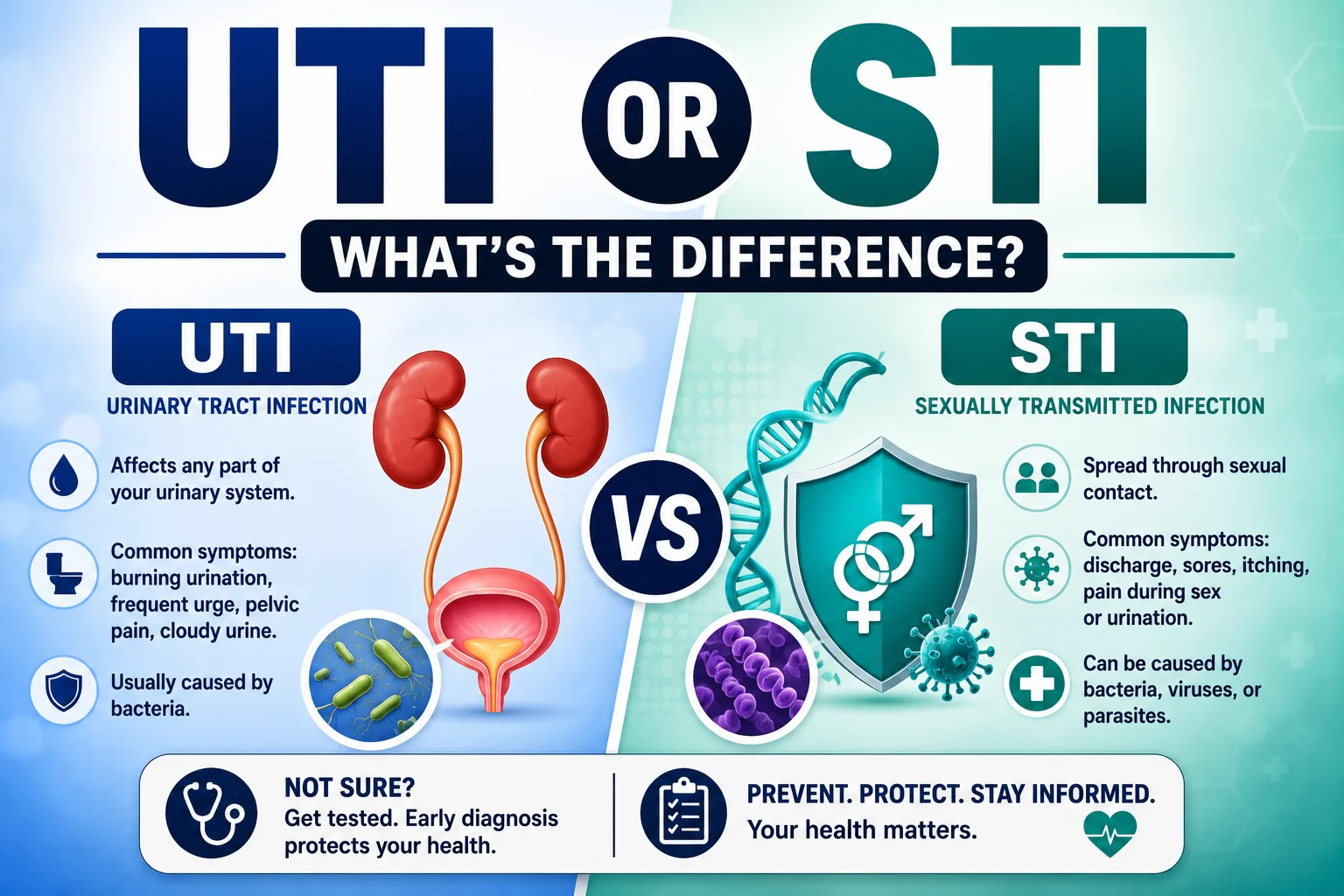
A UTI (Urinary Tract Infection) affects the urinary system and isn’t usually sexually transmitted, while an STI (Sexually Transmitted Infection) spreads primarily through sexual contact and requires different diagnosis and treatment.
If you’ve searched for UTI or STI, you’re probably trying to understand the difference between these two common health conditions. Because both can cause symptoms such as pain during urination or discomfort in the genital area, many people confuse them. Knowing the difference is important because the causes, treatments, and ways to prevent them are not the same.
A UTI (Urinary Tract Infection) affects the urinary system, including the bladder, kidneys, ureters, or urethra. An STI (Sexually Transmitted Infection) is an infection mainly spread through sexual contact. While some symptoms can overlap, a UTI is not usually considered a sexually transmitted infection.
This guide explains UTI or STI in simple language. You’ll learn what each term means, how they differ, common symptoms, causes, treatment options, and when to seek medical care. By the end, you’ll be able to understand the key differences and feel more confident discussing these conditions with a healthcare professional.
UTI or STI – Quick Answer
Quick Answer:
- UTI stands for Urinary Tract Infection.
- STI stands for Sexually Transmitted Infection.
- A UTI is usually caused by bacteria entering the urinary tract.
- An STI is usually spread through sexual contact.
Examples
- A person develops a UTI after bacteria enter the bladder.
- Someone is diagnosed with an STI after routine sexual health testing.
- Pain while urinating can occur with both a UTI and some STIs, so testing may be needed.
The Origin of UTI or STI
The term UTI is a medical abbreviation for Urinary Tract Infection. Healthcare professionals use it to describe infections affecting the urinary system.
STI stands for Sexually Transmitted Infection. In recent years, the medical community has increasingly used STI instead of STD (Sexually Transmitted Disease) because a person can have an infection without showing symptoms.
These are medical abbreviations, not different spellings of the same word.
British English vs American English Spelling
There is no spelling difference between British and American English for these abbreviations.
| Version | Spelling | Region | Example Sentence |
|---|---|---|---|
| Urinary Tract Infection | UTI | Used worldwide | The doctor diagnosed a UTI. |
| Sexually Transmitted Infection | STI | Used worldwide | She was tested for an STI. |
The abbreviations UTI and STI are used internationally in medical settings.
Which Term Should You Use?
US Audience
Use UTI when referring to a urinary tract infection. Use STI when referring to an infection spread through sexual contact.
UK/Commonwealth Audience
The same rule applies. Healthcare providers commonly use both abbreviations.
Global Audience
Use the correct medical term based on the condition you are discussing. Do not use UTI and STI interchangeably.
Common Mistakes with UTI or STI
Many people mistakenly believe these terms mean the same thing.
| Incorrect | Correct |
|---|---|
| Every UTI is an STI. | Most UTIs are not STIs. |
| UTI and STI mean the same thing. | They are different medical conditions. |
| Only sexually active people get UTIs. | Anyone can develop a UTI. |
| Pain during urination always means a UTI. | It can be caused by a UTI, an STI, or another condition. |
UTI or STI in Everyday Examples
Emails
“I have an appointment to check whether my symptoms are caused by a UTI or an STI.”
News Headlines
“Doctors Encourage Early Testing for UTIs and STIs.”
Social Media
“Don’t ignore burning during urination. Get checked by a healthcare provider.”
Formal Writing
“Healthcare professionals may recommend laboratory testing to distinguish between a UTI and an STI when symptoms overlap.”
UTI or STI – Google Trends & Usage
Searches for UTI or STI are common because both conditions can cause similar symptoms, especially pain or burning during urination. People often search for this phrase when they are unsure which condition better matches their symptoms.
Interest in this topic also increases during public health awareness campaigns and educational initiatives. Many users look for simple explanations that compare symptoms, causes, testing, and treatment.
Because symptoms can overlap, healthcare providers often recommend proper medical evaluation instead of self-diagnosis.
Comparison Table
| Feature | UTI | STI |
|---|---|---|
| Full Form | Urinary Tract Infection | Sexually Transmitted Infection |
| Main Cause | Usually bacteria in the urinary tract | Bacteria, viruses, or parasites spread mainly through sexual contact |
| Affects | Urinary system | Reproductive organs and sometimes other body systems |
| Spread Through Sex | Usually no | Usually yes |
| Can Cause Pain During Urination | Yes | Yes |
| Medical Testing | Urine test | Laboratory tests depending on the infection |
FAQs
Is a UTI the same as an STI?
No. A UTI affects the urinary tract, while an STI is mainly spread through sexual contact.
Can a UTI be mistaken for an STI?
Yes. Some symptoms overlap, so testing may be needed for an accurate diagnosis.
Can you have both a UTI and an STI?
Yes. It is possible to have both conditions at the same time.
Does burning during urination always mean a UTI?
No. It can also be caused by an STI or other medical conditions.
Should I see a doctor if I have UTI or STI symptoms?
Yes. A healthcare professional can determine the cause and recommend appropriate treatment.
Are UTI and STI treated the same way?
No. Treatment depends on the specific cause of the infection and should be guided by a healthcare provider.
Conclusion
Understanding the difference between UTI or STI is important because these conditions have different causes, treatments, and prevention methods. A UTI usually affects the urinary tract and is commonly caused by bacteria entering the bladder or other parts of the urinary system. An STI is an infection primarily spread through sexual contact and may require different tests and treatments.
Although some symptoms, such as burning during urination, can overlap, you should not assume you know the cause based on symptoms alone. Proper testing by a healthcare professional is the best way to receive an accurate diagnosis and the right treatment.
If you’re unsure whether your symptoms are related to a UTI or an STI, seek medical advice promptly. Early diagnosis and treatment can help prevent complications and support a faster recovery.