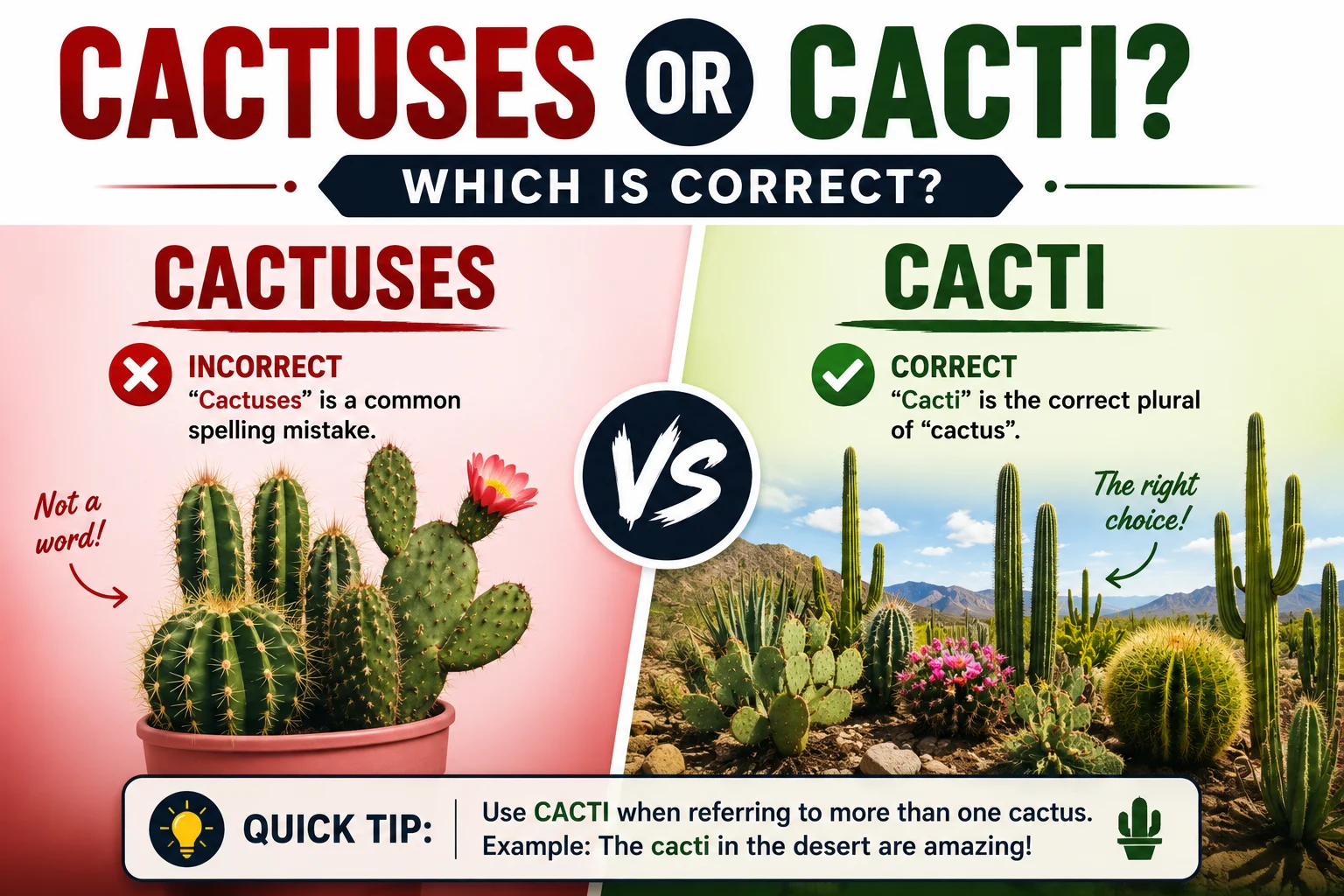
“Cactuses” and “cacti” are both correct plurals of “cactus,” but “cacti” is more traditional, while “cactuses” is more common in everyday English.
Have you ever stopped while writing and wondered whether to use cactuses or cacti? You are not alone. Many English learners, students, writers, and even native speakers ask this question because both words appear in books, websites, and everyday conversations.
The confusion comes from the fact that English accepts two plural forms of the word cactus. Some people prefer the traditional Latin plural, while others use the regular English plural. Because both are common, it can be difficult to know which one fits your audience.
The good news is that both cactuses and cacti are correct. The best choice depends on where you are writing and who will read your content. This guide explains the difference in simple English, shows real-life examples, and helps you choose the right word with confidence.
Cactuses or Cacti – Quick Answer
Both cactuses and cacti are correct plural forms of cactus.
- Cacti is the traditional Latin plural.
- Cactuses follows standard English grammar.
Real-life examples
- I bought three cactuses for my office.
- The garden has many cacti from Mexico.
- Our teacher showed us different types of cacti in class.
The Origin of Cactuses or Cacti
The word cactus comes from Latin, which borrowed it from an ancient Greek word. In Latin, many nouns ending in -us change to -i in the plural. That is why cactus became cacti.
As English grew, it often created regular plural forms by adding -es. This produced cactuses, which follows normal English spelling rules.
Today, dictionaries recognize both forms. One reflects the word’s Latin history, while the other follows modern English grammar.
British English vs American English Spelling
Unlike words such as colour and color, cactuses and cacti are not a British-versus-American spelling difference. Both forms are accepted in the UK, the US, Canada, Australia, and other English-speaking countries.
The main difference is writing style and audience rather than location.
| Version | Spelling | Region | Example Sentence |
|---|---|---|---|
| Traditional plural | Cacti | UK, US, Canada, Australia, and elsewhere | The desert is home to many cacti. |
| English plural | Cactuses | UK, US, Canada, Australia, and elsewhere | We planted several cactuses in the garden. |
Which Spelling Should You Use?
US audience
Both forms are correct. Cacti often appears in science books, while cactuses is common in everyday writing.
UK/Commonwealth audience
Readers understand both words. Cacti is slightly more common in formal or educational content, but cactuses is also acceptable.
Global/SEO audience
If you are writing for an international audience, use the form that matches your tone. You can mention both once near the beginning to help readers who search either version, then stay consistent throughout the article.
Common Mistakes with Cactuses or Cacti
Many people make small mistakes because they assume only one plural is correct.
| Incorrect | Correct |
|---|---|
| Cactis | Cacti |
| Cactusses | Cactuses |
| Cactuses | Cactuses |
| Cacti are wrong. | Cacti are correct. |
| Cactuses are incorrect. | Cactuses are also correct. |
A simple rule is to choose one form and use it consistently in the same document. Mixing cactuses and cacti without a reason can confuse readers.
Cactuses or Cacti in Everyday Examples
Here is how both words appear in different types of writing.
Emails
- We ordered five cactuses for the office reception area.
- The greenhouse received several rare cacti this week.
News Headlines
- Local Garden Show Features Hundreds of Cacti
- City Park Adds Colorful Cactuses to Desert Display
Social Media
- My new cactuses look amazing on the windowsill! 🌵
- I can’t stop collecting beautiful cacti! 🌵
Formal Writing
- The research focused on desert cacti native to North America.
- The botanical collection includes many species of cactuses from different regions.
Cactuses or Cacti – Google Trends & Usage
Both cactuses and cacti are searched online because people want to know which plural form is correct.
The word cacti is more common in science, gardening, education, and plant-related articles. It often appears in books, museums, and botanical websites because it follows the traditional Latin plural.
The word cactuses is frequently used in everyday English, especially by general readers, students, and casual writers. It sounds more natural to many people because it follows regular English grammar.
People in English-speaking countries search for both forms. Many websites include both words so readers can quickly find the information they need, regardless of which version they type into a search engine.
Comparison Table
| Feature | Cactuses | Cacti |
|---|---|---|
| Singular Form | Cactus | Cactus |
| Plural Type | Standard English plural | Traditional Latin plural |
| Grammar | Modern English | Latin-based |
| Common Use | Everyday writing | Scientific and formal writing |
| Reader Familiarity | Very easy for beginners | Common in education and gardening |
| Correct? | Yes | Yes |
Frequently Asked Questions
1. Is cactuses or cacti correct?
Yes. Both cactuses and cacti are correct plural forms of cactus. Your choice depends on your audience and writing style.
2. Which is more common, cactuses or cacti?
Cacti is more common in scientific, educational, and botanical writing. Cactuses is widely used in everyday English.
3. Should I use cactuses or cacti in school writing?
Either form is usually acceptable unless your teacher or style guide prefers one. If you choose one form, use it consistently.
4. Why are there two plural forms of cactus?
The word comes from Latin. English kept the original plural cacti while also creating the regular English plural cactuses.
5. Do dictionaries accept cactuses?
Yes. Modern dictionaries recognize both cactuses and cacti as correct plural forms.
6. Is cacti more formal than cactuses?
In many cases, yes. Cacti is often preferred in scientific and academic writing, while cactuses is common in everyday communication.
Conclusion
Choosing between cactuses and cacti is easier than it first seems. Both words are correct, and both are accepted by modern dictionaries. The difference is not about right or wrong but about style, audience, and context.
If you are writing a scientific paper, gardening guide, or academic article, cacti may sound more traditional and formal. If you are writing an email, blog post, school assignment, or social media update, cactuses feels natural and follows standard English grammar.
The most important tip is to stay consistent. Pick the form that best matches your audience and use it throughout your writing. By understanding the history behind both words, you can write with confidence and avoid common mistakes. Whether you choose cactuses or cacti, your readers will understand exactly what you mean.