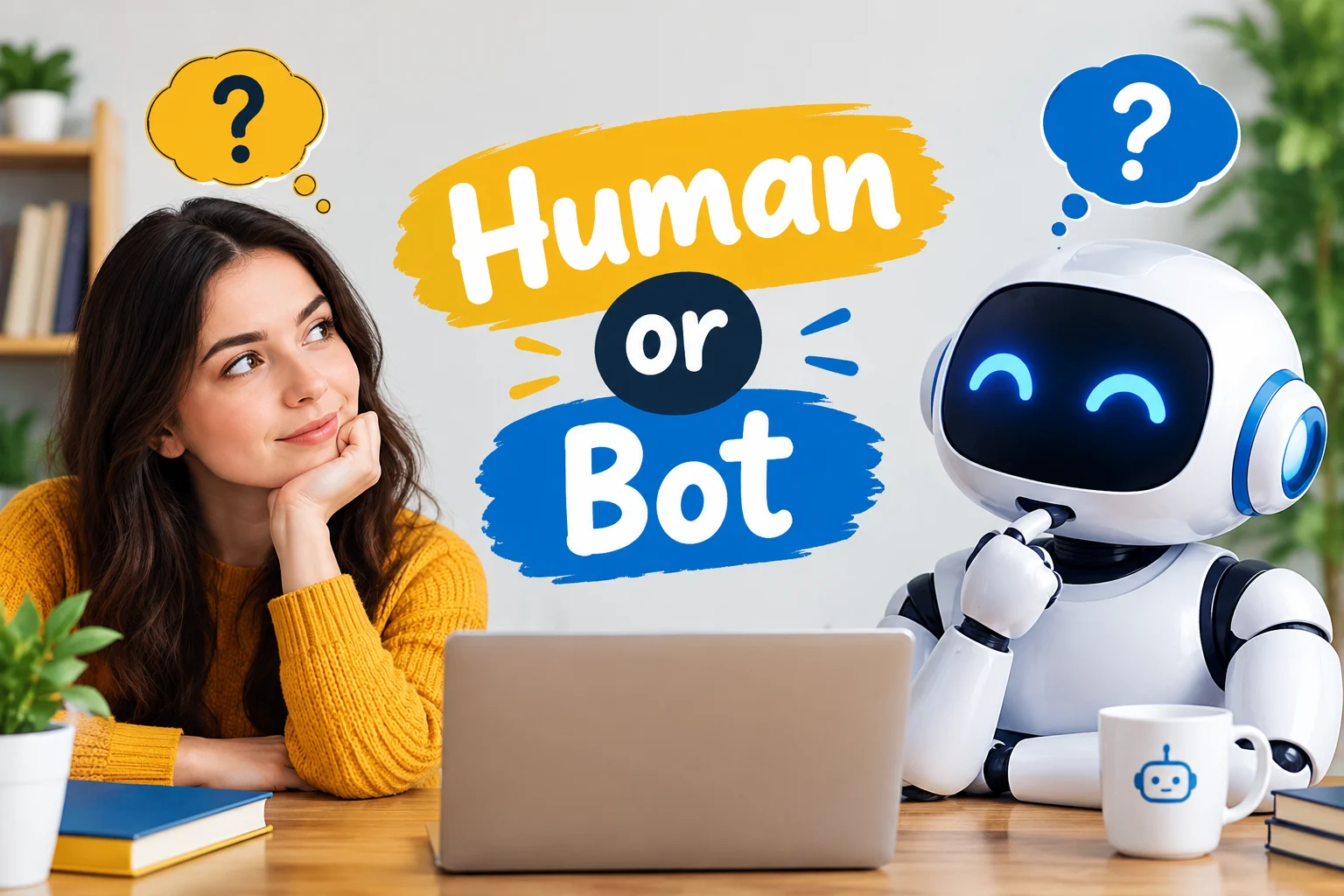
A human is a real person who can think, feel, and make choices. A bot is a software program that performs tasks or responds to people automatically.
Have you ever chatted with someone online and wondered, “Is this a real person or a bot?” You are not alone. Many people face this question when they use social media, websites, online stores, or customer support services.
The terms human or bot often appear in online chats, security checks, and digital tools. But they do not mean the same thing. A human can understand a situation through personal experience and emotions. A bot follows programmed rules or uses artificial intelligence (AI) to complete tasks.
As an English and SEO writer, I often see how these terms can confuse readers. Some people think every fast reply comes from a bot. Others believe that a friendly online message must come from a human. Neither idea is always correct.
This guide explains the difference between a human and a bot in simple words. You will learn what each term means, where the words come from, how bots work, and how to spot signs of automated activity. You will also see real-life examples and learn when to use each term in your writing.
By the end, you will know how to use human or bot with confidence.
Human or Bot – Quick Answer
A human is a person. A bot is a computer program that can perform tasks automatically. Some bots follow simple rules, while others use AI to create more flexible replies.
Here are two simple examples:
- Human: A customer service worker reads your complaint and replies based on their judgment.
- Bot: A website chatbot answers common questions about delivery times.
A bot may sound human, but that does not make it a person. Some AI bots can write, answer questions, and hold conversations. Still, they do not have human life experiences.
When you ask whether something is a human or bot, you are trying to learn whether a real person or an automated system is behind the activity.
The Origin and Background of Human or Bot
The words human and bot have different histories. Their meanings have also become more important as technology has changed.
Where Does the Word “Human” Come From?
The word human comes through Latin and Old French. It is linked to the Latin word humanus, which means “of a person” or “human.”
Today, we use human to describe people and things related to people.
Examples include:
- Human behavior
- Human rights
- Human emotions
- Human communication
The word can also appear as a noun. For example, someone might say, “Every human deserves respect.”
Where Does the Word “Bot” Come From?
The word bot is a short form of robot. It is used for software that carries out tasks automatically.
Bots became more common as computers and the internet grew. Early bots could perform simple jobs, such as following commands or collecting information. Modern bots can do much more.
Common examples include:
- Search engine bots that discover web pages
- Chatbots that answer questions
- Social media bots that post or respond automatically
- Customer service bots that guide users through common problems
AI has made some bots more advanced. They can now understand language patterns and generate detailed answers.
Why Do People Confuse Humans and Bots?
The main reason is that bots can copy parts of human communication. They may use greetings, answer questions, and write in a friendly tone.
For example, a bot might say, “Hello! I can help you track your order.” A human worker could send the same message.
The message alone may not tell you who sent it. You may need more context, such as the account details, the website’s disclosure, or the way the conversation develops.
Human or Bot Explained: Key Differences
Humans and bots can both communicate and complete tasks. However, they work in different ways.
1. Thinking and Decision-Making
Humans use experience, judgment, and an understanding of the world to make choices. They can reflect on their actions and change their minds for many reasons.
Bots process information according to their software, rules, or AI model. They can make useful recommendations, but they may also produce errors or misleading answers.
2. Emotions and Experience
Humans can feel emotions and have personal experiences. These experiences can shape how they respond to others.
A bot can recognize emotional language and generate a caring-sounding reply. That does not prove it feels the emotion it describes.
3. Speed and Repetition
Bots can handle repeated tasks very quickly. They can answer common questions, sort data, or check many web pages without getting tired in the human sense.
Humans may take longer, but they can often deal with unusual situations that need personal judgment or careful discussion.
4. Learning and Adaptation
People learn from life, education, feedback, and experience.
Some bots can improve through updates, training, or feedback systems. Others follow fixed rules and do not learn from each interaction. Their abilities depend on how they were designed.
Comparison Table: Human vs. Bot
| Term | Meaning | When to Use | Region/Context |
|---|---|---|---|
| Human | A real person | Talking about people, choices, or feelings | General use worldwide |
| Bot | Software that performs automated tasks | Talking about automated activity | Technology and online services |
| Chatbot | A bot that communicates with users | Customer support or online conversations | Websites, apps, and messaging |
| AI bot | A bot that uses artificial intelligence | Describing AI-based tasks or replies | AI tools and digital services |
| Human agent | A person who handles a service request | Showing that a real worker is responding | Customer support |
| Human-like bot | A bot designed to communicate in a human-like way | Describing natural-sounding automated replies | AI and chat systems |
Simple Examples
Human: “I spoke to a human agent about my refund.”
Bot: “A bot sent me an automatic order update.”
Chatbot: “The chatbot helped me find the return policy.”
AI bot: “The AI bot drafted a reply to my email.”
These terms are related, but they are not interchangeable in every situation.
Which Version or Approach Should You Use?
The best term depends on what you want to say.
For Students and English Learners
Use human when you mean a person. Use bot when you mean a software program.
For example:
- Correct: “A human answered my question.”
- Correct: “A bot answered my question automatically.”
If you are unsure whether the person replying is real, say, “I am not sure whether this account is run by a human or a bot.”
For Website Owners and SEO Writers
Use bot when discussing automated tools that visit, scan, or interact with websites.
Examples include:
- Search engine bots
- Website monitoring bots
- Chatbots
- Spam bots
If you are writing about customer support, make the difference clear. A human support agent is a person. A chatbot is an automated system.
For Businesses
Tell customers when they are interacting with a bot, especially if the conversation involves personal information, payments, or important decisions.
For example:
“Hi! I am an automated assistant. I can help with common questions or connect you to a human agent.”
This message sets clear expectations. It also gives customers a way to request help from a real person.
For General or Global Use
The words human and bot are widely understood in English. You do not need a different spelling for British and American readers.
Choose the more specific term when possible. For example, chatbot is clearer than bot when you mean a tool that talks with users.
Common Mistakes with Human or Bot
People often make mistakes when they try to identify bots or use these terms in writing.
Mistake 1: Thinking Every Fast Reply Comes from a Bot
Incorrect assumption: “The reply came in two seconds, so it must be a bot.”
Better approach: “The fast reply may be automated, but I need more evidence.”
Some humans type quickly or use prepared replies. Response speed alone does not prove that a bot is involved.
Mistake 2: Assuming Every Bot Uses AI
Incorrect: “All bots use artificial intelligence.”
Correct: “Some bots use AI, while others follow simple rules.”
A basic bot might send a fixed message when someone clicks a button. It may not use AI at all.
Mistake 3: Calling Every AI Tool a Bot
Incorrect: “Every AI tool is a bot.”
Correct: “Some AI tools work as bots, while others are designed for different tasks.”
For example, an AI image generator creates images. A chatbot uses conversation as its main way to interact with people.
Mistake 4: Believing Human-Like Language Proves Someone Is Human
Incorrect assumption: “This message sounds friendly, so a person must have written it.”
Better approach: “Both humans and AI bots can produce friendly messages.”
Look for more reliable information. Check whether the service identifies itself as automated, and be careful with accounts that ask for money or sensitive details.
Mistake 5: Using “Human” and “Bot” as Synonyms
Incorrect: “The human sent me an automated message from its software bot.”
Clearer: “The bot sent me an automated message.”
Use human for a person and bot for software. If you are unsure who sent a message, describe the uncertainty rather than making a claim.
Human or Bot in Real-World Examples
The phrase human or bot appears in many areas of daily life. Here is how you can use it naturally.
1. Professional Email
Subject: Request for Human Support
Hello Support Team,
I received an automated reply to my request. Could you please confirm whether my case is being handled by a human agent or a bot?
I would appreciate help from a team member if my issue needs a personal review.
Thank you.
This email uses the terms clearly and politely. It also explains what help the sender wants.
2. News Headline or Article
Headline: Businesses Use Chatbots to Answer Customer Questions
Example article text:
“Many businesses now use bots to answer common customer questions. These systems can save time, but customers may still need a human agent for complex problems.”
Here, bots refers to automated systems, while human agent means a real support worker.
3. Social Media Post
Example post:
“Have you ever wondered whether an online account is run by a human or bot? Check the account’s history, look for clear signs of automation, and be careful with suspicious links.”
This example uses the phrase to discuss online safety. It does not claim that one clue can prove an account is automated.
4. Formal Document or Report
Example report text:
“The customer support system uses a chatbot to handle routine questions. Requests that need additional review may be sent to a human agent.”
This wording works well in reports because it explains what the system does without making unsupported claims about its abilities.
5. Online Shopping
Imagine you ask a store, “Where is my order?”
A bot may provide a tracking link right away. If the package is missing, you may need a human worker to review the order and help resolve the issue.
Both can be useful. The best choice depends on the task.
6. Website Security
A website may use a test to check whether a visitor is human or an automated program. These checks can help limit spam and abuse.
However, automated systems sometimes make mistakes. A real person may struggle with a security check, while a bot may pass some checks. No single test is perfect.
Human or Bot — Data, Trends, and Usage
The phrase human or bot is linked to several growing areas of online life. These include artificial intelligence, online security, customer service, and social media.
Where Is the Topic Used Most?
The topic appears in many settings:
- Search engines: Website owners learn how bots discover and scan pages.
- Customer support: Businesses decide which questions a chatbot can handle.
- Social media: Users try to identify automated accounts and spam.
- Cybersecurity: Teams study automated traffic and suspicious activity.
- AI tools: People want to know whether a reply comes from a person or an AI system.
These are common contexts for the topic. Without current keyword research data, however, it would be misleading to claim exact search volumes or name one region as the top search market.
What Is the Search Intent?
The search intent is mainly informational. People want to understand the difference between a human and a bot.
Related searches may include:
- What is a bot?
- What is a chatbot?
- How can you tell if someone is a bot?
- Human vs. AI
- Can bots act like humans?
- What is a human agent?
Some users also have a practical goal. A customer may want to reach a real support worker. A website owner may want to manage bot traffic. A student may simply need a clear definition.
Why Does This Topic Matter Now?
AI systems can produce natural-sounding text, answer questions, and respond quickly. This can make online conversations harder to judge by appearance alone.
For this reason, clear disclosure matters. Businesses should explain when an automated assistant is in use. Users should avoid sharing private information with an account they do not trust.
For SEO writers, accurate wording also matters. A search engine bot, a chatbot, and a social media bot perform different jobs. Using the right term helps readers understand the topic and can make an article more useful.
Standalone Comparison Table: Human or Bot
The key point is simple: a human is a person, while a bot is software. A bot may imitate human communication, but the two terms describe different things.
Frequently Asked Questions
Q1: What does “human or bot” mean?
“Human or bot” asks whether an activity or message comes from a real person or an automated program. The phrase is common in online chats, security checks, and social media discussions.
Q2: How do you use “human or bot” correctly?
Use the phrase when you want to compare a person with an automated system. For example, “I cannot tell whether this account is run by a human or bot.” For smoother wording, you can also write “a human or a bot.”
Q3: What is the difference between a human and a bot?
A human is a living person with personal experiences and emotions. A bot is software built to perform tasks automatically. Some bots use AI to produce natural-sounding responses.
Q4: Is “human or bot” acceptable in formal writing?
Yes. The phrase is acceptable when it fits the topic. In a formal report, you may want to use more specific wording, such as “human agent or automated chatbot.”
Q5: Which is correct: “human” or “bot”?
Both words are correct, but they have different meanings. Use human for a person and bot for software. The right choice depends on what you are describing.
Q6: Where does the word “bot” come from?
Bot is a shortened form of robot. It is widely used for software that carries out automated tasks, including chat, search, and online account activity.
Q7: Can a bot sound like a human?
Yes. Modern chatbots and AI systems can use natural language and respond in a friendly way. However, a human-like reply does not prove that the system has human feelings or personal experiences.
Conclusion
Understanding human or bot is useful whenever you use websites, social media, online stores, or AI tools. The main difference is easy to remember: a human is a person, while a bot is software that performs tasks automatically.
Bots can save time. They can answer common questions, scan web pages, and handle repeated tasks. Some AI bots can even hold detailed conversations. Yet they can still make mistakes, and their friendly words do not prove that a real person is responding.
When you write about this topic, choose the term that matches the situation. Use human for people, bot for automated programs, and chatbot when the software communicates through chat. In business settings, clear labels help users know who—or what—is answering them.
If you are trying to identify an online account, do not rely on one clue alone. Check the account’s history, review the platform’s information, and protect your private details.
Now you know how to use human or bot correctly. Bookmark this guide, share it with someone who needs it, and use these simple tips the next time you encounter an unfamiliar online account.