Embedded is the standard and more common spelling. Imbedded is also a recognized variant, but embedded is the safer choice for most modern writing.
Have you ever typed a word, looked at it twice, and thought, “That spelling looks wrong”? Imbedded or embedded is one of those confusing pairs.
I have seen this question many times when helping students check essays, reports, emails, and online content. A writer may type imbedded because the word seems to follow the pattern of words that begin with im-. Then a spell checker may suggest embedded. That small difference can make you stop and wonder which form is truly correct.
The good news is simple: both forms have been used in English, but embedded is the standard choice today.
The word usually describes something placed firmly inside something else. It can describe a physical object, an image in a webpage, computer code, an idea, or even a person who works closely within a group.
So, should you write imbedded or embedded? Does one mean something different? Is imbedded wrong? Let’s clear up the confusion.
Imbedded or Embedded – Quick Answer
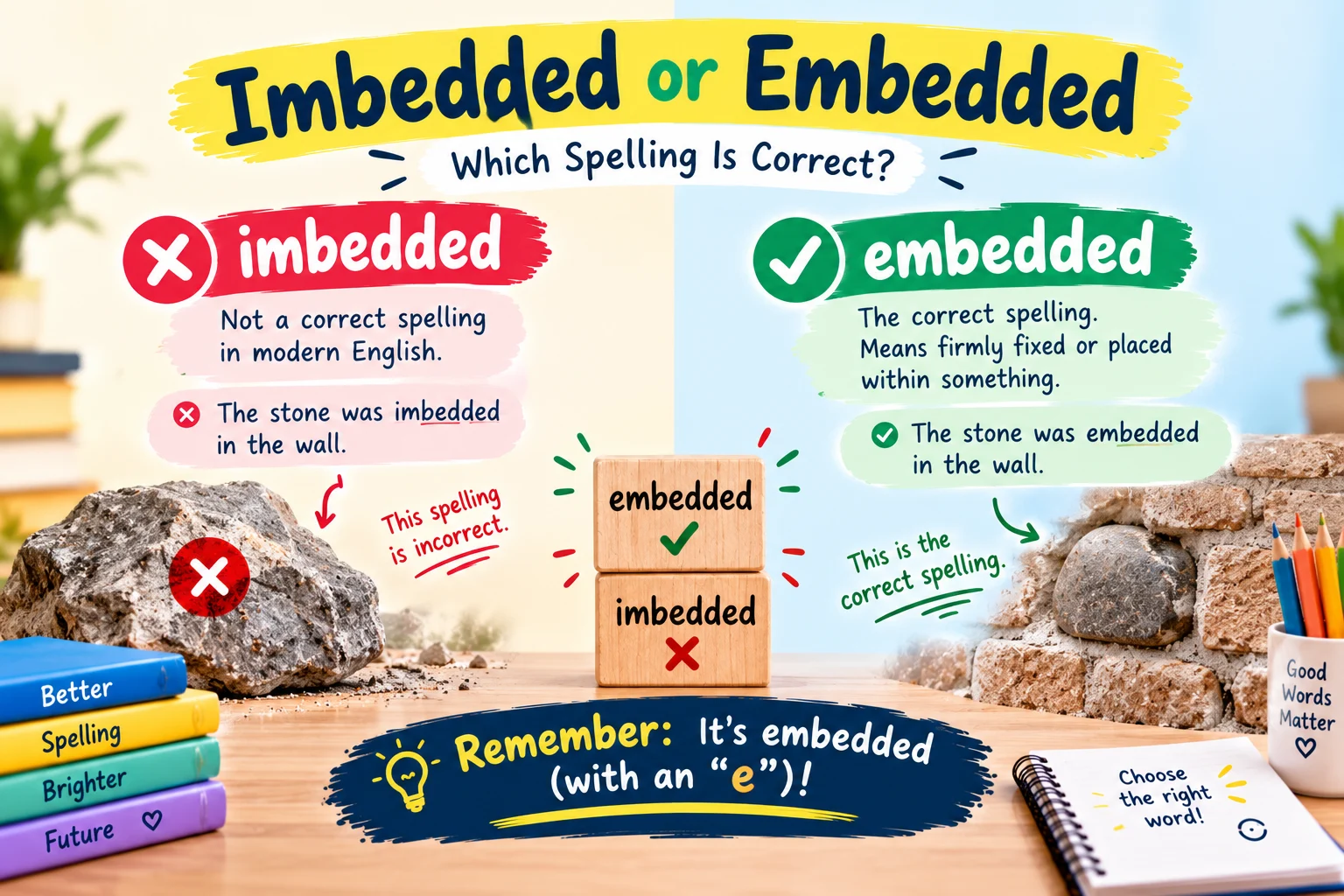
Embedded is the preferred spelling in modern standard English.
It means placed firmly, deeply, or securely inside something else.
For example:
- The stone was embedded in the wall.
- The article has an embedded video.
- The reporter was embedded with the military unit.
Imbedded can also be found in dictionaries and published writing. It is a variant spelling of embedded, not a completely different word.
The simple rule
Use “embedded” when you want the safest and most widely accepted spelling.
If you are writing an essay, business report, website, academic paper, or professional email, embedded is usually the better choice.
The Origin and Background of Embedded
The word embed has an interesting history.
It comes from the idea of putting something deep into a surrounding material. The word is related to older forms built from the prefix em- and the idea of being placed in a bed or surrounding substance.
The spelling can feel confusing because English often changes prefixes based on the sound or letter that follows them.
For example:
- embed
- embedded
- embedding
Some writers use imbedded because English has many words that use im- before certain sounds.
Consider words such as:
- impossible
- immature
- impatient
- imperfect
That pattern can make imbedded look natural.
However, embed → embedded is the spelling you will most often see in modern standard English.
Why do both spellings exist?
English spelling developed over many centuries. Different dictionaries, regions, publishers, and writers have sometimes preserved alternative forms.
As a result, imbedded has not simply appeared because of a spelling mistake. It has a history of use.
Still, frequency and modern convention matter.
Today, embedded is far more common and is the spelling most readers expect.
Imbedded or Embedded Explained — Key Differences
The biggest point is that imbedded and embedded generally have the same meaning.
They do not normally represent two different actions.
| Term | Meaning | When to Use | Region/Context |
|---|---|---|---|
| Embedded | Placed firmly or deeply inside something | Preferred in most writing | Modern standard English |
| Imbedded | Same basic meaning as embedded | Acceptable as a variant | Less common; some published usage |
1. Embedded
Embedded is the preferred form.
It can describe something physically placed inside another thing:
The glass was embedded in the concrete.
It can also describe digital content:
The website contains an embedded video.
The word has many figurative uses too:
The belief was embedded in the culture.
Here, the belief is not physically inside anything. It is deeply established in the culture.
2. Imbedded
Imbedded has the same basic meaning.
For example:
The jewel was imbedded in the crown.
This sentence can be understood, and the spelling has appeared in standard English sources.
However, many modern readers expect embedded.
That makes imbedded less useful when you want a clean, widely accepted style.
Embedded Has Several Common Meanings
One reason this word appears so often is that embedded works in many fields.
Physical meaning
Something is physically placed inside another material.
A small piece of metal was embedded in the wood.
Technology
Digital content can be placed inside another platform.
The teacher embedded a video in the lesson.
You may also see:
- embedded image
- embedded video
- embedded link
- embedded code
- embedded software
Journalism
An embedded journalist works closely with a military or other organized group while covering an event.
The reporter was embedded with the troops.
Social or cultural meaning
An idea, habit, or value can become deeply established.
The tradition is embedded in local culture.
Work and organizations
A person can work closely within another team or department.
She is embedded in the research team.
This broader meaning is why learning the word can improve your vocabulary.
Which Version Should You Use?
For most readers, the answer is easy.
For students → use embedded
If you are writing:
- school assignments
- university essays
- exams
- research papers
- class notes
choose embedded.
It is clear and familiar.
For professional writers → use embedded
Business writing should usually favor the more common form.
For example:
The report includes an embedded chart.
This looks natural and professional.
For websites and digital content → use embedded
Technology writing strongly favors embedded.
You will commonly see:
- embedded content
- embedded media
- embedded video
- embedded software
- embedded systems
For global audiences → use embedded
If your readers come from different English-speaking regions, embedded is the safest option.
It avoids unnecessary confusion.
What about imbedded?
You do not need to treat imbedded as a major spelling error.
It is a recognized variant.
However, unless you have a specific reason to use it, embedded is the better default.
Common Mistakes with Imbedded or Embedded
Mistake 1: Assuming imbedded is always wrong
Mistake:
The image was imbedded in the article.
Better:
The image was embedded in the article.
Why? Imbedded exists as a variant, but embedded is more common and preferred in modern writing.
Mistake 2: Using “embeded”
Mistake:
The video is embeded on the page.
Correct:
The video is embedded on the page.
The word has a double d in embedded.
The pattern is:
embed + ed = embedded
Mistake 3: Writing “embedding” incorrectly
Mistake:
We are embeddding the video.
Correct:
We are embedding the video.
The correct spelling is embedding.
Mistake 4: Confusing embedded with included
These words can overlap, but they are not always identical.
Included means something is part of a larger group or item.
Embedded suggests that something is placed inside or deeply integrated with something else.
Compare:
The report includes a video.
The report has an embedded video.
The second sentence suggests that the video is placed directly within the report or webpage.
Mistake 5: Changing the spelling in a proper name
Sometimes a company, product, or technical term may use a specific spelling.
If a proper name officially uses Imbedded, preserve that spelling.
Names do not always follow normal dictionary preferences.
Imbedded or Embedded in Real-World Examples
Seeing the word in context makes the difference easier to remember.
Professional Email
Subject: Embedded Video in the Training Guide
Hi Sarah,
I have added the embedded video to the training guide. Please review it and let me know if any changes are needed.
Here, embedded is the natural professional choice.
News Article
Embedded reporters provided updates from the conflict zone.
The word describes journalists working closely with a particular group or unit.
Social Media Post
We just added an embedded video to our latest post. Check it out!
This is common in digital communication.
Formal Report
The document contains embedded charts and supporting images.
This wording is clear and suitable for formal writing.
Technology Example
The device uses an embedded system to control its main functions.
This is a common technical use.
Embedded vs Related Words
Several words are close to embedded, but their meanings are not exactly the same.
Embedded vs inserted
Inserted means put into something.
Embedded often suggests that the item becomes firmly placed or integrated.
She inserted the key into the lock.
The chip was embedded in the device.
Embedded vs included
Included means made part of something.
Embedded gives a stronger sense of being placed within or integrated into something.
Embedded vs buried
Buried can mean covered by something, often deeply.
Embedded is broader and can be physical, digital, social, or figurative.
Standalone Comparison Table
| Term/Variant | Meaning | Region/Context | Best Used When |
|---|---|---|---|
| Embedded | Placed firmly or deeply inside | Modern standard English | Almost all general and professional writing |
| Imbedded | Variant of embedded | Less common usage | When following a source or established style |
| Embed | To place inside or integrate | Standard verb | Present tense or base form |
| Embedding | The act of placing or integrating | Standard English | Continuous action or noun use |
| Embedded | Past tense/past participle of embed | Standard English | Completed action or adjective |
Imbedded or Embedded — Data, Trends & Usage
The search for “imbedded or embedded” comes from a very common type of language question: readers recognize both forms but want to know which one is preferred.
This confusion is especially likely among:
- students
- ESL learners
- bloggers
- technical writers
- business professionals
- editors
- website creators
The word also appears across many fields.
Technology uses it in phrases such as embedded systems and embedded software. Journalism uses embedded journalists. Digital publishing uses embedded videos and embedded links. Everyday English uses phrases such as deeply embedded beliefs.
That wide range of uses makes the spelling worth learning.
Why does the preferred spelling matter?
Choosing the more common form can make your writing look cleaner.
If a reader sees embedded, the word is instantly familiar.
If they see imbedded, they may pause to check whether it is a typo.
That pause is easy to avoid.
For most situations, simply choose embedded.
How to Remember the Correct Spelling
Try this simple memory trick:
Embed has “bed” inside it.
Look at the word:
em + bed
The idea is that something is placed in a bed or surrounding material.
Then remember:
embed → embedded
Not:
embeded
So, keep the double d:
embedded
You can also remember the common technology phrase:
embedded system
If you have seen that phrase before, it can help lock the spelling into your memory.
Frequently Asked Questions
Q: Is imbedded or embedded correct?
A: Both forms have been used in English. However, embedded is the more common and preferred modern spelling.
Q: Is imbedded a misspelling?
A: Not necessarily. Imbedded is a recognized variant. Still, embedded is the safer choice for most modern writing.
Q: What does embedded mean?
A: Embedded means placed firmly or deeply inside something. It can also mean strongly integrated into a system, culture, group, or piece of content.
Q: Is embedded correct in formal writing?
A: Yes. Embedded is completely acceptable in formal writing. It is widely used in academic, business, technical, and professional contexts.
Q: What is the difference between embedded and inserted?
A: Inserted simply means put into something. Embedded often suggests that the item is firmly placed or integrated into its surroundings.
Q: What is the past tense of embed?
A: The past tense is embedded. For example: “The developer embedded the video in the webpage.”
Q: Should I use embedded in technical writing?
A: Yes. Embedded is the standard choice in technical phrases such as embedded system, embedded software, and embedded device.
Conclusion
So, imbedded or embedded? The answer is straightforward: embedded is the spelling you should normally choose.
Both forms have a history of use, so imbedded is not simply meaningless. However, embedded is much more common in modern English and is the best option for students, professionals, bloggers, editors, and technical writers.
Remember the key points:
- Embedded is the preferred modern spelling.
- Imbedded is a recognized variant.
- Both forms generally have the same meaning.
- Embedded works in physical, digital, professional, and figurative contexts.
- Always spell it with double d: embedded.
If you are unsure while writing an essay, email, report, or website article, choose embedded. It is clear, familiar, and widely accepted.
Bookmark this guide so you never second-guess “imbedded or embedded” again.