Witch is a person believed to use magic, while which is used to ask about or identify a person, thing, or choice. They sound alike, but their meanings and spellings are completely different.
Have you ever typed “witch” when you meant “which”? You are not alone. These two words can sound almost exactly the same, so they often cause mistakes in emails, school work, messages, and online writing.
I have seen this confusion many times when helping English learners improve their writing. A learner may write, “Witch book do you want?” The meaning is clear from the context, but the spelling is wrong. The correct sentence is, “Which book do you want?”
The good news is that the difference is easy to learn. Witch is mainly a noun connected with magic. Which is a question word and a relative pronoun used to identify or choose something.
This guide explains witch or which in simple English. You will learn their meanings, origins, grammar, pronunciation, common mistakes, and real-life examples. By the end, you will have an easy trick for remembering the correct spelling.
witch or which – Quick Answer
The simplest way to remember the difference is this:
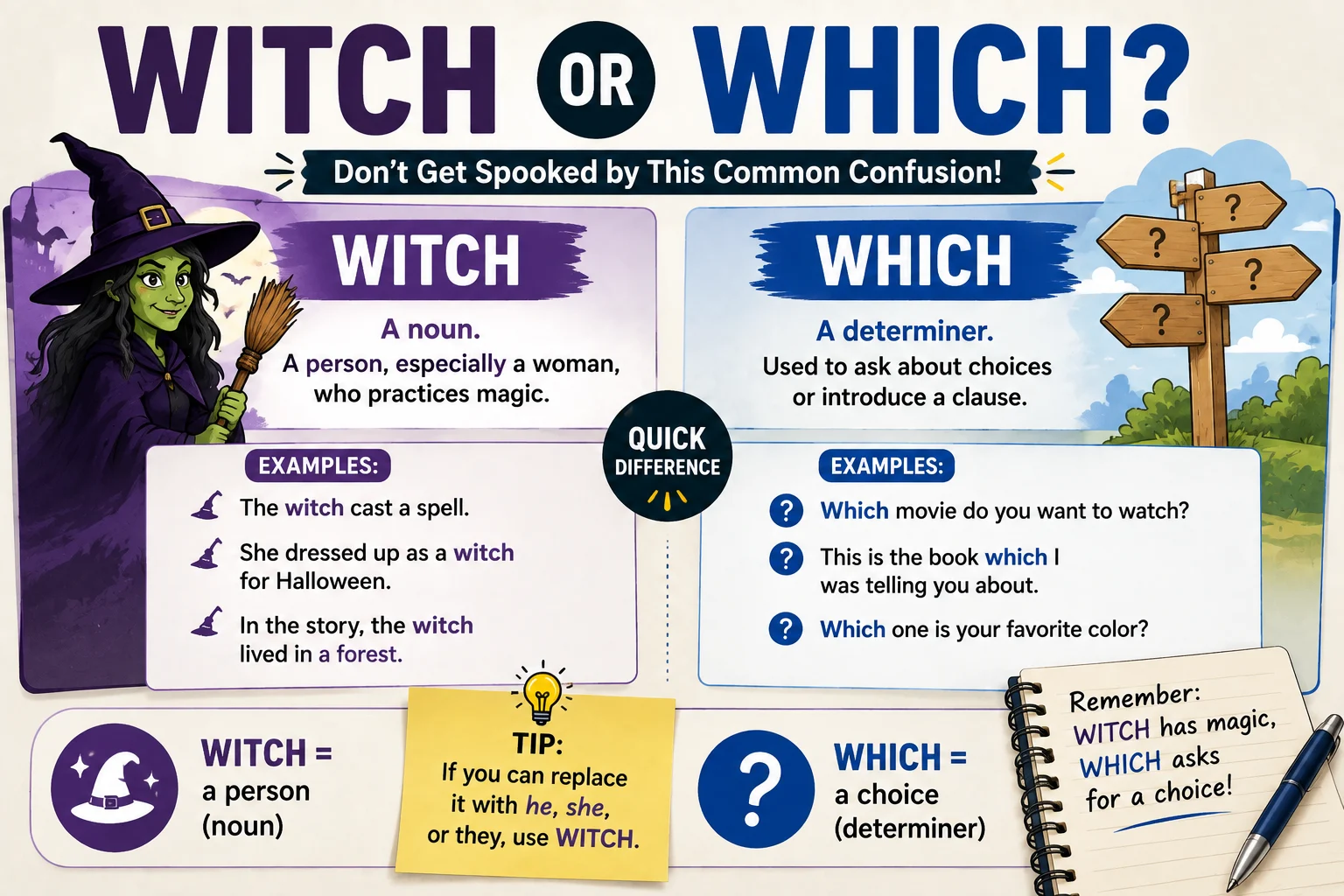
- Witch = a person associated with magic.
- Which = a word used to ask about a choice or identify something.
Examples with “witch”
The story is about a witch who lives in the forest.
The children dressed as a witch for Halloween.
Here, witch refers to a person traditionally believed to have magical powers.
Examples with “which”
Which color do you prefer?
I bought the phone which you recommended.
Here, which helps us choose or identify something.
The quick memory trick
Think:
Witch = magic
Which = choice
If you are asking someone to choose between things, you almost always need which.
Which dress should I wear? ✅
Not:
Witch dress should I wear? ❌
The Origin and Background of witch or which
Although witch and which look similar and are often pronounced alike, they come from different historical roots.
The origin of “witch”
Witch comes from Old English wicce, meaning a female practitioner of magic or sorcery. The masculine form was wicca.
Over time, these Old English forms changed in spelling and pronunciation. Middle English forms included spellings such as wicche. Eventually, the modern spelling witch developed.
The word has long been linked with magic, spells, supernatural powers, and folklore.
Today, witch can refer to a character in a fairy tale, a historical belief, or a person who practices modern witchcraft.
The origin of “which”
Which also comes from Old English. Its early form was hwilc, meaning something like “what one” or “which one.”
The spelling changed through Middle English before becoming the modern word which.
Unlike witch, it has nothing to do with magic.
Which developed into an important English question word and relative pronoun.
Why do they sound alike?
In most modern varieties of English, witch and which are pronounced the same or very similarly.
This is called a homophone relationship when two words have the same pronunciation but different meanings and spellings.
Other common examples include:
- right / write
- there / their
- flower / flour
- sea / see
- to / too / two
That is why context and spelling matter.
witch or which Explained — Key Differences
The biggest difference is their meaning and grammatical role.
| Term | Meaning | When to Use | Region/Context |
|---|---|---|---|
| witch | A person associated with magic | Talking about a magical person or character | All English varieties |
| which | A word used to identify or choose something | Questions and relative clauses | All English varieties |
“Witch” as a noun
Witch is usually a noun.
It refers to a person believed to use magic or supernatural powers.
The witch cast a spell.
The fairy tale has a wicked witch.
The word can also appear in discussions about history, folklore, religion, literature, and modern witchcraft.
“Which” as a question word
Which is often used when you are choosing between two or more possibilities.
Which shirt do you want?
Which road should we take?
Which movie did you watch?
It asks you to identify one option.
“Which” as a relative pronoun
Which can also connect extra information to a noun.
I bought a laptop, which was on sale.
She chose the blue dress, which looked beautiful.
Here, which does not ask a question. It connects parts of the sentence.
“Which” can refer to things
In standard English, which is mainly used for things and animals, rather than people.
Which book did you read?
The car, which I bought last year, is still working well.
For people, who is usually the better choice.
The teacher who helped me was very kind.
Which Version Should You Use?
The correct choice depends on what you mean.
For magic or folklore → use witch
Choose witch when you are talking about:
- Magic
- Spells
- Witchcraft
- Fairy tales
- Folklore
- A magical character
Example:
The witch lived in a small cottage.
For questions and choices → use which
Choose which when you are asking someone to identify or select something.
Which answer is correct?
Which restaurant do you prefer?
For relative clauses → use which
Use which to add information about a thing or animal.
The book, which I bought yesterday, is very interesting.
For beginners
A simple test can help.
Ask yourself:
“Am I talking about magic?”
If yes, use witch.
If not, and you are asking about a choice or connecting information about something, which is probably correct.
Common Mistakes with witch or which
Because these words sound alike, spelling mistakes are very common.
| Mistake | Correct Form | Why? |
|---|---|---|
| Witch book do you want? | Which book do you want? | This is a question about a choice. |
| The which cast a spell. | The witch cast a spell. | This refers to a magical person. |
| Witch one is yours? | Which one is yours? | “Which” asks someone to choose. |
| The which lives in the castle. | The witch lives in the castle. | The sentence refers to a magical character. |
| I chose the phone, witch was cheaper. | I chose the phone, which was cheaper. | “Which” introduces information about the phone. |
Mistake 1: “Witch one?”
This is one of the most common errors.
Witch one do you want? ❌
Correct:
Which one do you want? ✅
You are asking someone to choose.
Mistake 2: “Which” for a magical person
The which flew over the house. ❌
Correct:
The witch flew over the house. ✅
The sentence is about a magical character.
Mistake 3: Confusing “which” with “who”
Sometimes learners use which when talking about people.
The man which called me was friendly. ❌
Better:
The man who called me was friendly. ✅
Use who for people in standard English.
witch or which in Real-World Examples
Seeing both words in different settings can make the difference easier to remember.
Professional email
Which:
Could you please confirm which document I should send to the client?
This is a question about a choice.
Witch would not make sense here.
News headline or article
Witch:
Local Museum Opens Exhibition on Historic Witch Trials
Here, witch is connected with historical beliefs and trials involving people accused of witchcraft.
Social media post
Which:
Which phone would you choose for photography?
The writer is asking followers to choose an option.
Witch:
My Halloween costume is a witch this year!
Here, witch refers to a costume based on a magical character.
Formal document
Which:
The applicant must select which option best describes their experience.
The word which identifies a choice.
Storytelling
Witch:
A mysterious witch appeared at the edge of the village.
This is a classic use of witch in fiction.
Everyday conversation
Which:
Which bus goes to the city center?
You are asking someone to identify the correct bus.
witch or which — Data, Trends & Usage
The search intent behind “witch or which” is mainly informational. People usually search this phrase because the two words sound alike and they want to know which spelling fits their sentence.
This type of spelling question is especially common among:
- English learners
- Students
- ESL writers
- Content writers
- People checking emails
- People writing social media posts
The confusion is also linked to English pronunciation. In many accents, witch and which sound the same. When you hear the word, you cannot always know its spelling.
That makes context very important.
If the sentence contains a question about a choice, think which.
Which one should I choose?
If the sentence contains magic, think witch.
The witch entered the castle.
A useful writing habit
When you are unsure, stop and ask:
“What does this word mean in my sentence?”
Do not choose the spelling only because it sounds right.
witch vs. which: Standalone Comparison Table
| Term/Variant | Meaning | Region/Context | Best Used When |
|---|---|---|---|
| witch | A person associated with magic | Folklore, fiction, history, witchcraft | Talking about a magical person |
| which | Identifies or selects something | Questions | Asking about a choice |
| which | Adds information about something | Relative clauses | Connecting information |
| who | Refers to a person | Questions and relative clauses | Talking about people |
Easy rule to remember
Magic → witch
Choice → which
For example:
The witch lives in the forest.
Which forest does she live in?
The two words can appear in the same conversation, but they do very different jobs.
Frequently Asked Questions About witch or which
Q: What does “witch” mean?
A: A witch is a person traditionally believed to use magic or supernatural powers. The word is also common in fairy tales, folklore, history, and modern discussions of witchcraft.
Q: What does “which” mean?
A: Which is used to ask about or identify a person, thing, or choice. It can also introduce extra information about a thing or animal.
Q: How do I remember witch or which?
A: Use this simple rule: witch = magic, while which = choice or identification. If you are asking, “What one?” or “What choice?” use which.
Q: Are witch and which pronounced the same?
A: In many English accents, they are pronounced the same. This makes them easy to confuse when speaking or listening.
Q: Which is correct: “witch one” or “which one”?
A: Which one is correct when you are asking someone to choose. For example, “Which one do you like?”
Q: Is “witch” a noun or a verb?
A: Witch is mainly used as a noun. It names a person associated with magic or witchcraft.
Q: Can “which” be used in a question?
A: Yes. This is one of its most common uses. For example, “Which book do you want?” asks someone to choose or identify a book.
Q: Can “which” refer to people?
A: In standard English, which is generally used for things and animals, not people. Use who when referring to people in most cases.
Q: Is “witch” always negative?
A: No. The word can have different meanings and tones depending on context. In fairy tales, a witch may be evil, kind, funny, wise, or simply mysterious.
Conclusion
The difference between witch or which is simple once you focus on meaning.
Witch refers to a person associated with magic, spells, or witchcraft. Which is used to ask about a choice or identify something. It can also connect extra information to a noun.
Remember the easiest rule:
Witch = magic.
Which = choice.
For example:
The witch lives in the forest.
Which path leads to the forest?
Although the two words often sound the same, their meanings are very different. That is why checking the meaning of the sentence is better than relying only on pronunciation.
A little practice will make this distinction automatic. Bookmark this guide and share it with someone who often confuses “witch” and “which.”