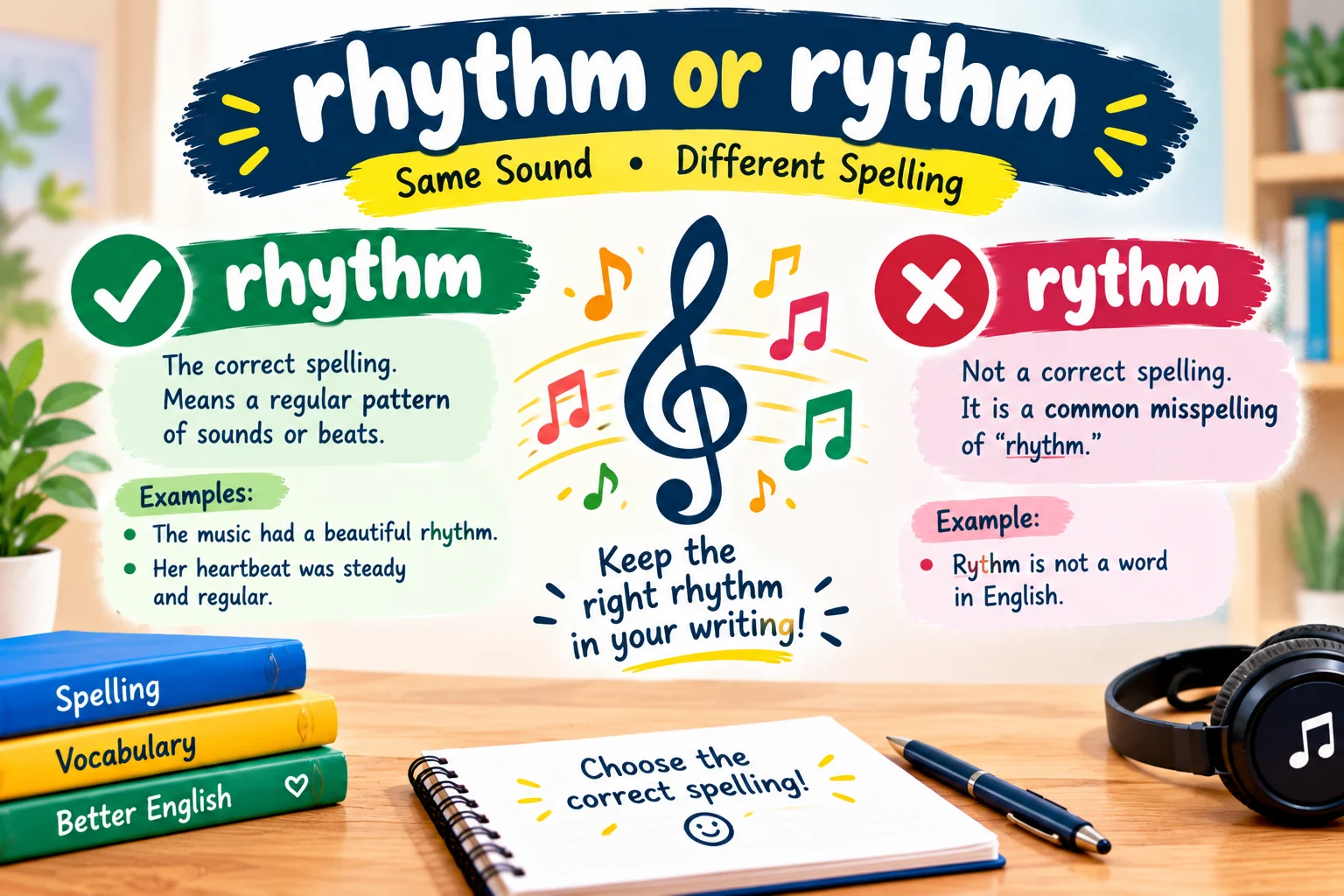
Rhythm is the correct spelling. Rythm is a common misspelling and should not be used in standard English.
Some English words seem designed to test your memory. Rhythm is one of them.
I have seen strong students stop at this word because it looks unusual. They know exactly what they want to say, but the spelling feels uncertain. Is it rhythm or rythm? Should there be an extra vowel? Where does the h go?
The confusion makes sense. Rhythm is one of the most unusual-looking common English words. It contains no traditional vowel a, e, i, o, or u, yet it is easy to pronounce once you know it. Because rythm looks shorter and simpler, many writers leave out the first h.
There is a clear answer, though. Rhythm is the standard spelling. Rythm is incorrect in ordinary English.
In this guide, you will learn why the spelling is rhythm, what the word means, where it came from, and how to remember it. You will also see real examples, common mistakes, and a simple spelling trick that makes this tricky word much easier.
Rhythm or Rythm – Quick Answer
The correct spelling is:
Rhythm ✅
The incorrect spelling is:
Rythm ❌
Rhythm means a regular pattern of sounds, beats, movements, or events.
Examples
The drummer kept a steady rhythm.
The poem has a gentle rhythm.
Our daily lives often follow a natural rhythm.
The spelling rythm is not the standard spelling of the English word.
What Does Rhythm Mean?
Rhythm is a repeated pattern.
It is often connected with music, but the word has a much wider meaning.
In music
Rhythm describes the pattern of beats and sounds.
The song has a strong rhythm.
In poetry
Rhythm refers to the pattern created by stressed and unstressed sounds.
The poem has a smooth rhythm.
In movement
A person or group can move in rhythm.
The dancers moved to the rhythm of the music.
In everyday life
Rhythm can describe a repeated pattern in life or nature.
The body has its own natural rhythm.
So, rhythm is not only about music. It can describe any regular pattern of movement, sound, or activity.
The Origin and Background of Rhythm
The spelling of rhythm has a long history.
The word comes from Greek rhythmos, which referred to a measured movement or regular flow. It entered English through French and Latin forms before developing into the modern English word rhythm.
The Greek connection helps explain the unusual spelling.
English kept the rh- beginning and the y that appears in the middle of the word. Over time, the modern spelling became established as:
rhythm
The word may look strange to modern English learners because its spelling does not match the patterns found in many everyday words.
That is one reason rythm appears as a common misspelling.
Why Is Rhythm So Hard to Spell?
There are several reasons.
1. It has an unusual vowel pattern
The word rhythm has no standard vowel letters a, e, i, o, or u.
Instead, the letter y helps represent the vowel sound.
That makes the word visually unusual.
2. The beginning is easy to forget
Some people remember the sound but forget the first h.
They write:
rythm
instead of:
rhythm
3. The pronunciation does not reveal every letter
English spelling often contains letters that are not obvious from pronunciation.
Rhythm is a good example.
You need to remember the written form rather than spell it only from sound.
Rhythm or Rythm Explained — Key Differences
There is only one standard English spelling for the ordinary word.
| Term | Meaning | When to Use | Region/Context |
|---|---|---|---|
| rhythm | A regular pattern of sound, movement, or events | Standard English | All major English varieties |
| rythm | Common misspelling of rhythm | Do not use in standard English | Nonstandard |
| rhythmic | Having or relating to rhythm | Describing something with rhythm | Standard English |
| rhythmically | In a rhythmic way | Describing an action | Standard English |
| rhythms | More than one rhythm | Plural noun | Standard English |
Correct: Rhythm
The music has a powerful rhythm.
Incorrect: Rythm
The music has a powerful rythm. ❌
The second sentence has a spelling error.
Correct plural: Rhythms
The composer experimented with different rhythms.
Notice that the spelling keeps the rhythm base.
Which Version Should You Use?
The choice is simple.
For students
Always use rhythm.
If you are writing an essay, homework answer, or exam response, rhythm is the correct spelling.
For professional writers
Use rhythm in articles, reports, books, and other professional content.
For musicians
Use rhythm when discussing beats, timing, or musical patterns.
The drummer changed the rhythm.
For poetry
Use rhythm when talking about the flow and beat of language.
The poem’s rhythm makes it easy to read aloud.
For global English
Use rhythm.
Unlike some British and American spelling differences, there is no standard regional choice between rhythm and rythm.
Rhythm is the correct spelling in standard English.
Common Mistakes with Rhythm or Rythm
1. Leaving out the first “h”
Incorrect:
rythm
Correct:
rhythm
This is the most common spelling error.
2. Writing “rythm” because it looks simpler
Incorrect:
The song has a good rythm.
Correct:
The song has a good rhythm.
The shorter spelling may look logical, but it is not standard.
3. Adding an unnecessary vowel
Some writers may try forms such as:
rhythum
This is incorrect.
The correct form is:
rhythm
4. Confusing rhythm with rhyme
Rhythm and rhyme are related to poetry and sound, but they mean different things.
- Rhythm = a pattern or beat
- Rhyme = matching or similar sounds, especially at the ends of words
For example:
The poem has a strong rhythm and clear rhyme.
Both words can appear together, but they describe different features.
5. Misspelling related words
The same spelling pattern appears in related forms.
Correct:
- rhythm
- rhythms
- rhythmic
- rhythmically
Learning the base word rhythm makes these forms easier to remember.
A Simple Trick to Remember Rhythm
One popular memory trick is:
Rhythm Helps Your Two Hips Move
The first letters give you:
R H Y T H M
That spells:
RHYTHM
It is a useful trick for students because the word itself does not follow an easy spelling pattern.
Another way is to break the letters into small groups:
RHY + THM
Then remember:
R-H-Y-T-H-M
There are six letters.
The important thing is not to remove the first h.
Rhythm vs. Rhyme
These words often appear together, so it helps to understand the difference.
Rhythm
A pattern of beats, sounds, or movement.
The rhythm of the song is fast.
Rhyme
A similarity in sound between words.
“Light” and “night” rhyme.
A poem can have:
- rhythm but no rhyme
- rhyme but a different rhythm
- both rhythm and rhyme
This distinction is useful for students studying poetry and literature.
Rhythm in Real-World Examples
1. Professional Email
The project has gained a steady rhythm after the first few weeks.
Here, rhythm is used in a figurative sense. It describes a regular and comfortable pattern of work.
2. News Headline
New Study Examines the Rhythm of Sleep
The word refers to a regular pattern in sleep.
3. Social Media Post
The rhythm of this song is impossible to resist! 🎵
This is a natural informal use.
4. Formal Document or Report
The study examined changes in the natural rhythm of daily activity.
Here, rhythm has a formal and scientific use.
5. Everyday Conversation
I love the rhythm of this song.
This is one of the most common uses.
Rhythm in Different Fields
The word appears in many areas of life.
Music
The rhythm keeps the song moving.
Poetry
The rhythm of the poem creates a calm mood.
Dance
The dancers followed the rhythm of the drums.
Biology
The body follows many natural rhythms.
Work
After a few weeks, she found a good rhythm at work.
Sports
The player found his rhythm in the second half.
This wide range of meanings makes rhythm an important vocabulary word.
Rhythm or Rythm — Data, Trends & Usage
The search “rhythm or rythm” has clear informational intent.
People who search this phrase usually want to know whether they have spelled the word correctly. The question often appears when someone is writing about:
- music
- poetry
- dance
- biology
- sleep
- sports
- daily routines
- creative writing
The confusion is understandable because rhythm has an unusual spelling and pronunciation.
Unlike words such as color/colour or realize/realise, this is not a British-versus-American spelling issue.
You should not switch to rythm based on your location.
The standard spelling remains:
rhythm
That makes this word especially useful for spelling practice. Once you memorize the six-letter pattern, you can avoid the error in almost every context.
Rhythm or Rythm: Standalone Comparison
| Term/Variant | Meaning | Region/Context | Best Used When |
|---|---|---|---|
| rhythm | Regular pattern of sound, movement, or events | Standard English | Always use for the standard word |
| rythm | Misspelling | Nonstandard | Avoid |
| rhythms | Plural of rhythm | Standard English | More than one rhythm |
| rhythmic | Related to rhythm | Standard English | Describing something with rhythm |
| rhythmically | In a rhythmic way | Standard English | Describing an action |
How to Pronounce Rhythm
Rhythm is commonly pronounced approximately:
RITH-um
The exact pronunciation can vary slightly by accent.
The spelling is harder than the pronunciation.
That is why many learners hear the word correctly but struggle to write it.
The key is to memorize the letters rather than try to spell the word only from its sound.
Is Rhythm a Noun?
Yes.
Rhythm is primarily a noun.
Examples:
The rhythm is fast.
She has a good sense of rhythm.
The rhythm of the poem is beautiful.
It can also appear in many fixed expressions.
Common phrases with rhythm
- sense of rhythm
- steady rhythm
- natural rhythm
- strong rhythm
- musical rhythm
- rhythmic pattern
- find your rhythm
- change the rhythm
- keep the rhythm
Learning these phrases can help you use the word naturally.
FAQs About Rhythm or Rythm
Q: Which is correct, rhythm or rythm?
A: Rhythm is the correct spelling. Rythm is a common misspelling and should be avoided in standard English.
Q: Why is rhythm spelled with no normal vowel?
A: The word does not contain a, e, i, o, or u. The letter y helps represent the vowel sound, which makes the spelling unusual.
Q: Is rythm ever correct?
A: Rythm is not the standard spelling of the English word. Use rhythm in school, work, formal writing, and everyday standard English.
Q: What does rhythm mean?
A: Rhythm means a regular pattern of sounds, beats, movements, or events. It is common in music and poetry but can also describe patterns in life, work, sleep, and nature.
Q: Is rhythm a noun or a verb?
A: Rhythm is mainly a noun. You can say “the rhythm of the song” or “a steady rhythm.”
Q: What is the difference between rhythm and rhyme?
A: Rhythm is a pattern of beats or sounds. Rhyme is a similarity between sounds in words, often at the ends of lines in poetry.
Q: Is rhythm spelled differently in British and American English?
A: No. Rhythm is the standard spelling in both British and American English. Rythm is not a standard regional variant.
Conclusion
If you are wondering about rhythm or rythm, the answer is clear: rhythm is correct.
The spelling may look strange, but it follows a long-established form of the English word. Rythm is simply a common misspelling.
Remember these key points:
- Rhythm is the correct spelling.
- Rythm is incorrect in standard English.
- Rhythm means a regular pattern of sound, movement, or events.
- The word is used in music, poetry, dance, biology, sports, work, and everyday life.
- Rhythm is spelled the same way in major English varieties.
If the spelling keeps slipping your mind, use the memory phrase “Rhythm Helps Your Two Hips Move.” Its first letters spell RHYTHM.
You do not need to second-guess this word anymore. The next time you write about music, poetry, movement, or a regular pattern, choose rhythm with confidence.
Bookmark this guide so you never write “rythm” by mistake again.