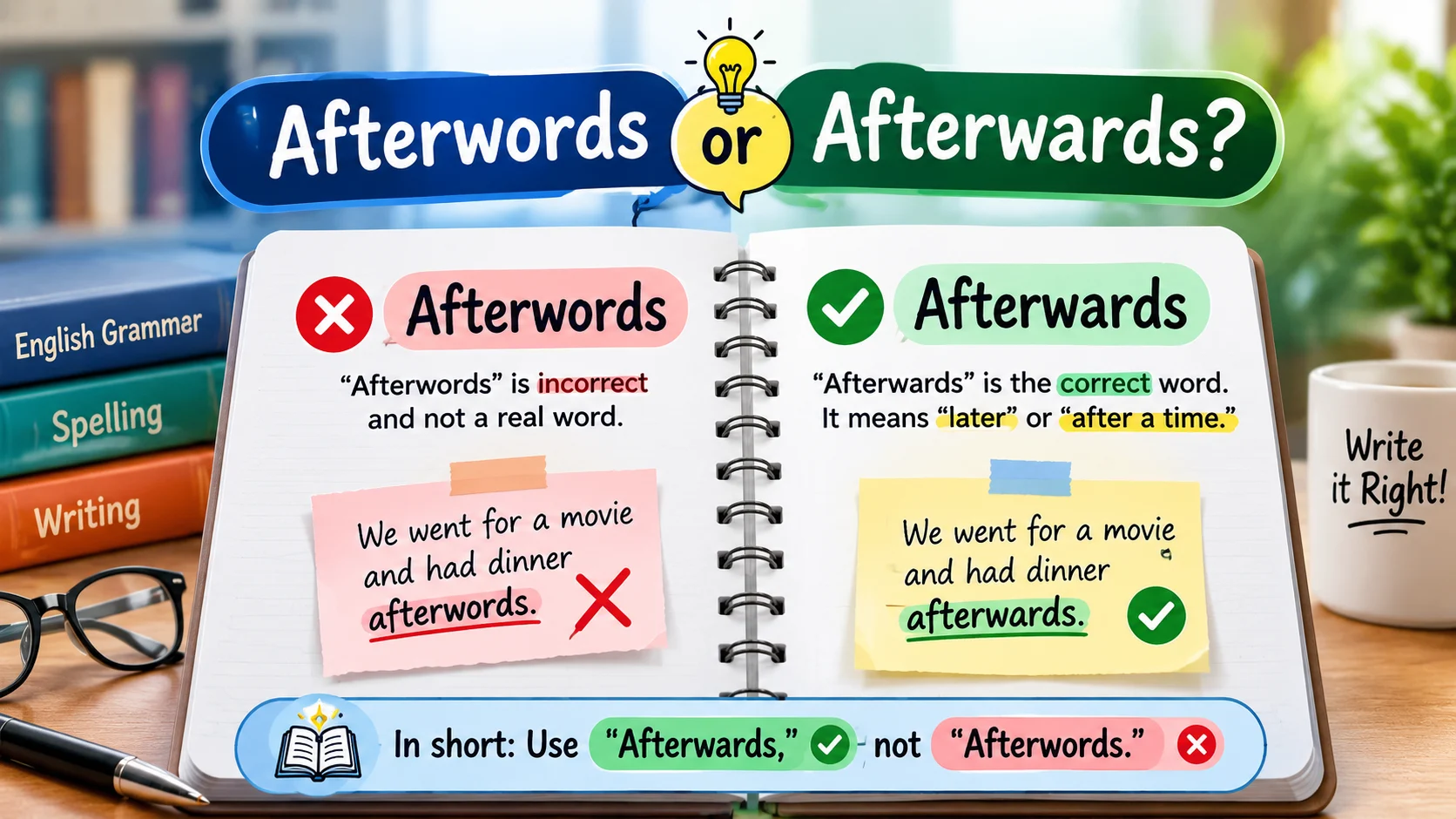
Afterwards means later or at a later time, while afterwords refers to the concluding section of a book written after the main text.
Have you ever wondered whether you should write afterwords or afterwards? These two words look almost identical, but they have completely different meanings. Because they differ by only one letter, many writers accidentally use the wrong one in emails, essays, books, and online content.
If you’ve searched for afterwords or afterwards, you’re probably trying to decide which word fits your sentence. The good news is that both words are correct, but they are not interchangeable. Afterwords is the plural form of afterword, a section at the end of a book. Afterwards is an adverb that means later or after that.
This guide explains the difference between afterwords and afterwards in simple English. You’ll learn what each word means, where it came from, how British and American English use them, common mistakes to avoid, and which one you should choose in different situations.
Afterwords or Afterwards – Quick Answer
Both afterwords and afterwards are correct, but they have different meanings.
- Afterwords is the plural of afterword, which is a section at the end of a book written by the author or another contributor.
- Afterwards means later, after that, or at a later time.
Examples
- The new edition contains two afterwords by different authors.
- We went out for dinner afterwards.
- I read the afterwords after finishing the novel.
The Origin of Afterwords or Afterwards
Although the words look similar, they developed from different ideas.
Afterword combines the words after and word. It refers to written comments placed at the end of a book. The plural form is afterwords.
Afterwards comes from afterward, meaning later or following an event. The ending -s is commonly used in British English, although both forms are accepted.
The similarity in spelling often causes confusion, but the meanings are completely different.
British English vs American English Spelling
This topic involves both meaning and regional preference.
| Version | Spelling | Region | Example Sentence |
|---|---|---|---|
| Book Section (Plural) | Afterwords | US & UK | The book includes several afterwords. |
| Adverb | Afterward | Mainly US | We talked afterward. |
| Adverb | Afterwards | Mainly UK, also common internationally | We talked afterwards. |
Afterwords and afterwards are not regional spelling variants of the same word.
Which Spelling Should You Use?
US Audience
- Use afterwords when referring to multiple book sections.
- Use afterward more often than afterwards when meaning later.
UK/Commonwealth Audience
- Use afterwords for book sections.
- Use afterwards when meaning later.
Global/SEO Audience
Choose the word based on its meaning:
- Afterwords = multiple book endings.
- Afterwards = later or after that.
Common Mistakes with Afterwords or Afterwards
Here are common mistakes people make.
❌ We went home afterwords.
✅ We went home afterwards.
❌ I enjoyed the author’s afterwards.
✅ I enjoyed the author’s afterword.
❌ The novel contains three afterwards.
✅ The novel contains three afterwords.
❌ They have the same meaning.
✅ They have different meanings.
Afterwords or Afterwards in Everyday Examples
Emails
- Let’s discuss the project afterwards.
- The textbook includes helpful afterwords.
News Headlines
- Readers praise the new edition’s afterwords.
- The meeting ended, and reporters spoke afterwards.
Social Media
- We grabbed coffee afterwards!
- I loved reading the afterwords in this novel.
Formal Writing
- The revised edition contains two scholarly afterwords.
- Participants completed a survey afterwards.
Afterwords or Afterwards – Google Trends & Usage
Searches for afterwards are much more common because it is used in everyday conversation and writing.
People search afterwords less often because it mainly appears in publishing, literature, and book reviews.
Many users search afterwords or afterwards because the words look alike, even though they have different meanings. Understanding the distinction helps writers avoid common errors.
Comparison Table
| Feature | Afterwords | Afterwards |
|---|---|---|
| Correct spelling | ✅ Yes | ✅ Yes |
| Refers to book sections | ✅ Yes | ❌ No |
| Means later | ❌ No | ✅ Yes |
| Part of speech | Noun (plural) | Adverb |
| Used in publishing | ✅ Yes | Rarely |
| Used in everyday conversation | Rarely | ✅ Very Common |
| Same meaning | ❌ No | ❌ No |
FAQs
Is it afterwords or afterwards?
Both are correct, but they have different meanings.
What does afterwords mean?
Afterwords is the plural of afterword, meaning sections at the end of books.
What does afterwards mean?
Afterwards means later or after that.
Is afterwards the same as afterword?
No. Afterword is a noun, while afterwards is an adverb.
Which spelling is more common?
Afterwards is much more common because it is used in everyday language.
Can I use afterwords instead of afterwards?
No. They are different words with different meanings.
Conclusion
The difference between afterwords or afterwards is based on meaning, not spelling preference. Afterwords is the plural form of afterword, which refers to written sections placed at the end of books. Afterwards, on the other hand, is an adverb that means later or after that. Even though the words look almost identical, they cannot be used interchangeably.
There is also a small regional difference for the adverb. American English often prefers afterward, while British English commonly uses afterwards. However, afterwords always refers to multiple afterwords in books, regardless of where you are writing.
If you’re discussing publishing or literature, use afterwords. If you’re describing something that happens later, choose afterwards. Remembering this simple distinction will help you write more clearly, avoid common mistakes, and communicate with confidence in both everyday and professional English.