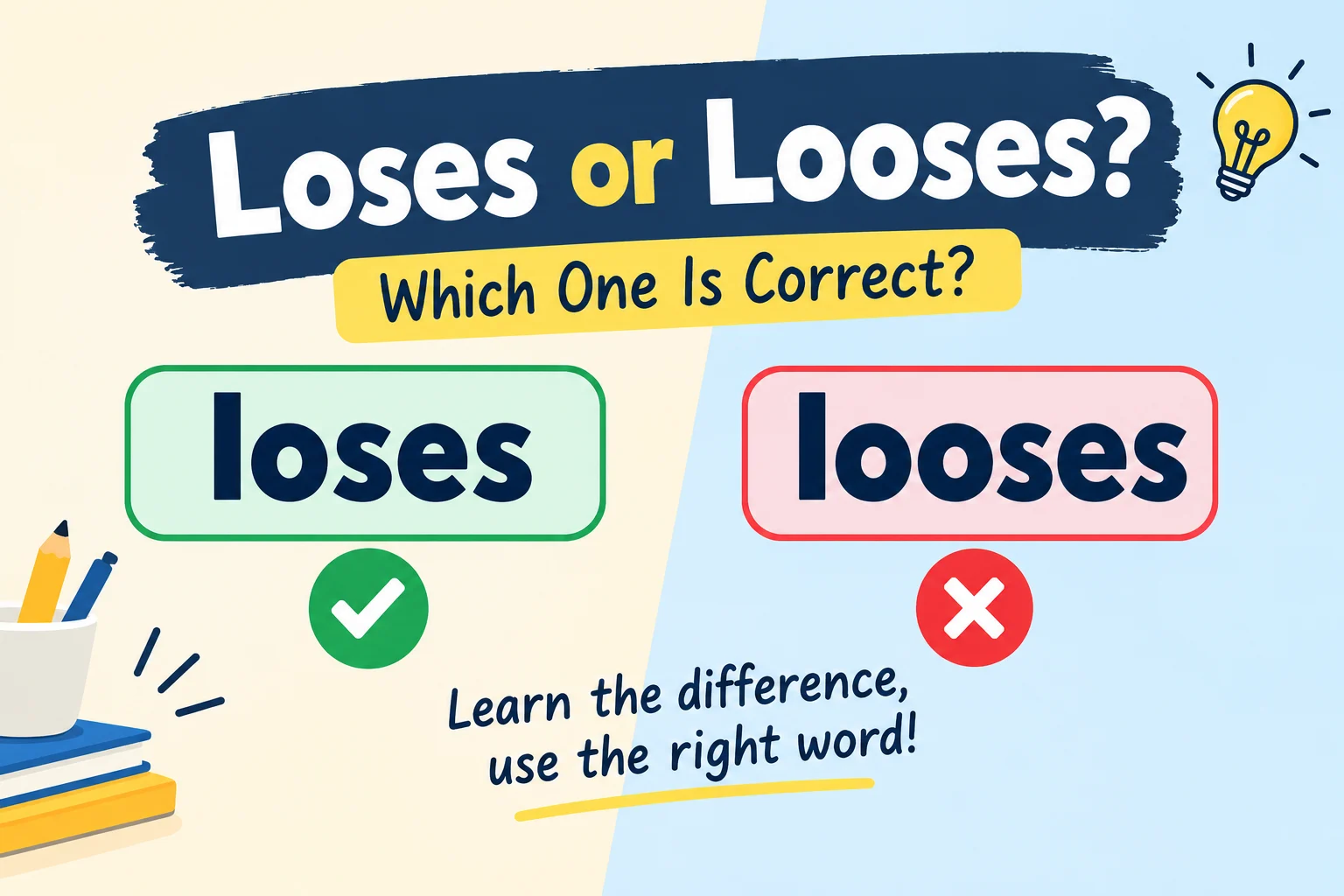
Loses means to no longer have something or to fail to win. Looses means to release, set free, or make something loose. Both words are correct, but they have different meanings.
Have you ever stopped while writing because you were unsure whether to use loses or looses? You are not alone. These two words look almost the same, and they sound very similar. Yet, their meanings are different.
Imagine writing a sentence about a football match. You want to say that your favorite team does not win. Should you write, “The team loses the match” or “The team looses the match”? The correct choice is loses.
Now imagine a dog owner who opens a gate and lets a dog run free. In a rare or literary use, you might say the owner looses the dog. Here, looses means releases.
As an English vocabulary writer, I would teach this difference through simple examples and word patterns. The key is to understand what each word does in a sentence. Once you learn the basic rule, you can choose the right spelling with ease.
This guide explains the meanings, origins, grammar, examples, and common mistakes linked to loses and looses. You will also learn a simple trick to remember the difference.
Loses or Looses: Quick Answer
Loses is the third-person singular form of the verb lose. It means to misplace something, stop having something, or fail to win.
Looses is the third-person singular form of the verb loose. As a verb, loose means to release or set free. This use is much less common in everyday English.
Examples of Loses
- She loses her keys often.
- Our team loses when it does not score enough points.
- He loses interest in the game.
Examples of Looses
- The writer looses an arrow in the story.
- The character looses the birds from their cage.
These examples show that loses is common in daily speech, while looses often appears in literary, historical, or formal contexts.
Easy rule: If you mean “fails to win” or “no longer has,” use loses. If you mean “releases” or “sets free,” use looses.
The Origin and Background of Loses and Looses
The words lose and loose have different histories. Their similar spelling can make them hard to remember, but their meanings help explain how they work.
Where Does Lose Come From?
The verb lose comes from Old English losian, which meant to perish, become lost, or be destroyed. Over time, its meaning grew to include misplacing things, failing to win, and no longer having something.
Today, we use lose in many common phrases:
- Lose a game
- Lose your keys
- Lose interest
- Lose time
- Lose hope
When we add -s to lose for he, she, or it, the result is loses.
Examples:
- I lose my pencil.
- She loses her pencil.
The spelling changes only by adding the final s.
Where Does Loose Come From?
The word loose comes from Old Norse lauss, meaning free or not tied. It developed into an English word used to describe something that is not tight, fixed, or secure.
Today, loose is most often an adjective.
Examples:
- The shirt is loose.
- The dog is loose in the garden.
- The screw feels loose.
However, loose can also be a verb. As a verb, it means to release or set free.
When we add -s to this verb, we get looses.
Example: The hero looses an arrow.
Why Are These Words Confused?
There are three main reasons:
- Similar spelling: Both words begin with lo and contain the letters s and e.
- Similar sounds: In many English accents, they sound alike or very close.
- Different word forms: Lose is a verb, while loose is often an adjective but can also be a verb.
The best way to avoid confusion is to learn the meaning first, then check which word fits the sentence.
Loses vs. Looses: Key Differences Explained
The main difference lies in meaning and use.
What Does Loses Mean?
Loses is a verb. It is used with singular subjects such as he, she, it, or a singular noun.
It can mean:
- To fail to win
- To misplace something
- To stop having something
- To miss an opportunity
- To become less of something
Examples:
- Maria loses her phone at school.
- The player loses the final match.
- The plant loses its leaves in autumn.
- He loses patience when he waits too long.
In each sentence, something is gone, reduced, or not won.
What Does Looses Mean?
Looses is also a verb, but it comes from loose. It means to release, free, or let go.
Examples:
- The archer looses an arrow.
- In the tale, the king looses his prisoners.
- The character looses the animals into the field.
This verb is not common in everyday conversation. Most people would say releases, sets free, or lets go instead.
Comparison Table
| Term | Meaning | When to Use | Region/Context |
|---|---|---|---|
| Loses | Misplaces, no longer has, or fails to win | Everyday speech and writing | Standard English |
| Looses | Releases or sets free | Literary, historical, or formal writing | Standard English, but uncommon |
| Lose | The base verb meaning to misplace or fail to win | Present tense with I, you, we, or they | Standard English |
| Loose | Not tight; also a verb meaning to release | Describing fit or freedom; sometimes as a verb | Standard English |
| Lost | Past tense of lose | Talking about something that happened before | Standard English |
Notice that loose is much more common as an adjective than as a verb.
For example, “My shoe is loose” is a normal sentence. “He looses the rope” is grammatically possible, but “He releases the rope” sounds more natural in everyday English.
Which Version Should You Use?
Choosing between loses and looses depends on your intended meaning.
For Students
Use loses when writing about a loss, a mistake, or a failure to win.
Examples:
- She loses her notebook.
- The team loses the game.
- He loses marks because of spelling errors.
Use looses only when you mean to release something, especially in a story or a literary passage.
For Teachers
Explain the difference through short sentences.
Write these two examples on the board:
- The boy loses his ball.
- The boy looses the bird.
Ask students what happens in each sentence. The first means the boy no longer has his ball. The second means he releases the bird.
This helps learners connect spelling with meaning.
For Bloggers and Content Writers
Use loses in most everyday situations. It is common in articles about sports, habits, business, relationships, and daily life.
Examples:
- A team loses a match.
- A company loses customers.
- A person loses interest in a topic.
Use looses only when the meaning is truly “releases” or “sets free.” In most modern articles, releases is clearer.
For Formal and Professional Writing
Both words are correct when used with the right meaning. However, looses may sound unusual to many readers.
Compare:
- Literary: The archer looses an arrow.
- Clear and modern: The archer releases an arrow.
For professional writing, choose the word that makes your meaning clear.
Common Mistakes with Loses and Looses
Here are five errors to avoid.
1. Using Looses When You Mean Loses
Incorrect: He looses his wallet every week.
Correct: He loses his wallet every week.
Why? The sentence means he misplaces his wallet. It does not mean he releases it.
2. Using Loses When You Mean Releases
Incorrect: The hero loses an arrow from his bow.
Correct: The hero looses an arrow from his bow.
More natural modern version: The hero releases an arrow from his bow.
Why? The intended action is to send or release the arrow, not to misplace it.
3. Confusing Loose and Lose
Incorrect: My shoes are lose.
Correct: My shoes are loose.
Why? Loose describes something that is not tight. Lose is a verb about losing something.
4. Using Loses With the Wrong Subject
Incorrect: They loses the game.
Correct: They lose the game.
Why? Use lose with I, you, we, and they. Use loses with he, she, it, or a singular noun.
5. Using Looses in Everyday Writing When a Simpler Word Works
Unusual: She looses the dog from its lead.
Clearer: She releases the dog from its lead.
Why? Looses is correct in this sense, but it is uncommon. A more familiar word helps readers understand your message quickly.
Loses or Looses in Real-World Examples
Seeing these words in context makes the difference easier to remember.
1. In a Professional Email
Subject: Report Update
Dear Team,
The project loses time whenever we delay the review process. Please send your comments by Friday so we can stay on schedule.
Best regards,
Alex
Here, loses means the project wastes or falls behind on time.
2. In a News Headline
Illustrative headline: “Local Team Loses Final Match After Close Contest”
The word loses means the team did not win the match.
This is an example of a possible headline, not a report of a real event.
3. In a Social Media Post
“Our team loses sometimes, but we keep learning and come back stronger!”
This is a natural use of loses in a post about sports or personal growth.
4. In a Story
“The brave archer looses an arrow toward the distant target.”
Here, looses means releases. This use suits a story with a dramatic or historical style.
5. In a Formal Report
“The company loses money when operating costs rise above its income.”
The word describes a financial loss.
6. In Everyday Conversation
- “She loses her glasses all the time.”
- “The knot came loose.”
- “The character looses the horses in the final scene.”
These sentences show why meaning matters more than appearance.
Loses or Looses: Data, Trends, and Usage
The spelling question loses or looses is mainly an informational query. Readers want to know which word is correct and how to use it.
Which Word Is More Common?
Loses is far more common in everyday English. People use it to discuss sports, money, objects, time, and opportunities.
Looses is a valid word, but it is much less common as a verb. It appears more often in literary, historical, or formal contexts.
Who Searches for These Words?
Likely readers include:
- Students learning English grammar
- English learners checking spelling
- Teachers preparing language lessons
- Bloggers and content writers
- People editing emails, essays, or reports
These are likely audience groups, not verified search demographics.
Why Does This Difference Matter?
A single spelling change can alter the meaning of a sentence.
For example:
- “She loses the bird” suggests that she no longer has it.
- “She looses the bird” means she sets it free.
The context changes the message. That is why proofreading should include meaning, not just spelling.
There are no verified search-volume figures presented here, so exact monthly searches or regional rankings should not be assumed. For educational content, clear definitions and natural examples offer the most useful answer.
Standalone Comparison Table: Loses vs. Looses
| Term/Variant | Meaning | Region/Context | Best Used When |
|---|---|---|---|
| Loses | Fails to win or no longer has something | Everyday English | Talking about losses, misplaced items, or missed chances |
| Looses | Releases or sets free | Literary or less common usage | Describing the act of setting something free |
| Lose | Base verb meaning to misplace or fail to win | Everyday English | With I, you, we, or they |
| Loose | Not tight; sometimes means to release | Everyday English | Describing clothing, objects, or something not firmly held |
| Lost | Past tense of lose | Everyday English | Talking about a past loss |
Frequently Asked Questions
Q1: What does loses mean?
A: Loses means to misplace something, stop having something, or fail to win. For example, “She loses her keys often.”
Q2: What does looses mean?
A: Looses means releases or sets free. It is a correct but uncommon verb form, often found in stories or formal writing.
Q3: Loses vs. looses: What is the difference?
A: Loses refers to losing something or failing to win. Looses means letting something go free. The correct word depends on the action you want to describe.
Q4: Is looses a real word?
A: Yes, looses is a real English word. It is the third-person singular form of the verb loose, meaning to release or set free.
Q5: Which spelling is correct in formal writing?
A: Both spellings are correct when used with their proper meanings. Use loses for a loss and looses for releasing something.
Q6: Where do loses and looses come from?
A: Loses comes from the verb lose, which has Old English roots. Looses comes from loose, a word linked to the idea of being free or not tied.
Q7: Can I use loses and looses in the same sentence?
A: Yes, if each word fits its meaning. For example, “The character loses his map, then looses the bird from its cage.” The first word means misplaces; the second means releases.
Q8: What is an easy way to remember loses vs. looses?
A: Think of lose a game and loose clothing. Loses relates to losing, while looses means releasing something. Remember that loose is usually an adjective, as in “loose shoes.”
Conclusion
The difference between loses or looses becomes simple when you focus on meaning.
Loses is the common word. It means to misplace something, no longer have it, or fail to win. You may use it when talking about a lost game, missing keys, or a business that loses money.
Looses is also correct, but it is much less common. It means to release or set free. You may see it in stories, historical writing, or formal descriptions.
Remember these three points:
- Use loses when something is lost or not won.
- Use looses when something is released.
- Use loose as an adjective when something is not tight.
When in doubt, read the whole sentence and ask yourself what action is taking place. This small habit can prevent many spelling mistakes.
Now you know how to use loses and looses correctly. Bookmark this guide, practice with your own sentences, and share it with someone who wants to improve their English spelling.