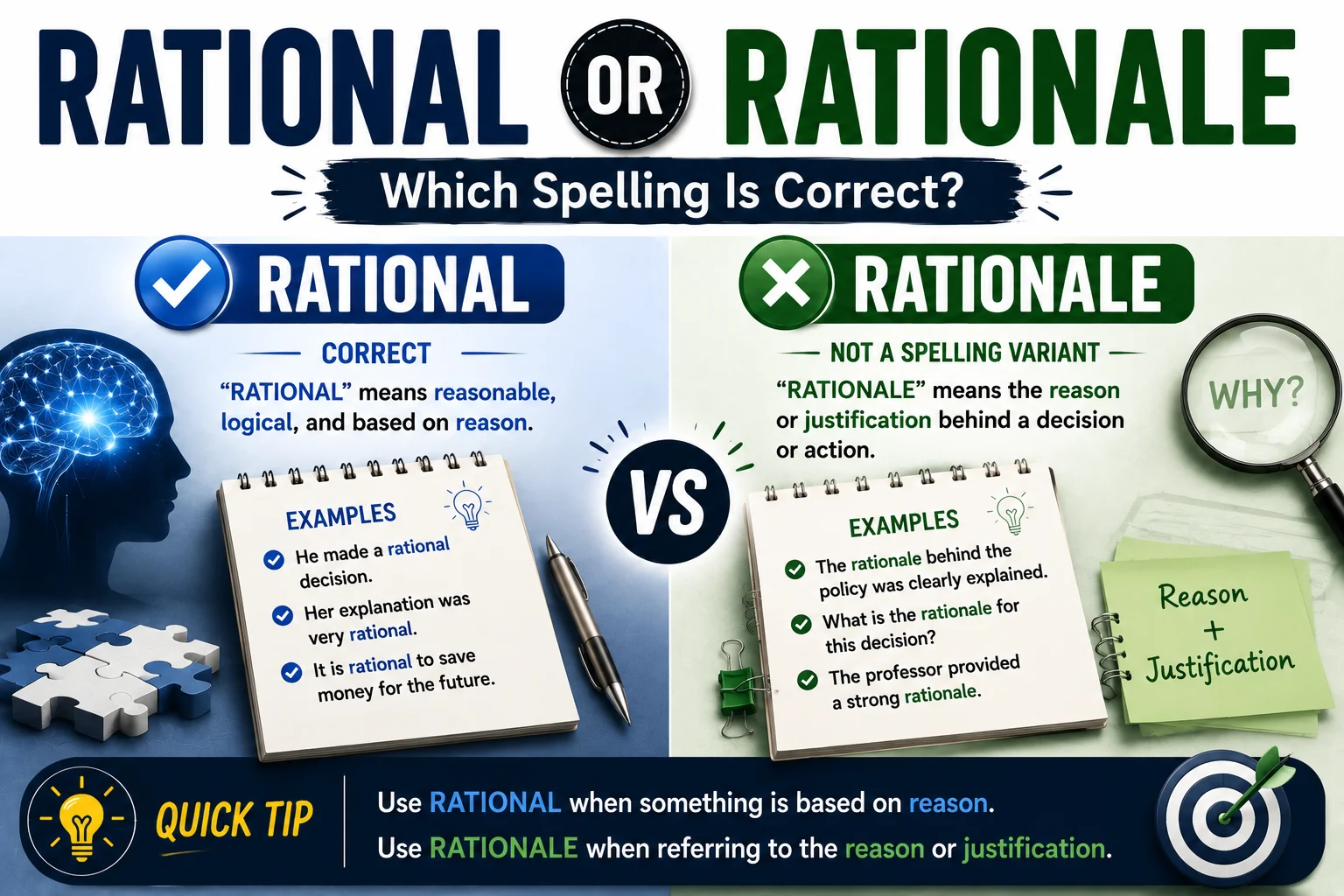
Rational is an adjective meaning sensible, logical, or based on reason. Rationale is a noun meaning the reason or explanation behind a decision, plan, or action.
Have you ever written a sentence such as “What is the rational for this decision?” and stopped because something looked wrong?
As an English teacher and language editor, I have seen this mistake often. The problem is easy to understand. Rational and rationale look almost the same, sound related, and come from the same word family. Yet they do different jobs in a sentence.
The good news is that you do not need to memorize a long grammar rule. You only need to ask one simple question: Are you describing something, or are you naming a reason?
If you are describing a decision as sensible, use rational. If you are asking for or giving the reason behind that decision, use rationale.
This small difference matters in school essays, business emails, reports, research papers, and everyday writing. A single ending can change the grammatical role of the word.
Let’s make the difference clear with simple rules, examples, common mistakes, and practical tips.
Rational or Rationale – Quick Answer
Rational is an adjective. It describes someone or something that is logical, sensible, or based on reason.
“She made a rational decision.”
Rationale is a noun. It means the reason or explanation behind a decision, action, policy, or idea.
“She explained the rationale behind her decision.”
The easiest way to remember it
Think:
Rational = describes the decision.
Rationale = explains the reason.
Compare these two sentences:
- “The manager made a rational choice.”
- “The manager explained the rationale for the choice.”
Both are correct. They simply perform different grammatical jobs.
The Origin and Background of Rational and Rationale
The words rational and rationale are closely related.
Both come from the Latin word rationalis, which is connected with reason, calculation, and thinking. The English word rational developed from this idea of using reason and sound judgment.
Over time, English also developed rationale as a noun for the reasoning behind something.
That shared history explains why the two words look so similar.
But their grammatical roles became different.
Rational as an adjective
An adjective describes a person, thing, idea, action, or decision.
For example:
“That is a rational explanation.”
Here, rational describes the explanation.
Other examples include:
- rational decision
- rational argument
- rational approach
- rational choice
- rational thinker
Rationale as a noun
A noun names something.
Rationale names the reasoning or explanation behind something.
For example:
“The report gives the rationale for the new policy.”
You can often replace rationale with reasoning or reason.
“What is the rationale for this change?”
This means:
“What is the reason for this change?”
That substitution is a useful memory trick.
Rational or Rationale Explained — Key Differences
The main difference is simple:
Rational = logical or sensible
Use rational when you are describing something.
Examples:
- “He gave a rational answer.”
- “We need a rational solution.”
- “Her decision was rational.”
- “Try to remain rational during the discussion.”
Rationale = reason or explanation
Use rationale when you mean the reasoning behind something.
Examples:
- “Please explain the rationale for the decision.”
- “The report provides a clear rationale.”
- “I understand the rationale behind the new rule.”
- “What was the rationale for changing the schedule?”
A quick test
Ask yourself:
Am I describing something as logical?
Use rational.
Am I talking about the reason behind something?
Use rationale.
| Term | Meaning | When to Use | Region/Context |
|---|---|---|---|
| Rational | Logical or sensible | To describe a person, idea, choice, or action | Standard English |
| Rationale | Reason or explanation | To explain why something was done | Standard English |
| Reason | Cause or explanation | General everyday use | Standard English |
| Reasoning | The process of thinking about something | When discussing thought or logic | Standard English |
| Rationally | In a logical or sensible way | To describe how an action is done | Standard English |
Which Version Should You Use?
Choosing between rational and rationale depends on what you want to say.
For students → check the grammar
If you are writing an essay, ask whether the word is describing something or naming a reason.
Correct:
“The author presents a rational argument.”
Here, rational describes the argument.
Correct:
“The author explains the rationale behind the argument.”
Here, rationale names the explanation.
For professional writing → use rationale for the reasoning
Business and workplace writing often uses rationale when discussing decisions.
For example:
“Please provide the rationale for the proposed changes.”
This sounds clear and professional.
You could also write:
“Please explain the reason for the proposed changes.”
Both are correct. Reason is simpler, while rationale can sound more formal.
For everyday English → reason may be easier
You do not always need rationale.
Instead of:
“What is your rationale for leaving early?”
You can simply say:
“Why are you leaving early?”
Or:
“What is your reason for leaving early?”
Rationale is useful when you are discussing a plan, policy, decision, argument, or formal process.
For global English → choose clarity
If your readers include beginners or non-native English speakers, reason is often easier to understand.
Use rational when you need the adjective.
Use rationale when you specifically mean the reasoning behind something.
Common Mistakes with Rational or Rationale
These words are often mixed up because they share most of their letters.
Mistake 1: Using rational instead of rationale
Incorrect:
“What is the rational for this decision?”
Correct:
“What is the rationale for this decision?”
Why?
Because you are asking for the reason behind the decision.
Mistake 2: Using rationale as an adjective
Incorrect:
“She made a rationale decision.”
Correct:
“She made a rational decision.”
Why?
You are describing the decision as logical. Therefore, you need the adjective rational.
Mistake 3: Confusing rationale with rationally
Incorrect:
“He acted rationale.”
Correct:
“He acted rationally.”
Rationally is an adverb. It tells us how someone acted.
Compare:
- Rational → a rational person
- Rationale → the rationale for the decision
- Rationally → acted rationally
Mistake 4: Assuming rationale means “rational”
The words are related, but they are not interchangeable.
“The decision was rational.”
This means the decision was sensible.
“The rationale was clear.”
This means the reasoning behind the decision was clear.
The first describes the quality of the decision.
The second describes the reasoning behind it.
Mistake 5: Using rationale when reason is more natural
Formal:
“The committee explained the rationale for the policy.”
Simple:
“The committee explained the reason for the policy.”
Both work.
The best choice depends on your audience and tone.
Rational or Rationale in Real-World Examples
Seeing these words in different situations makes the difference easier to remember.
1. Professional email
“Could you please explain the rationale behind the proposed budget changes?”
Here, rationale means the reasoning or justification for the changes.
A simpler version is:
“Could you please explain the reason for the proposed budget changes?”
2. News article
“The minister said the decision was based on a rational assessment of the situation.”
Here, rational describes the assessment.
Another example:
“Officials explained the rationale behind the new policy.”
Here, rationale means the reason for the policy.
3. Social media post
“There must be a rational explanation for what happened.”
The word rational describes the explanation.
You could also write:
“I finally understand the rationale behind the decision.”
Here, rationale means the reason behind the decision.
4. Formal report
“The committee adopted a rational approach to the problem.”
Here, rational describes the approach.
Now compare:
“The report explains the rationale for the committee’s approach.”
The meaning changes slightly.
The first tells us the approach was logical.
The second tells us why the committee chose that approach.
5. Academic writing
“The study provides a rational basis for further research.”
Here, rational describes the basis.
But:
“The researchers provide a clear rationale for conducting the study.”
Here, rationale means the reason for conducting the study.
Rational or Rationale — Data, Trends & Usage
The search intent behind “rational or rationale” is mainly informational and grammatical.
People often search for these words when they have encountered a sentence such as:
“What is the rational for this decision?”
They may know what they want to say but are unsure which word fits.
This is especially common in:
- Academic writing
- Business communication
- Research papers
- Reports
- Policy documents
- Professional emails
- English-learning exercises
The confusion is understandable because rational and rationale share the same root and look almost identical.
The useful insight is that the difference is not about British versus American spelling. Both words are standard in both major varieties of English.
The issue is grammar and meaning.
That makes this pair different from spelling variations such as colour/color or travellers/travelers. You are not choosing between two regional spellings.
You are choosing between two different words.
Standalone Comparison Table
| Term/Variant | Meaning | Region/Context | Best Used When |
|---|---|---|---|
| Rational | Logical, sensible, reasonable | All standard English | Describing a decision or idea |
| Rationale | Reason or explanation | All standard English | Explaining why something was done |
| Reason | Cause or explanation | Everyday and formal English | General situations |
| Reasoning | Thought process or logic | Academic and general English | Explaining how someone reached a conclusion |
| Rationally | In a logical way | All standard English | Describing an action or thought process |
Remember this simple formula
Rational = describes.
Rationale = explains.
That one rule will solve most cases.
FAQs About Rational or Rationale
Q: What is the difference between rational and rationale?
A: Rational is an adjective meaning logical or sensible. Rationale is a noun meaning the reason or explanation behind something.
Q: Is “rational for the decision” correct?
A: Usually, no. If you mean the reason behind a decision, use rationale: “What is the rationale for the decision?”
Q: Is “rationale” a formal word?
A: Yes. Rationale is common in formal, academic, business, and professional writing. In casual English, reason is often simpler and more natural.
Q: Can rational and rationale be used in the same sentence?
A: Yes. For example: “The committee made a rational decision after reviewing the rationale.” The first word describes the decision, while the second names the reasoning.
Q: Is rationale the same as reason?
A: They are very close in meaning. Rationale usually refers to the reasoning or justification behind a decision, while reason has a wider everyday use.
Q: Is “rationale decision” correct?
A: No. Use rational decision. The word rational is the adjective needed to describe the decision.
Q: Where does rationale come from?
A: Rationale is related to Latin words connected with reason and reasoning. It developed in English as a noun referring to the explanation or reasoning behind something.
Q: Is rational or rationale a spelling difference between American and British English?
A: No. Both rational and rationale are standard words in American and British English. The choice depends on meaning and grammar, not region.
Q: Can I replace rationale with reason?
A: Usually, yes. For example, “the rationale for the decision” and “the reason for the decision” have similar meanings. Rationale often sounds more formal.
Final Verdict: Rational or Rationale?
The choice between rational and rationale becomes easy once you know their jobs.
Use rational when you are describing something as logical, sensible, or reasonable:
“It was a rational decision.”
Use rationale when you mean the reason or explanation behind something:
“Please explain the rationale for the decision.”
You can also use reason when you want a simpler, more common word.
Remember:
- Rational = logical or sensible
- Rationale = reason or explanation
- Rationally = in a logical way
- Reason = a cause or explanation
There is no British-versus-American spelling issue here. These are separate words with different grammatical roles.
The next time you write “the rational for the decision,” stop and ask yourself what you mean. If you mean the reason, the correct word is rationale.
Bookmark this guide so you never second-guess “rational or rationale” again.