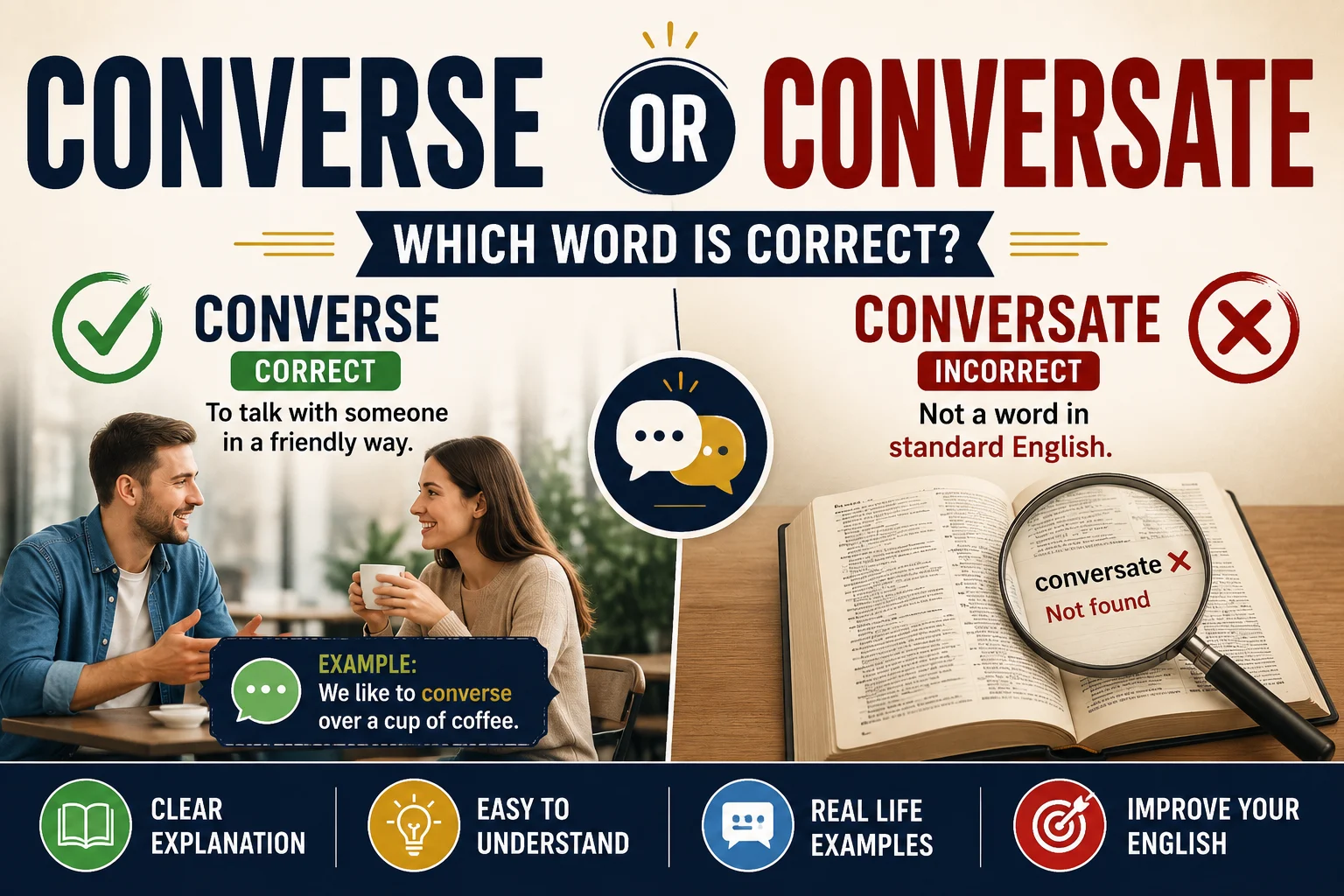
Converse is the standard and widely accepted verb meaning to talk with someone. Conversate is a less common verb and is often viewed as nonstandard or informal, so converse is the safer choice in formal writing.
Have you ever written a sentence like, “We need to converse about this,” and then wondered if conversate might be better?
As an English writer and language editor, I have seen this question many times. The confusion is easy to understand. Both words look like verbs, and both are connected with the idea of talking. Yet they do not have the same status in standard English.
You may hear someone say, “We were conversating all evening.” You may also see conversate on social media or in casual speech. That does not mean it is the best choice for an essay, email, report, or professional document.
The key is simple: converse is the established standard verb. Conversate exists in English usage, but it is much less common and is often treated as nonstandard.
So, which word should you choose? The answer becomes much clearer when you look at their meanings, history, grammar, and real-world use.
Converse or Conversate – Quick Answer
Converse is the preferred standard word when you mean to talk or have a conversation with someone.
For example:
- “I enjoy conversing with my friends.”
- “The two leaders conversed for several hours.”
- “She likes to converse with her neighbors.”
Conversate is also used by some speakers to mean “talk” or “have a conversation.” However, it is far less common and is often considered informal or nonstandard.
The easiest rule
If you are unsure, choose converse.
Use converse in:
- School assignments
- Business emails
- Academic writing
- Formal reports
- Professional communication
- Edited articles
You may hear conversate in casual speech, music, social media, or other informal settings. But it is not the safest choice when you want standard English.
The Origin and Background of Converse
The word converse has a long history.
It comes from Latin conversari, which meant something like to associate with, keep company, or live among others. Over time, the word developed in English and became connected with talking and social interaction.
That history helps explain why converse sounds natural in formal English.
For example:
“The students conversed after class.”
Here, conversed simply means that the students talked with each other.
The word also has other meanings. Converse can be a noun or an adjective in certain contexts.
For example:
- “We discussed the converse of the argument.”
- “The converse statement is also true.”
These meanings are different from the verb converse, which means to talk.
Why does “conversate” exist?
Conversate is a real word found in English usage, but it has never reached the same level of acceptance or frequency as converse.
One reason may be its structure.
English speakers often create verbs from nouns or other word forms. Since conversation is the noun, some speakers naturally form the verb conversate.
But English does not always follow that pattern.
The standard verb is already converse.
Think of it this way:
conversation → converse
Not every noun needs a matching verb ending in -ate.
Converse or Conversate Explained — Key Differences
The biggest difference is standard usage and frequency.
1. Converse
Converse means to talk with another person or group.
It is a standard English verb.
Examples:
- “We conversed about the new project.”
- “They converse every evening.”
- “I would like to converse with you.”
- “She was conversing with her teacher.”
The word can sound slightly formal compared with the simple verb talk.
2. Conversate
Conversate is used by some English speakers as a verb meaning to talk or have a conversation.
Examples you may hear include:
- “We were conversating about music.”
- “They like to conversate after work.”
However, many dictionaries and language guides treat it as uncommon, informal, or nonstandard compared with converse.
That makes it a poor choice when you need safe, standard English.
Quick comparison
| Term | Meaning | When to Use | Region/Context |
|---|---|---|---|
| Converse | Talk with someone | Formal and general writing | Standard English |
| Conversing | Talking with someone | Formal and general writing | Standard English |
| Conversed | Talked with someone | Past-tense situations | Standard English |
| Conversate | Talk or have a conversation | Casual or marked usage | Less common |
| Conversation | An exchange of spoken ideas | General use | Standard English |
| Talk | Speak with someone | Everyday communication | Very common |
The important point is that converse and conversation are standard choices, while conversate is much less widely accepted.
Which Version Should You Use?
For most writers, the answer is simple:
For students → use converse
If you are writing an essay, assignment, application, or school project, choose converse.
Better:
“The characters converse about their problems.”
Avoid:
“The characters conversate about their problems.”
The first sentence follows standard English usage.
For professional writers → use converse
Business writing should be clear and familiar.
You could write:
“I would like to converse with the client before making a final decision.”
However, there is an even more natural option in many business situations:
“I would like to speak with the client.”
Or:
“I would like to discuss this with the client.”
These verbs often sound more direct.
For casual speech → context matters
You may hear conversate in informal speech.
If someone says:
“We were just conversating.”
Most listeners will understand the intended meaning.
But understanding a word does not make it the best word for every setting.
For global English → choose converse
If your readers come from different countries, converse is the safer choice.
It is recognized as a standard English verb.
Common Mistakes with Converse or Conversate
These two words can cause several common errors.
Mistake 1: Using conversate in formal writing
Incorrect or less suitable:
“The researchers conversated about the results.”
Better:
“The researchers conversed about the results.”
Even better, depending on the meaning:
“The researchers discussed the results.”
Mistake 2: Using “converse” when you mean “talk to”
The verb converse normally describes talking with someone.
Natural:
“She enjoys conversing with her colleagues.”
The preposition with is common because conversation involves an exchange.
Mistake 3: Confusing converse with conversation
These words are related but have different jobs.
Converse is usually a verb:
“They converse every morning.”
Conversation is a noun:
“They had a long conversation.”
Do not write:
“We had a long converse.”
Write:
“We had a long conversation.”
Mistake 4: Using a formal word when a simple word is better
Converse is correct, but it can sound formal.
For example:
“I need to converse with my brother.”
This is grammatically fine.
But in everyday speech, most people would say:
“I need to talk to my brother.”
Good writing is not only about being correct. It is also about choosing the most natural word for the situation.
Mistake 5: Assuming every “-ate” verb is correct
English has many verbs ending in -ate, such as:
- communicate
- educate
- separate
- generate
- celebrate
That does not mean we can add -ate to any noun and create a standard verb.
Conversation already has the established verb converse.
Converse or Conversate in Real-World Examples
Knowing the rule is useful. Seeing the words in context is even better.
1. Professional email
Recommended:
Dear Mr. Ahmed,
I would be happy to converse with you about the project and answer your questions.
A more natural modern business version might be:
I would be happy to discuss the project with you.
Both are clear and professional.
2. News article
A formal article might say:
“The two leaders conversed privately before the meeting began.”
The verb conversed works well because it has a formal tone.
3. Social media post
You might see:
“I love conversing with people who have different views.”
This is perfectly acceptable.
You could also say:
“I love talking with people who have different views.”
The second version sounds more relaxed.
4. Formal report
Recommended:
“The committee members conversed about the proposed changes before voting.”
For a formal report, conversed is much safer than conversated.
5. Everyday conversation
You would probably say:
“We talked for two hours.”
You can say:
“We conversed for two hours.”
But talked sounds more natural in ordinary conversation.
Converse or Conversate — Data, Trends & Usage
People who search for “converse or conversate” are usually looking for a spelling or usage answer.
The intent is mainly informational.
They want to know:
- Which word is correct?
- Is conversate a real word?
- Can I use conversate in formal writing?
- What is the difference between converse and conversate?
- What is the correct past tense?
- Is conversing correct?
The key usage insight is that converse has a much stronger position in standard English.
You may encounter conversate in informal language, online writing, lyrics, and speech. But if your goal is clear, standard English, converse is the better choice.
This matters because a word can exist in real usage without being the best option for every audience.
Language changes over time. Still, formal writing often follows established vocabulary and grammar.
Standalone Comparison: Converse vs Conversate
| Term/Variant | Meaning | Region/Context | Best Used When |
|---|---|---|---|
| Converse | Talk with someone | Standard English | Formal and general writing |
| Conversed | Talked with someone | Standard English | Past events |
| Conversing | Talking with someone | Standard English | Ongoing actions |
| Conversation | An exchange of ideas | Standard English | As a noun |
| Conversate | Talk or chat | Informal/less common usage | Casual contexts only |
| Talk | Speak with someone | Everyday English | Most casual situations |
| Discuss | Talk about a subject | Professional and academic | Topics, issues, ideas |
The simplest choice
If you are writing something important, choose:
converse → conversed → conversing
If you want a simple everyday word, choose:
talk → talked → talking
FAQs About Converse or Conversate
Q: Is converse or conversate correct?
A: Converse is the standard and widely accepted verb. Conversate is used by some speakers but is much less common and is often considered nonstandard or informal.
Q: Can I use conversate in formal writing?
A: It is best to avoid conversate in formal writing. Use converse, talk, or discuss instead.
Q: Is “conversing” a correct word?
A: Yes. Conversing is the present participle of converse. For example: “They were conversing in the hallway.”
Q: What is the past tense of converse?
A: The past tense is conversed. For example: “We conversed about the problem yesterday.”
Q: Is converse the same as talk?
A: They have similar meanings, but converse is more formal. Talk is much more common in everyday English.
Q: Where does converse come from?
A: Converse comes from Latin conversari, which was linked to associating or spending time with others. Its meaning later developed toward talking and social interaction.
Q: Is conversate a real word?
A: Conversate does appear in English usage. However, it is much less common than converse and is not the preferred choice in standard formal English.
Q: Should I say “converse with” or “converse to”?
A: Use converse with when you mean talking with someone. For example: “She conversed with her manager.”
Q: Is “conversation” related to “converse”?
A: Yes. They are closely related words. Conversation is the noun, while converse is commonly used as the verb.
Final Verdict: Converse or Conversate?
When you need one clear answer, choose converse.
Converse is the standard verb for talking with someone. Its forms include converse, converses, conversed, and conversing.
Conversate can be found in real English usage, especially in informal settings. However, it is not the safest choice for school, academic, business, or professional writing.
There is also a useful style lesson here. You do not always need the most formal word. In everyday English, talk is often better than converse because it sounds natural and direct.
So remember these three choices:
- Formal: “We conversed about the issue.”
- Neutral: “We talked about the issue.”
- Professional: “We discussed the issue.”
If you are unsure about conversate, replace it with one of these established choices.
Bookmark this guide so you never have to second-guess “converse or conversate” again.