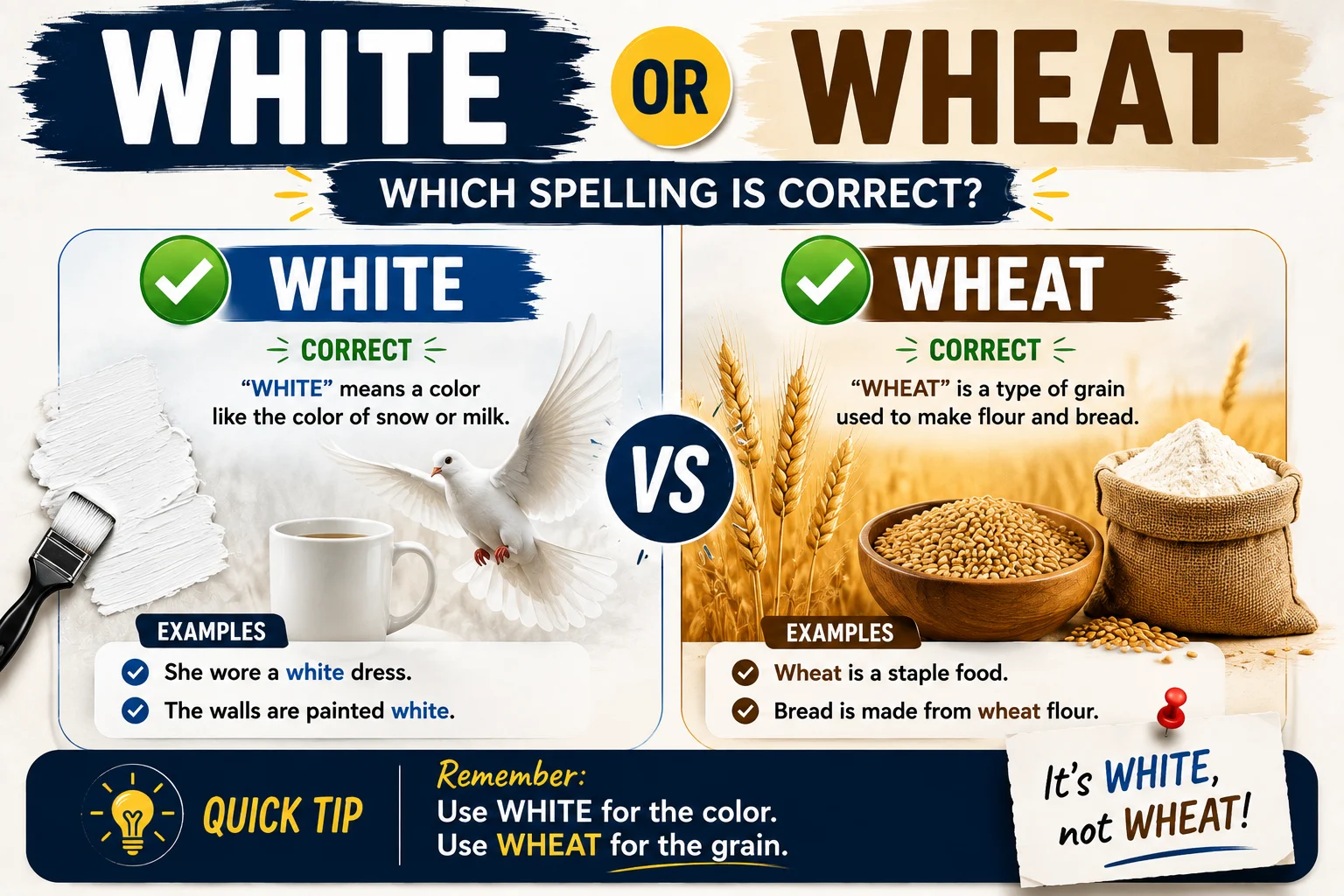
White and wheat are both correct English words, but they have different meanings. White describes a color, while wheat is a grain used to make foods such as bread and flour.
Have you ever heard someone say a word and wondered, “Did they mean white or wheat?” This small spelling question can cause real confusion, especially for English learners.
The two words look and sound quite different in careful speech. Yet in fast conversation, accents and unclear pronunciation can make them seem closer than they are. I often see learners pause over words such as white bread and wheat bread, too. That example shows why the difference matters. One word describes color. The other names a type of grain.
The good news is that the rule is simple. Once you know what each word means, choosing the right spelling becomes much easier.
This guide explains white or wheat, their meanings, pronunciation, origins, common mistakes, and real-world use. You will also see simple examples that make the difference easy to remember.
Let’s start with the answer you need most.
White or Wheat – Quick Answer
White means a color. It is the color of snow, milk, or fresh paper.
Wheat is a type of grain. It is used to make flour, bread, pasta, cereal, and many other foods.
Simple examples
- The wall is white.
→ Here, white describes a color. - Farmers grow wheat.
→ Here, wheat means a grain. - She wore a white shirt.
- The farmer harvested wheat.
So, remember this:
White = color
Wheat = grain
There is also an important phrase that often causes confusion: white bread and wheat bread.
White bread is usually made from refined wheat flour. Wheat bread usually refers to bread made with wheat flour, often with more of the wheat grain retained.
The Origin and Background of White and Wheat
The words white and wheat have old English roots. They are not different spellings of the same word.
Where does “white” come from?
White comes from Old English hwīt.
It has been used for centuries to describe a light color. Related forms appear in several Germanic languages.
Today, we use white in many ways:
- white dress
- white paper
- white paint
- white flowers
- white clouds
The basic idea remains the same: the word describes a color or something associated with that color.
Where does “wheat” come from?
Wheat comes from Old English hwǣte.
It has long referred to the grain that comes from the wheat plant.
Wheat has played a major role in human food for thousands of years. It is now one of the world’s most important cereal crops.
You may see wheat in words and phrases such as:
- wheat flour
- wheat bread
- whole wheat
- wheat field
- wheat grain
- wheat products
The different histories make one thing clear: white and wheat are separate words with separate meanings.
White or Wheat Explained — Key Differences
The easiest way to understand the difference is to focus on the noun or idea each word represents.
White
White is mainly an adjective.
It describes a color.
Examples:
- I bought a white car.
- She has a white dress.
- The walls are white.
- The dog has white fur.
It can also be used as a noun in some contexts:
- White is my favorite color.
Wheat
Wheat is a noun.
It refers to a cereal plant and its grain.
Examples:
- The farmer grows wheat.
- The bread contains wheat.
- This field is full of wheat.
- Some people avoid foods that contain wheat.
You should not use wheat when you mean the color.
Likewise, you should not use white when you mean the grain.
Quick comparison
| Term | Meaning | When to Use | Region/Context |
|---|---|---|---|
| White | A color | Describing color or appearance | All major varieties of English |
| Wheat | A cereal grain | Talking about farming, food, flour, or crops | All major varieties of English |
| White bread | Bread usually made with refined flour | Talking about a type of bread | Common in everyday English |
| Wheat bread | Bread made with wheat flour | Talking about bread ingredients or type | Common in food contexts |
| Whole wheat | Wheat containing much of the grain | Talking about food and nutrition | Common in food labeling |
Why Do People Confuse White and Wheat?
At first glance, there does not seem to be much reason to confuse these words.
The problem often comes from pronunciation, especially in fast speech or with different accents.
White is pronounced roughly like “wite.”
Wheat is pronounced roughly like “weet.”
The first sounds are different:
- white → /waɪt/
- wheat → /wiːt/
The vowel sound is the key difference.
Compare:
white → “eye” sound
wheat → long “ee” sound
Try saying these pairs slowly:
- white / wheat
- white / wheat
- white bread / wheat bread
- white flour / wheat flour
You should hear the difference more clearly when you slow down.
Which Version Should You Use?
The correct choice depends on what you want to say.
If you are talking about color → use white
Use white when you describe something that has a light color.
Examples:
- white shoes
- white flowers
- white walls
- white paper
- white clouds
If you are talking about grain or food → use wheat
Use wheat when you are talking about the crop, grain, flour, or food made from it.
Examples:
- wheat flour
- wheat bread
- wheat field
- wheat production
- whole wheat cereal
For students and beginners
A simple memory trick works well:
White has “I” → think of your eyes seeing a color.
Wheat has “eat” sounds → think of food.
This is not an etymological rule. It is simply a memory aid.
White Bread vs Wheat Bread
This is one of the most useful differences to understand.
What is white bread?
White bread is generally made from refined wheat flour. During processing, parts of the wheat grain are removed.
The bread is often light in color and has a soft texture.
Example:
I usually eat white bread for breakfast.
What is wheat bread?
Wheat bread is made with wheat flour. Depending on the product, it may contain more of the wheat grain.
A label may also say whole wheat bread. In that case, the bread is made with whole-wheat flour.
Example:
My doctor suggested that I try whole wheat bread.
Why the names can be confusing
Both types of bread can contain wheat.
That means white bread does not mean bread made without wheat.
This is a common misunderstanding.
The word white describes the bread’s appearance or type. The word wheat tells you about the grain used to make it.
Common Mistakes With White or Wheat
These words are easy once you know their meanings. Still, learners make a few common errors.
1. Using “wheat” for a color
❌ The wall is wheat.
This is normally wrong if you simply mean the color white.
✅ The wall is white.
Why?
White is the color word.
2. Using “white” for the grain
❌ The farmer grows white.
✅ The farmer grows wheat.
Why?
The farmer grows a crop. That crop is wheat.
3. Confusing white bread with wheat bread
❌ I bought white bread because I wanted bread made from wheat.
This sentence may not express what you mean.
A better sentence is:
✅ I bought wheat bread because I wanted bread made with wheat flour.
If you mean bread made from refined flour, say:
✅ I bought white bread.
4. Spelling “wheat” as “weat”
❌ Weat flour
✅ Wheat flour
The h is part of the correct spelling, even though it is not strongly heard in modern pronunciation.
5. Spelling “white” as “wite”
❌ Wite shirt
✅ White shirt
The correct spelling contains wh.
White or Wheat in Real-World Examples
Seeing the words in normal sentences makes the difference easier to remember.
1. Professional email
Subject: Order for White Paper
Hello Mark,
Please confirm that the office has received the white paper for the new reports.Thank you.
Here, white describes the color of the paper.
2. News headline
Wheat Prices Rise After Poor Harvest
Here, wheat refers to the agricultural crop.
Another example:
Farmers Prepare for the New Wheat Season
Again, the topic is grain and farming.
3. Social media post
“I finally painted my room white! It looks so bright.”
Here, white describes the room’s color.
Another post might say:
“I found a great recipe for homemade wheat bread.”
Here, wheat refers to the ingredient.
4. Formal report
“The region produced a large amount of wheat this year.”
The report is discussing agriculture.
Compare that with:
“The building has a white exterior.”
This sentence describes the building’s color.
White or Wheat — Data, Trends & Usage
The search intent behind white or wheat is mainly informational.
People usually search this comparison because they:
- Are unsure about the spelling.
- Heard one word and cannot identify it.
- Are learning English.
- Want to understand white bread vs wheat bread.
- Need to check a word before writing.
- Confuse the pronunciation of the two words.
The words also appear in very different subject areas.
White is common in general writing because color is part of everyday description.
Wheat appears often in agriculture, food, cooking, farming, nutrition, and food labeling.
One useful insight is that context can solve the confusion quickly. If the sentence talks about color, clothing, paint, or appearance, white is likely the word you need. If it talks about bread, flour, farming, grain, or crops, wheat is likely correct.
Standalone Comparison: White vs Wheat
| Term/Variant | Meaning | Region/Context | Best Used When |
|---|---|---|---|
| White | A color | General English | Describing color |
| Wheat | A grain or cereal crop | Food and agriculture | Talking about grain or flour |
| White bread | A type of bread made commonly from refined flour | Food | Describing bread type |
| Wheat bread | Bread made with wheat flour | Food | Discussing wheat-based bread |
| Whole wheat | Wheat made using the whole grain | Food and nutrition | Talking about whole-grain products |
White or Wheat: A Simple Memory Trick
If you keep mixing them up, use this quick method.
Think about white = sight
You see white.
- white shirt
- white house
- white snow
- white car
Think about wheat = food
You can eat wheat products.
- wheat bread
- wheat flour
- wheat cereal
- wheat pasta
So remember:
White is something you see. Wheat is something you grow and eat.
This simple link can help English learners remember the difference.
Frequently Asked Questions
Q: What does white mean?
A: White is a color. It describes things that have a very light color, such as snow, paper, or some clothing.
Q: What does wheat mean?
A: Wheat is a type of cereal grain. It is widely used to make flour, bread, pasta, cereal, and other foods.
Q: White or wheat — which spelling is correct?
A: Both are correct, but they have different meanings. Use white for the color and wheat for the grain.
Q: Are white and wheat pronounced the same?
A: No. White is pronounced roughly like “wite,” while wheat sounds like “weet.” Their vowel sounds are different.
Q: Is wheat bread the same as white bread?
A: Not always. White bread is usually made with refined flour, while wheat bread is made with wheat flour. Whole wheat bread specifically uses whole-wheat flour.
Q: Where does the word wheat come from?
A: Wheat comes from Old English hwǣte. The word has been used for centuries to describe the important cereal grain.
Q: Can white be used as a noun?
A: Yes. White can be a noun when talking about the color itself. For example, “White is a popular color for bedrooms.”
Final Thoughts on White or Wheat
The difference between white or wheat is simple once you connect each word with its meaning.
White is mainly a color word. You use it to describe things such as clothes, walls, cars, paper, and flowers.
Wheat is a grain. You use it when talking about farming, flour, bread, cereal, and other foods.
The two words also have different pronunciations. White has the long “eye” sound, while wheat has the long “ee” sound.
If you are writing about appearance or color, choose white. If you are writing about grain or food, choose wheat.
When you see white bread and wheat bread, remember that the words describe different ideas. White describes the type or appearance of the bread, while wheat points to the grain used to make it.
Now you know exactly when to use white or wheat. Bookmark this guide so you never second-guess these two words again, and share it with someone learning English.