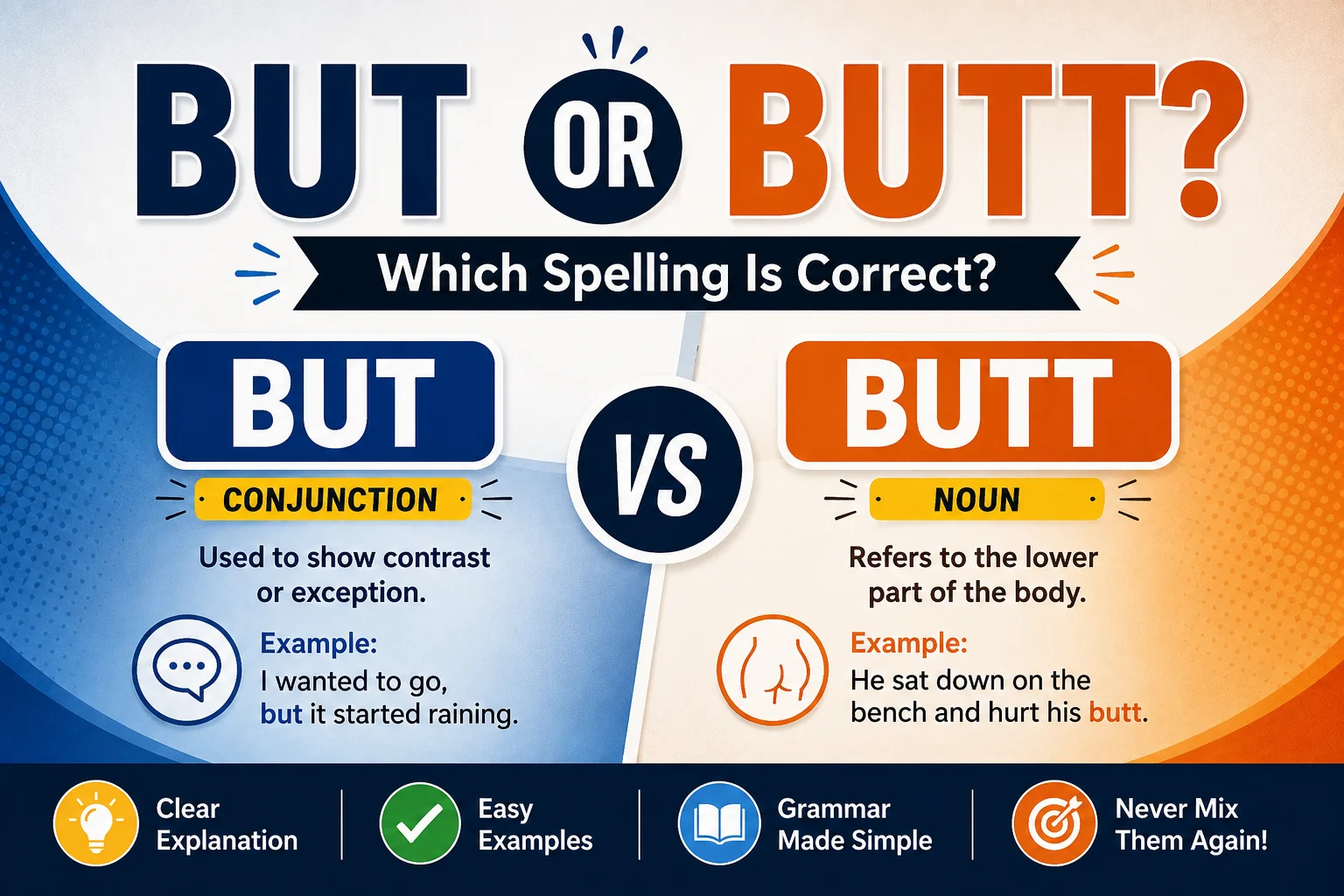
But is usually a conjunction or preposition meaning “except,” “however,” or “although.” Butt is a noun or verb that can mean the back part of the body, the thick end of something, or to hit with the head.
Have you ever typed but and wondered if you needed an extra t? These two words look almost the same, but one extra letter changes the meaning completely.
As an English teacher, I have seen this mistake many times in student writing. The confusion often happens because but and butt sound very similar in some forms of speech. Yet they do very different jobs in a sentence.
For example, you might write, “I wanted to go, but I was tired.” Here, but connects two ideas. If you write “He sat on his butt,” the word has a completely different meaning.
The good news is that the difference is easy to learn. Once you understand what each word means, you can choose the right spelling with confidence.
This guide explains but or butt, including their meanings, origins, grammar, common mistakes, pronunciation, real-world examples, and formal usage. By the end, you will know exactly when to use each word.
But or Butt – Quick Answer
But and butt are both correct English words, but they have different meanings and grammatical uses.
But
But is most often used to show a contrast between two ideas.
Examples:
- I wanted to go, but I was busy.
- She is young, but very smart.
- He studied hard, but he failed the test.
It can also mean except in some sentences:
Everyone came but John.
Butt
Butt has several meanings.
It can refer to:
- The back part of the body.
- The thick or lower end of something.
- A person who is the target of a joke or criticism.
- The act of hitting with the head.
Examples:
- He fell on his butt.
- Hold the butt of the tool firmly.
- She became the butt of the joke.
- The goat tried to butt the fence.
The simplest rule is:
But = contrast or exception
Butt = body part, end of something, target, or hit
The Origin and Background of But and Butt
Although but and butt look related, they developed from different historical forms and have different uses.
Where does “but” come from?
The word but has very old roots in English.
It developed from Old English forms such as būtan, which carried the sense of “outside” or “except.”
Over time, its use expanded.
Today, but is one of the most common conjunctions in English. It often introduces a contrast.
For example:
The test was difficult, but I passed.
The first part gives one idea. The second part gives an idea that contrasts with it.
But can also introduce an exception:
Everyone but Sarah agreed.
Here, but means except.
Where does “butt” come from?
Butt has a different history.
It has long been connected with the end or thick part of something. This idea appears in phrases such as the butt end of an object.
The word also developed meanings connected with the back part of the body and with hitting or pushing with the head.
That gives us several modern uses:
- butt of the body
- butt end
- butt of a joke
- to butt someone
So, while the words look similar, their meanings have developed in different ways.
But or Butt Explained — Key Differences
The easiest way to choose between but and butt is to look at the role the word plays in your sentence.
1. But shows contrast
Use but when two ideas do not fully agree.
I was tired, but I finished my work.
The speaker was tired. However, the work was completed.
Another example:
The phone is expensive, but it works very well.
The high price contrasts with its good performance.
2. But can mean “except”
But can sometimes mean except.
Everyone but Ali was ready.
This means:
Everyone except Ali was ready.
Another example:
I eat all fruits but bananas.
This means:
I eat all fruits except bananas.
3. Butt can refer to the body
In informal English, butt can mean a person’s backside.
For example:
The child fell on his butt.
I sat on my butt for two hours.
This use is common in casual speech. However, it is informal.
In formal writing, alternatives such as bottom, backside, or a more specific anatomical term may be better, depending on the context.
4. Butt can mean the end of something
Butt can describe the thick or lower end of an object.
For example:
Hold the butt of the handle firmly.
You may also see the phrase butt end, which means the thicker or rear end of something.
5. Butt can mean “hit with the head”
To butt means to strike or push with the head.
Animals such as goats are often described as butting objects or other animals.
Example:
The goat butted the gate.
It can also describe a person using their head as a weapon:
He butted the man during the fight.
Comparison Table: But vs Butt
| Term | Meaning | When to Use | Region/Context |
|---|---|---|---|
| But | Shows contrast | Connecting two opposing ideas | Standard English |
| But | Means “except” | Showing an exception | Standard English |
| Butt | Backside of the body | Informal conversation | Mainly casual English |
| Butt | Thick or rear end | Describing an object | General English |
| Butt | Target of a joke | Saying someone is mocked | General English |
| Butt | Hit with the head | Describing an action | General English |
Which Version Should You Use?
Your choice depends on your meaning.
For contrast → use but
Use but when you mean:
- however
- although
- in contrast
- except
Examples:
I called him, but he did not answer.
She is tired, but she keeps working.
For the body → use butt
Use butt when you mean the informal word for the backside.
He landed on his butt.
Remember that this meaning is casual.
For a formal report, medical document, or professional setting, choose a more suitable word.
For an object → use butt
If you mean the rear or thick end of something, butt can be correct.
Example:
The butt of the tool was made from wood.
For formal writing → be careful with “butt”
The word butt itself is not always informal. Some meanings are perfectly standard.
For example:
The butt of the rifle rested against his shoulder.
However, the body-part meaning is casual.
If you are writing a school essay, business report, or formal article, avoid using butt for the backside unless the context requires it.
Common Mistakes With But or Butt
Mistake 1: Adding an extra “t” to “but”
❌ I wanted to come, butt I was sick.
✅ I wanted to come, but I was sick.
Why?
You need the conjunction but to connect the two ideas.
Mistake 2: Using “but” for the body
❌ He fell on his but.
✅ He fell on his butt.
Why?
The body-part meaning requires butt with two t’s.
Mistake 3: Confusing “but” with “butt” in texting
❌ I am tired butt I will finish it.
✅ I am tired but I will finish it.
This mistake is common when people type quickly.
A simple proofreading trick helps: stop and ask what the word means.
If it means however, use but.
Mistake 4: Writing “butt” in formal contexts without thinking
❌ The patient complained about pain in his butt.
✅ The patient complained of pain in the buttocks.
The second version is more suitable for a medical context.
The best word depends on your audience and purpose.
Mistake 5: Confusing “butt” with “butt in”
Butt in is a phrasal verb.
It means to interrupt a conversation or interfere when you are not invited.
Example:
Please don’t butt in while they are talking.
Here, butt is part of the phrase butt in.
But or Butt in Real-World Examples
Seeing the words in different situations can make the difference much clearer.
1. Professional email
Subject: Meeting Update
I wanted to attend the meeting, but I have another appointment at that time.
Here, but shows contrast.
It is completely suitable for professional writing.
2. News headline
Prices Rise, but Demand Remains Strong
Here, but connects two contrasting facts.
Another example:
Officials Warn of Risks, but Work Continues
Again, but introduces a contrast.
3. Social media post
“I was going to stay home, but my friends convinced me to go out!”
This is a normal casual use of but.
For butt, you might see:
“I fell right on my butt today!”
That sentence is informal and conversational.
4. Formal report
“The first test produced poor results, but the second test was successful.”
But is suitable for formal writing because it clearly connects two contrasting points.
A technical document may also use butt when discussing the end of a physical object:
“The butt end of the component must remain free from damage.”
Here, butt has a technical meaning.
But or Butt — Pronunciation
Pronunciation can also help you remember the spelling.
But
But is pronounced roughly like “buht.”
It has one t at the end.
Butt
Butt is pronounced the same way in most varieties of English.
That is why these words can be confusing.
They are homophones in standard pronunciation. This means they sound the same but have different spellings and meanings.
The context tells you which word is meant.
Compare:
I wanted to go, but I stayed home.
with:
He sat on his butt.
The pronunciation is similar, but the meaning is completely different.
But or Butt — Data, Trends & Usage
The search intent behind but or butt is mainly informational.
People usually search for this pair because they want to:
- Check the correct spelling.
- Understand the difference.
- Improve their English writing.
- Learn which word fits a sentence.
- Understand informal expressions.
- Avoid spelling mistakes.
But is far more common in everyday English because it is a basic conjunction.
You will find it in conversations, emails, books, news reports, essays, and almost every other type of writing.
Butt is less common and has several specific meanings. Its body-part meaning is especially common in casual speech and social media.
The key lesson is simple: sound alone cannot tell you the spelling. You must look at the meaning.
Easy Memory Trick for But or Butt
Here is a quick way to remember the difference.
But = one T
Think:
One T = contrast.
I wanted to go, but I was busy.
Butt = two Ts
Think:
Two Ts = the backside.
He fell on his butt.
This trick is not a grammar rule. It is simply an easy way to remember the spelling.
You can also remember:
but = however
butt = backside
If you can replace the word with however, use but.
Example:
I was tired, but I worked.
→ I was tired; however, I worked.
That confirms that but is correct.
Frequently Asked Questions
Q: What does “but” mean?
A: But usually shows a contrast between two ideas. It can also mean except in some sentences.
Q: What does “butt” mean?
A: Butt can mean the back part of the body in informal English. It can also mean the thick end of an object, the target of a joke, or to hit with the head.
Q: Which is correct, but or butt?
A: Both are correct, but they have different meanings. Use but for contrast or exception and butt for its specific noun or verb meanings.
Q: Are but and butt pronounced the same?
A: Yes. In most standard varieties of English, but and butt are pronounced the same. Their different meanings and spellings come from context.
Q: Is “butt” a formal word?
A: Butt is a standard English word, but its meaning as a person’s backside is informal. In formal writing, another term may be more suitable.
Q: Can “but” mean “except”?
A: Yes. For example, “Everyone but John came” means “Everyone except John came.”
Q: What does “butt in” mean?
A: Butt in means to interrupt or enter a conversation without being invited. For example, “Please don’t butt in while we are talking.”
Conclusion
The difference between but or butt is easy once you focus on meaning.
Use but when you want to show contrast. It is also used to mean except in some sentences.
Use butt when you mean the backside, the end of an object, the target of a joke, or the action of hitting with the head.
The biggest challenge is pronunciation. In most English accents, but and butt sound the same. That means you cannot always rely on sound. You need to look at the sentence and ask what the word means.
For writing, remember the simple rule:
But = however or except.
Butt = body, end, target, or head-butt.
Once you remember that, this spelling choice becomes much easier.
Bookmark this guide so you never second-guess “but or butt” again, and share it with someone who is learning English.