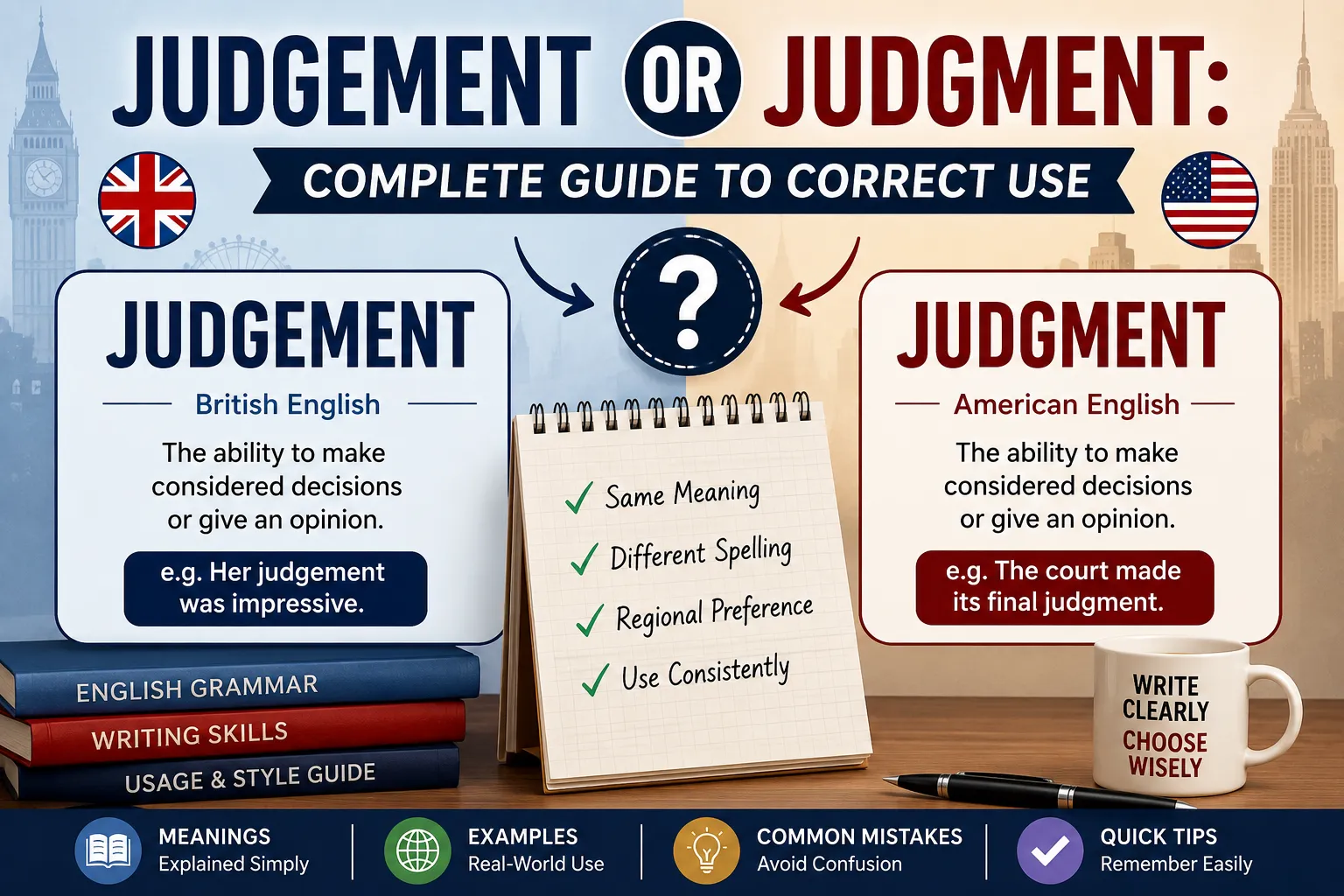
Judgement and judgment mean the same thing: a decision, opinion, or ability to form conclusions. The main difference is spelling. Judgment is more common in American English, while judgement often appears in British English.
Years ago, while editing content for a student magazine, I noticed something strange. One student wrote judgment, while another wrote judgement. Both students were confident. Both believed they were right.
Then the questions started.
“Which one is correct?”
“Is one a mistake?”
“Will teachers mark it wrong?”
I have seen this happen many times. The confusion feels real because both spellings appear online, in books, and even in official documents. You read one version on a website, then notice another version somewhere else. Suddenly you begin second-guessing yourself.
You may have searched for judgement or judgment because you are writing an essay, a business email, a school paper, or even a social media post. You simply want the right answer.
The good news is that this spelling puzzle is much easier than it looks. Once you understand where these words came from and when people use each version, the confusion disappears.
Let’s clear it up.
Judgement or Judgment – Quick Answer
Judgment and judgement have the same meaning. They both refer to a decision, opinion, conclusion, or ability to think wisely.
The biggest difference is spelling preference.
Real-world examples
American English:
“The court made its final judgment yesterday.”
British English:
“Her judgement was impressive during the debate.”
Both communicate the same idea.
The Origin / Background of Judgement or Judgment
The story starts many years ago.
The word came from the old French word jugement. Later it entered English and changed over time.
English spelling did not always follow strict rules. People often wrote words differently.
That created variation.
Eventually, American English began removing extra letters in some words. This made spelling shorter and simpler.
Examples include:
- Colour → Color
- Favourite → Favorite
- Judgement → Judgment
British English often kept older forms.
Confusion exists because dictionaries and style guides do not always agree. Some British publications still prefer judgement, while others accept judgment.
Legal writing also adds another twist.
Many legal systems use judgment even in places that normally use British spelling.
Judgement or Judgment Explained — Key Differences or Variations
The meaning stays the same.
The spelling changes based on context.
| Term | Meaning | When to Use | Region/Context |
|---|---|---|---|
| Judgment | Decision or opinion | American writing | United States |
| Judgement | Decision or opinion | British writing | UK and some Commonwealth regions |
| Legal Judgment | Official court decision | Legal documents | Global legal use |
Examples
Judgment
“Good judgment helps leaders make smart choices.”
Judgement
“Her judgement improved after experience.”
Legal judgment
“The court issued a final judgment.”
Which Version or Approach Should You Use?
Your audience matters.
- For students in the United States → use judgment because schools and style guides prefer it.
- For students in the UK → use judgement if your teacher follows British spelling.
- For business professionals → use judgment because it appears more often internationally.
- For legal writing → use judgment because legal systems commonly prefer it.
- For global or neutral writing → use judgment because more readers recognize it.
A simple rule works well:
Stay consistent.
Do not switch between both spellings in the same document.
Common Mistakes with Judgement or Judgment
People often make these mistakes.
Mistake 1
❌ Use both spellings in one article
✅ Pick one spelling style
Why it happens: Writers mix American and British English.
Mistake 2
❌ Assume one version is always wrong
✅ Understand that both versions exist
Why it happens: People expect only one correct spelling.
Mistake 3
❌ Use judgement in American academic writing
✅ Use judgment
Why it happens: Online sources vary.
Mistake 4
❌ Ignore your audience
✅ Match the spelling to readers
Why it happens: Writers focus only on personal preference.
Mistake 5
❌ Change spelling halfway through a report
✅ Keep one style throughout
Why it happens: Content comes from different sources.
Judgement or Judgment in Real-World Examples
You will see these words in many places.
Professional email
“Please use your best judgment before approving the final proposal.”
News headline
“Court delivers final judgment in major case.”
Social media post
“True sign of growth: learning to trust your own judgement.”
Formal document or report
“The committee exercised careful judgment during the review process.”
Judgement or Judgment — Data, Trends & Usage
Interest in judgement or judgment remains strong because many writers stop and question themselves before publishing.
Search intent category
Informational
People want the correct spelling and usage.
Popular audiences
- Students
- Teachers
- Bloggers
- Content writers
- Business professionals
- Legal professionals
Regions with high interest
- United States
- United Kingdom
- Canada
- Australia
Why this matters now
People write more online than ever before.
Emails, blogs, reports, and social posts appear every day. Small spelling choices shape how professional your writing looks.
Standalone Comparison Table
| Term/Variant | Meaning | Region/Context | Best Used When |
|---|---|---|---|
| Judgment | Decision or opinion | American English | Academic and professional writing |
| Judgement | Decision or opinion | British English | British communication |
| Legal Judgment | Court decision | Legal context | Official legal documents |
| Personal Judgment | Individual opinion | General use | Daily communication |
Frequently Asked Questions
Q: What does judgement or judgment mean?
A: Both words mean a decision, opinion, or ability to think carefully and reach conclusions.
Q: How do you use judgment correctly?
A: Use it according to your audience. American English usually prefers judgment, while British English may use judgement.
Q: Judgement vs judgment — what is the difference?
A: The meaning is identical. The difference mainly comes from spelling traditions and regional preferences.
Q: Is judgment acceptable in formal writing?
A: Yes. It is widely accepted and commonly used in academic, business, and legal writing.
Q: Which version is correct — judgement or judgment?
A: Both are correct. The better choice depends on whether you follow American or British English.
Q: Where does judgment come from?
A: It comes from older French and English language roots connected to decision-making and forming opinions.
Q: Can judgment be used in legal writing?
A: Yes. Legal documents commonly use judgment, even in many places that follow British English.
Conclusion
The debate around judgement or judgment looks bigger than it really is. Both spellings carry the same meaning. The difference mostly comes from regional language habits.
You learned that judgment is common in American English and legal writing. You also saw that judgement often appears in British English. Most importantly, you discovered that consistency matters more than anything else.
Remember these key points:
- Both spellings are correct
- Audience matters
- Legal writing usually prefers judgment
- Keep one style throughout your work
Now you know exactly how to use judgement or judgment without doubt. Bookmark this guide so you never pause over this spelling choice again. Share it with someone who keeps changing between both versions.