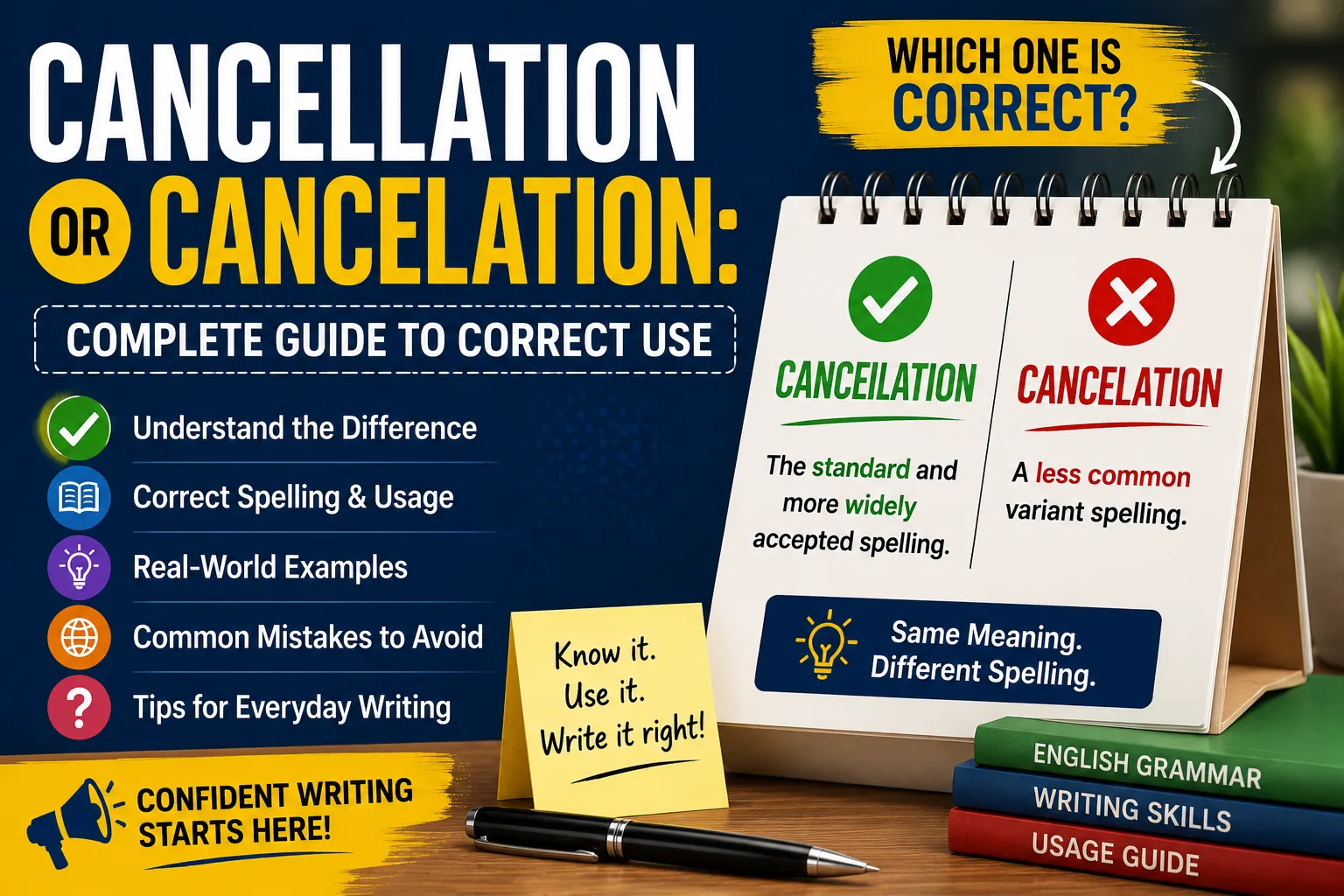
Cancellation and cancelation both mean the act of stopping, ending, or calling something off. Cancellation is the standard and more widely accepted spelling, while cancelation exists but appears less often.
A few years ago, I was reviewing website content for a travel company. Everything looked perfect until I reached one page. I noticed something odd. One section said flight cancellation policy, while another said flight cancelation policy.
I paused.
At first, I thought it was just a typing mistake. Then I saw the same spelling in another document. Suddenly I had the same question many writers have:
“Wait… are both correct?”
That confusion happens more often than people think. You write an email, school paper, blog post, or business report. Then spell-check highlights one version. Another website uses the other version. You stop writing and start searching.
You probably landed here for the same reason. You want one clear answer without reading ten different pages.
The good news is that the difference is simple. Once you understand where these spellings came from and how people actually use them, choosing the right one becomes easy.
Let’s clear up the confusion.
Cancellation or Cancelation – Quick Answer
Cancellation and cancelation mean stopping or ending something.
The difference is spelling frequency and usage.
Cancellation is the standard spelling used by most dictionaries and style guides.
Real-world examples
Example 1:
“The airline announced a flight cancellation due to weather.”
Example 2:
“The event cancelation notice arrived yesterday.”
Both can appear in writing, but one is much more common.
The Origin / Background of Cancellation or Cancelation
The word began with cancel, which came from older Latin and French roots.
Originally, the word meant crossing something out.
People later used it to describe ending agreements, plans, and events.
English created nouns from verbs by adding endings. Sometimes spelling patterns changed during that process.
That is where confusion began.
Many English words double letters when adding endings:
- Travel → Travelling
- Refer → Referring
- Cancel → Cancellation
American English often removes extra letters in some words.
Yet cancellation kept the double l in most modern usage.
Because of that, cancelation survived but became less common.
Cancellation or Cancelation Explained — Key Differences or Variations
The meaning does not change.
Only the spelling changes.
| Term | Meaning | When to Use | Region/Context |
| Cancellation | Ending or stopping something | General writing | Global |
| Cancelation | Ending or stopping something | Less common writing | Limited usage |
| Cancellation Policy | Rules for ending services | Travel and business | Global |
Examples
Cancellation
“The concert cancellation disappointed fans.”
Cancelation
“A meeting cancelation email was sent.”
You may see cancelation, but cancellation appears much more often.
Which Version or Approach Should You Use?
Your audience matters.
- For students → use cancellation because schools commonly expect it.
- For bloggers and writers → use cancellation because readers recognize it quickly.
- For business professionals → use cancellation because companies and documents usually follow standard spelling.
- For global or neutral use → use cancellation because it creates less confusion.
A simple rule helps:
Choose cancellation and stay consistent.
Common Mistakes with Cancellation or Cancelation
People often make similar mistakes.
Mistake 1
❌ cancelation policy
✅ cancellation policy
Why it happens: Writers assume one l stays after adding an ending.
Mistake 2
❌ Use both spellings in one document
✅ Pick one spelling style
Why it happens: Content comes from different sources.
Mistake 3
❌ Trust every online source
✅ Follow standard dictionaries
Why it happens: Websites sometimes copy errors.
Mistake 4
❌ Depend only on memory
✅ Check style guides
Why it happens: English spelling rules vary.
Mistake 5
❌ Assume shorter means correct
✅ Check actual usage patterns
Why it happens: People expect simplified spelling.
Cancellation or Cancelation in Real-World Examples
You see this word almost everywhere.
Professional email
“Please review the cancellation request before processing the refund.”
News headline
“Flight cancellation affects thousands of travelers.”
Social media post
“Unexpected class cancellation means coffee and movies today.”
Formal document or report
“The company policy explains conditions for service cancellation.”
Cancellation or Cancelation — Data, Trends & Usage
Interest in cancellation or cancelation remains high because people frequently stop while writing and question themselves.
Search intent category
Informational
People want spelling guidance and correct usage.
Audiences with strong interest
- Students
- Bloggers
- Teachers
- Content writers
- Business professionals
- Travel companies
Regions with high searches
- United States
- United Kingdom
- Canada
- Australia
Why this matters now
People write more emails, articles, and online content than before.
Small spelling choices shape credibility. Readers notice details quickly.
Standalone Comparison Table
| Term/Variant | Meaning | Region/Context | Best Used When |
| Cancellation | Ending something | Standard English | Professional and academic writing |
| Cancelation | Ending something | Less common usage | Rare contexts |
| Cancellation Policy | Rules for ending services | Business and travel | Customer information |
| Event Cancellation | Stopping planned activities | General use | Announcements |
Frequently Asked Questions
Q: What does cancellation or cancelation mean?
A: Both words mean ending, stopping, or calling something off. The meaning stays the same regardless of spelling.
Q: How do you use cancellation correctly?
A: Use cancellation in emails, school work, reports, and professional writing. It is the standard spelling most readers expect.
Q: Cancellation vs cancelation — what is the difference?
A: The meaning is identical. The difference is that cancellation is much more common and widely accepted.
Q: Is cancellation acceptable in formal writing?
A: Yes. It is the preferred choice in business, education, and professional documents.
Q: Which version is correct — cancellation or cancelation?
A: Both exist, but cancellation is generally considered the safer and more standard option.
Q: Where does cancellation come from?
A: The word developed from cancel, which has roots in older French and Latin language history.
Q: Can cancellation be used in business writing?
A: Yes. Businesses frequently use it in refund policies, agreements, contracts, and customer service communication.
Conclusion
The debate around cancellation or cancelation becomes easy once you know one key fact. Both forms exist, but they are not used equally.
You learned that cancellation is the standard spelling found in most dictionaries and professional writing. You also discovered that cancelation appears sometimes but is much less common.
Remember these key points:
- Both spellings carry the same meaning
- Cancellation is the preferred form
- Professional writing usually uses cancellation
- Consistency matters
Small spelling choices can make your writing feel stronger and more polished. A tiny extra letter may seem unimportant, but readers notice details.
Now you know exactly how to use cancellation or cancelation with confidence. Bookmark this guide so you never stop and wonder again. Share it with someone who keeps second-guessing this spelling