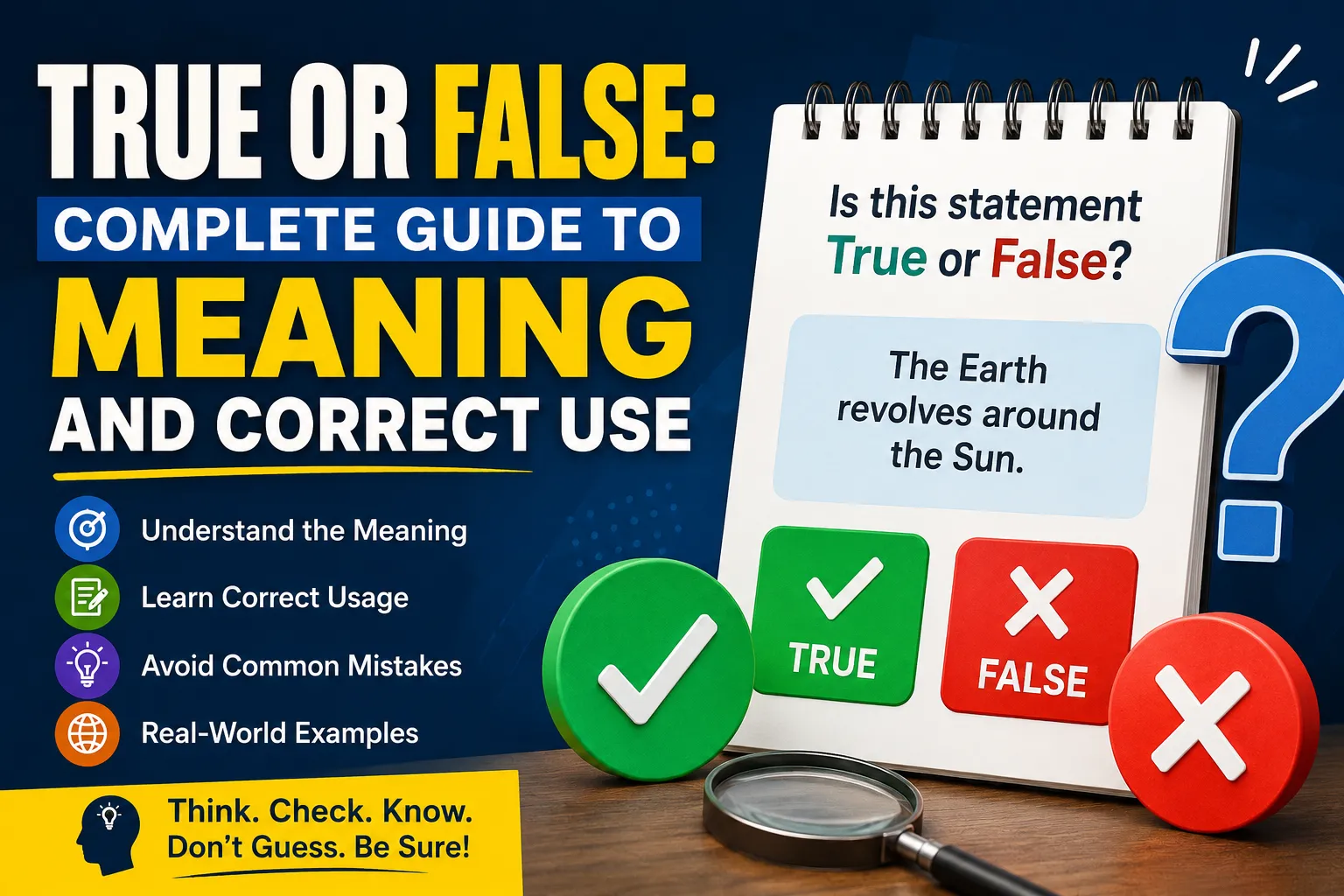
True or false means deciding whether a statement is correct or incorrect. People use it in quizzes, school tests, games, surveys, and daily conversations to check facts or understanding.
I still remember helping a young student prepare for a school exam years ago. The student looked nervous and said, “I know the lesson, but I keep getting the true or false questions wrong.” That surprised me. The answers looked simple. You only had two choices.
Then I watched what happened.
The student read too fast. Small words changed everything. Words like always, never, and only caused mistakes. The problem was not knowledge. The problem was understanding.
Many people search for true or false because it feels easy at first. Yet this small phrase creates confusion. Students face it in exams. Teachers use it in classrooms. Social media users see claims every day and wonder if they are real.
You may think true or false is just a simple choice. But there is more behind it. Understanding it can help you score better in tests, avoid false information, and think more clearly.
Let’s break it down in a simple way.
True or False – Quick Answer
True or false is a method used to judge if something is right or wrong.
You usually get a statement and choose between two options:
- True = the statement is correct
- False = the statement is incorrect
Real-world examples
Example 1:
“Water boils at 100°C.”
Answer: True
Example 2:
“The sun moves around Earth.”
Answer: False
The idea sounds easy. Still, many mistakes happen because wording matters.
The Origin / Background of True or False
The words true and false are very old.
The word true came from old language roots meaning faithful, honest, and real.
The word false came from words linked to deception or being wrong.
Teachers later used these terms in education. Schools needed fast ways to test knowledge. Instead of long written answers, students could simply mark true or false.
Over time, the phrase moved beyond schools.
Now people use it in:
- Exams
- Quiz shows
- Mobile apps
- Fact-checking websites
- Social media posts
- Online surveys
Confusion exists because people sometimes use the phrase in different ways.
Some use it as a question.
Example:
“True or false: Cats can breathe underwater.”
Others use it casually.
Example:
“True or false — pineapple belongs on pizza.”
True or False Explained — Key Differences or Variations
People often think all true or false statements work the same way. They do not.
Some statements are facts. Others are opinions.
| Term | Meaning | When to Use | Region/Context |
|---|---|---|---|
| True | Fact is correct | Confirming accuracy | Global |
| False | Fact is wrong | Rejecting incorrect claims | Global |
| Fact | Can be proven | Science, education, reports | Global |
| Opinion | Personal belief | Discussions and social media | Global |
Examples
Fact:
“Earth has one moon.”
This can be checked.
Opinion:
“Chocolate ice cream tastes better than vanilla.”
This depends on personal preference.
People often confuse opinions with facts. That creates errors.
Which Version or Approach Should You Use?
Different situations need different approaches.
- For students → use careful reading because small words change meaning.
- For teachers → use clear statements because confusing wording hurts learning.
- For researchers or professionals → use fact-based statements because accuracy matters.
- For global or neutral use → use simple language because everyone understands it easily.
A strong rule helps.
Read twice before answering once.
That small habit saves many mistakes.
Common Mistakes with True or False
Many people repeat the same errors.
Mistake 1
❌ “I answered before reading carefully.”
✅ Read the whole sentence first.
Why it happens: People rush.
Mistake 2
❌ Ignore words like always or never
✅ Notice strong words carefully.
Why it happens: Extreme words often change the answer.
Mistake 3
❌ Mix opinions with facts
✅ Ask if the statement can be proven
Why it happens: Social media mixes both together.
Mistake 4
❌ Guess without checking facts
✅ Look for evidence
Why it happens: People trust memory too much.
Mistake 5
❌ Focus on one word only
✅ Understand the full sentence
Why it happens: Readers scan too fast.
True or False in Real-World Examples
You see true or false almost everywhere.
Professional email
“Please review the report and confirm whether the following statement is true or false before approval.”
News headline
“Experts examine whether online health claims are true or false.”
Social media post
“True or false: Drinking water before meals helps reduce hunger?”
Formal document or report
“Survey participants marked each statement as true or false during the research process.”
True or False — Data, Trends & Usage
Interest in true or false stays strong because people constantly need answers.
Search behavior usually shows interest from:
- Students
- Teachers
- Quiz creators
- Parents
- Trivia fans
- Fact-check readers
Search intent category
Informational
People want to understand meaning or find answers.
Regions and audiences
Many searches come from:
- English-speaking countries
- Education communities
- Online learning users
Why this matters now
False information spreads very fast online.
People share posts in seconds.
Many users now ask one question before believing something:
Is it true or false?
That habit matters more today than ever before.
Standalone Comparison Table
| Term/Variant | Meaning | Region/Context | Best Used When |
|---|---|---|---|
| True | Correct statement | Global | Confirming facts |
| False | Incorrect statement | Global | Rejecting wrong information |
| Fact Check | Verify information | News and media | Testing claims |
| Opinion | Personal view | Social discussion | Sharing beliefs |
| Quiz Statement | Learning question | Education | Testing knowledge |
Frequently Asked Questions
Q: What does true or false mean?
A: True or false means deciding whether a statement is correct or incorrect. It is often used in tests, games, and learning activities.
Q: How do you use true or false correctly?
A: Read the statement carefully and look at every word. Then decide if the information matches facts or evidence.
Q: True or false vs fact check — what’s the difference?
A: True or false gives two answer choices. Fact-checking is a process that investigates and verifies information more deeply.
Q: Is true or false acceptable in formal writing?
A: Yes. Schools, research papers, reports, and surveys often use true or false questions or statements.
Q: Which version is correct — true/false or true or false?
A: Both are used. True or false is more natural in sentences. True/false often appears in forms, quizzes, and labels.
Q: Where does true or false come from?
A: The words come from older language roots linked to honesty and deception. Schools later adopted them as learning tools.
Q: Can true or false be used in social media content?
A: Yes. Many creators use true or false questions because they encourage comments and interaction.
Conclusion
True or false may look simple, but small details matter. You learned that true means correct and false means incorrect. You also saw how wording changes meaning. Tiny words can turn an answer around very fast.
You discovered common mistakes people make. You saw how the phrase works in school, work, news, and social media. You also learned that facts and opinions are not the same thing.
The biggest lesson is simple.
Do not rush.
Read carefully. Think for a moment. Look for proof when needed.
That small habit can improve your grades, sharpen your thinking, and help you avoid false information online.
Now you know exactly how to use true or false — go try it in your next quiz, conversation, or piece of writing. Bookmark this guide so you never second-guess true or false again.
Prayers for Guest Speakers 🙏✨