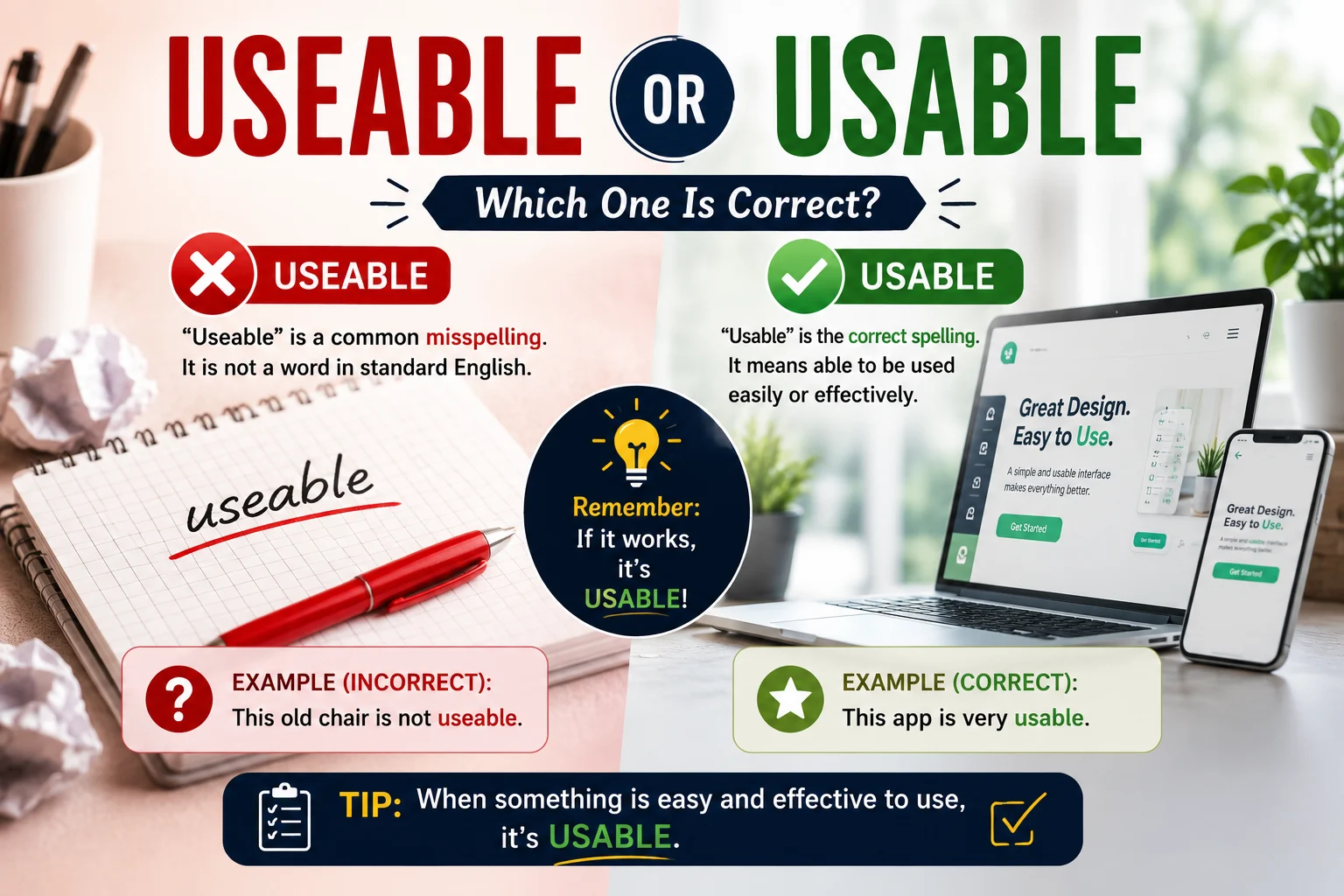
Have you ever paused while writing and wondered whether useable or usable is the correct spelling? You’re not alone. This question is common because both words appear online, in books, and even in professional documents. Seeing two versions of the same word can make it difficult to know which one you should use.
The good news is that both useable and usable are recognized English spellings. However, usable is the preferred and much more common form in modern English. It appears more often in dictionaries, style guides, business writing, and everyday communication. While useable is not wrong, it is considered a less common variant.
In this guide, you’ll learn the difference between useable or usable, discover where the spellings came from, understand regional preferences, and see practical examples. You’ll also find comparison tables, common mistakes, and FAQs to help you choose the right spelling with confidence. By the end, you’ll know exactly which version fits your audience and writing style.
Useable or Usable – Quick Answer
Both usable and useable are correct.
However:
- Usable is the preferred and standard spelling.
- Useable is an accepted but less common variant.
Both words mean able to be used or fit for a purpose.
Real-Life Examples
- This chair is still usable after the repair.
- The software is simple and usable for beginners.
- The old building is useable, but it needs some improvements.
The Origin of Useable or Usable
The adjective comes from the word use, combined with the suffix -able, meaning “capable of.”
Historically, English allowed two spellings:
- Usable
- Useable
Over time, writers, publishers, and dictionaries began favoring usable because it is shorter and follows modern spelling preferences.
Today:
- Usable is the standard spelling in most English dictionaries.
- Useable remains acceptable but is rarely preferred.
British English vs American English Spelling
Unlike many spelling differences, there is no major regional rule for these words.
Both American and British English generally prefer usable.
| Version | Spelling | Region | Example Sentence |
|---|---|---|---|
| Preferred | Usable | US, UK, Canada, Australia | The report is now usable after editing. |
| Less Common Variant | Useable | Occasionally seen in all regions | The equipment is useable after repairs. |
Key Point
- Usable is the standard spelling worldwide.
- Useable is accepted but uncommon.
Which Spelling Should You Use?
For a US Audience
Use usable.
It is the spelling most readers expect in American English.
For a UK or Commonwealth Audience
Choose usable.
British publishers and style guides also prefer this spelling.
For a Global or SEO Audience
Always use usable.
It is more familiar to readers and matches the spelling found in most dictionaries and search results.
Common Mistakes with Useable or Usable
Many writers are unsure which spelling is preferred.
| Incorrect or Less Preferred | Better Choice |
|---|---|
| useable (when consistency matters) | usable |
| useble | usable |
| usible | usable |
| usabel | usable |
Other Common Mistakes
- Mixing usable and useable in the same article.
- Assuming useable is the only correct spelling.
- Thinking one spelling belongs only to British English.
Useable or Usable in Everyday Examples
Emails
The updated template is now usable for all departments.
News Headlines
New Community Center Is Fully Usable After Renovation
Social Media
Finally! My old laptop is usable again.
Formal Writing
The revised document is now usable for training purposes.
Useable or Usable – Google Trends & Usage
People often search for useable or usable because they notice both spellings in different sources.
In modern English, usable is far more common in books, newspapers, websites, business documents, and educational materials. Most dictionaries list it as the preferred spelling.
The variant useable still appears from time to time, especially in older publications or personal writing. However, many editors and style guides recommend usable because it is shorter and more widely recognized.
For clear communication and better consistency, usable is usually the best choice.
Useable vs Usable Comparison Table
| Feature | Useable | Usable |
|---|---|---|
| Correct spelling | ✅ Yes | ✅ Yes |
| Preferred spelling | No | Yes |
| Common in modern English | Less common | Very common |
| Found in dictionaries | Yes | Yes |
| Used in formal writing | Sometimes | Yes |
| Recommended for SEO | No | Yes |
| Best for academic writing | Acceptable | Recommended |
| Best for business writing | Acceptable | Recommended |
Frequently Asked Questions
Is useable or usable correct?
Both are correct, but usable is the preferred spelling in modern English.
Why is usable more common?
Most dictionaries, publishers, and style guides recommend usable because it is simpler and more widely accepted.
Is useable wrong?
No. Useable is an accepted spelling, but it is much less common.
Which spelling should I use in professional writing?
Use usable. It is the standard choice for business, academic, and formal writing.
Do British and American English use different spellings?
No. Both generally prefer usable.
Does Google recognize both spellings?
Yes. Search engines understand both words, but usable is much more common in online content.
Should I avoid useable?
You don’t have to avoid it completely, but usable is usually the better choice because it is the preferred standard spelling.
Conclusion
Choosing between useable or usable is easier than it first appears. Both spellings are correct and mean “able to be used.” However, usable has become the standard form in modern English and is preferred by dictionaries, publishers, educators, and professional writers around the world. While useable is still accepted, it appears much less often and may seem outdated to some readers.
If you’re writing an email, article, report, website, or academic paper, usable is the safest and most natural choice. It works well for American, British, and international audiences, making your writing clear and consistent.
The key is consistency. Choose one spelling and use it throughout your document. In most situations, usable is the best option because it matches current writing standards and reader expectations. By following this simple rule, you’ll never have to wonder about useable or usable again.