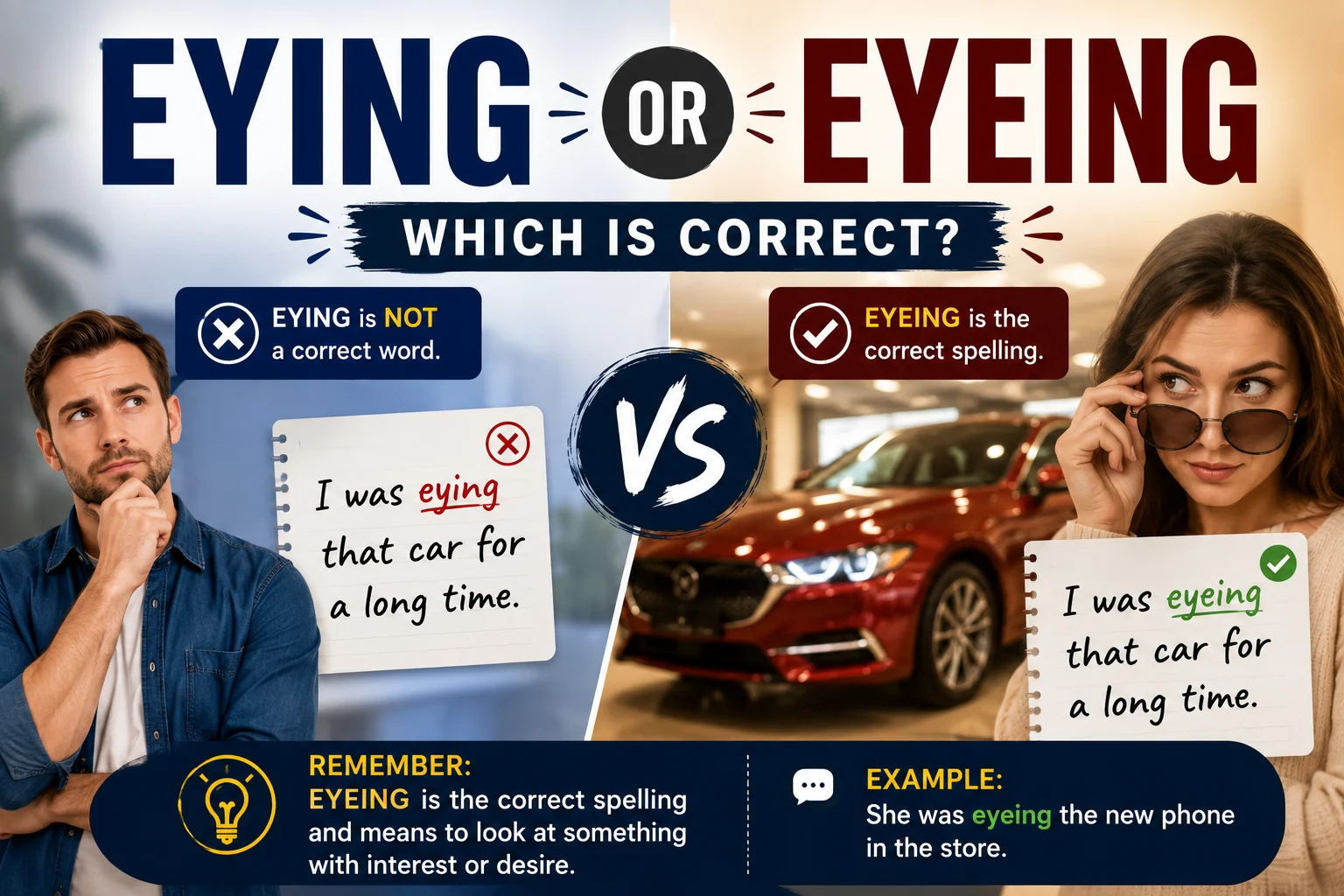
Both spellings are correct, but eyeing is the more common and widely accepted form, while eying is a shorter variant used less often.
Have you ever wondered whether you should write eying or eyeing? You are not alone. Many English learners, students, and writers search for this question because both spellings appear online. This can make it difficult to know which one is correct.
The keyword eying or eyeing is a common spelling question. The confusion happens because the verb eye ends with the letter e, and people are unsure whether they should keep or remove it before adding -ing. Choosing the correct spelling helps your writing look more natural and professional.
In this guide, you will learn the difference between eying and eyeing, why both spellings exist, and which one is more common in different types of English. You will also see simple examples, common mistakes, and practical tips. By the end of this article, you will know exactly which spelling to use with confidence.
Eying or Eyeing – Quick Answer
Both “eying” and “eyeing” are correct. They have the same meaning: looking at someone or something with interest, attention, or desire.
The main difference is spelling preference.
- Eyeing is the more common spelling in American English.
- Eying is accepted and appears more often in British English, although eyeing is also widely used there.
Examples
- She was eyeing the new laptop in the store.
- He kept eying the last slice of pizza.
- The dog was eyeing the food on the table.
The Origin of Eying or Eyeing
The verb eye comes from the Old English word ēage, meaning the organ used for sight. Over time, eye also became a verb, meaning “to look at carefully” or “to watch with interest.”
When adding -ing to the verb eye, writers have used both eying and eyeing.
Many modern dictionaries list both spellings as correct. However, eyeing became more common because it keeps the base word eye easy to recognize. This spelling also helps readers avoid confusion.
British English vs American English Spelling
Unlike many English words, this difference is based more on usage preference than strict spelling rules.
| Version | Spelling | Region | Example Sentence |
|---|---|---|---|
| American English | Eyeing | United States | She is eyeing a new apartment. |
| British English | Eying or Eyeing | United Kingdom | He was eying the prize carefully. |
| Global English | Eyeing | International | Investors are eyeing new opportunities. |
Which Spelling Should You Use?
Choose the spelling that best matches your audience.
For a US Audience
Use eyeing. It is the standard and most common spelling in American English.
For a UK or Commonwealth Audience
Both eying and eyeing are accepted. However, eyeing is becoming more common in modern publications.
For a Global or SEO Audience
Use eyeing. It is easier to recognize and is the spelling most readers expect. Using one spelling consistently also improves readability.
Common Mistakes with Eying or Eyeing
Here are some mistakes people often make.
Incorrect
- She was eye-ing the new phone.
- He was eyeing the prize. (Less common spelling pattern.)
- Mixing eying and eyeing in the same article.
Correct
- She was eyeing the new phone.
- He kept eying the prize. (Accepted, especially in British English.)
- Choose one spelling and use it consistently.
Eying or Eyeing in Everyday Examples
Emails
- We are eyeing a new office location.
- Our team is eying several possible suppliers.
News Headlines
- Company Eyeing International Expansion
- Investors Eying New Market Opportunities
Social Media
- I’m eyeing those new sneakers.
- Definitely eying this vacation spot!
Formal Writing
- Researchers are eyeing new treatment methods.
- The organization is eying future partnerships.
Eying or Eyeing – Google Trends & Usage
People often search for eying or eyeing because both spellings appear in books, articles, and online content.
In general, eyeing is more common in modern writing, especially in the United States and on international websites. Eying also appears in dictionaries and British publications but is seen less often.
For SEO and general readability, eyeing is usually the safer choice because it matches what most readers expect.
Comparison Table
| Feature | Eying | Eyeing |
|---|---|---|
| Meaning | Looking at carefully | Looking at carefully |
| Correct? | Yes | Yes |
| More Common | Less common | More common |
| American English | Rare | Preferred |
| British English | Accepted | Also accepted |
| Best for SEO | Acceptable | Recommended |
| Meaning Difference | None | None |
FAQs
Is eying or eyeing correct?
Both spellings are correct. Eyeing is simply more common in modern English.
Which is more common, eying or eyeing?
Eyeing is more widely used, especially in American English and online writing.
Is eying wrong?
No. Eying is an accepted spelling found in many dictionaries.
Why do both spellings exist?
Different spelling traditions developed over time, and both forms remained acceptable.
Should I use eyeing for SEO?
Yes. Eyeing is generally the better choice because it is more familiar to readers.
Do eying and eyeing have different meanings?
No. They have exactly the same meaning.
Conclusion
Choosing between eying or eyeing is easier once you understand the difference. Both spellings are correct and both mean looking at someone or something with interest or attention. The difference is mainly one of spelling preference, not meaning.
If you are writing for an American audience or a global website, eyeing is the better choice because it is more common and easier for readers to recognize. If you are writing for a British audience, eying is also accepted, although eyeing appears frequently there as well.
The most important rule is to stay consistent. Do not switch between the two spellings in the same document. Choosing one version and using it throughout your writing makes your content look polished and professional. With this simple guideline, you can confidently decide whether to write eying or eyeing in any situation.