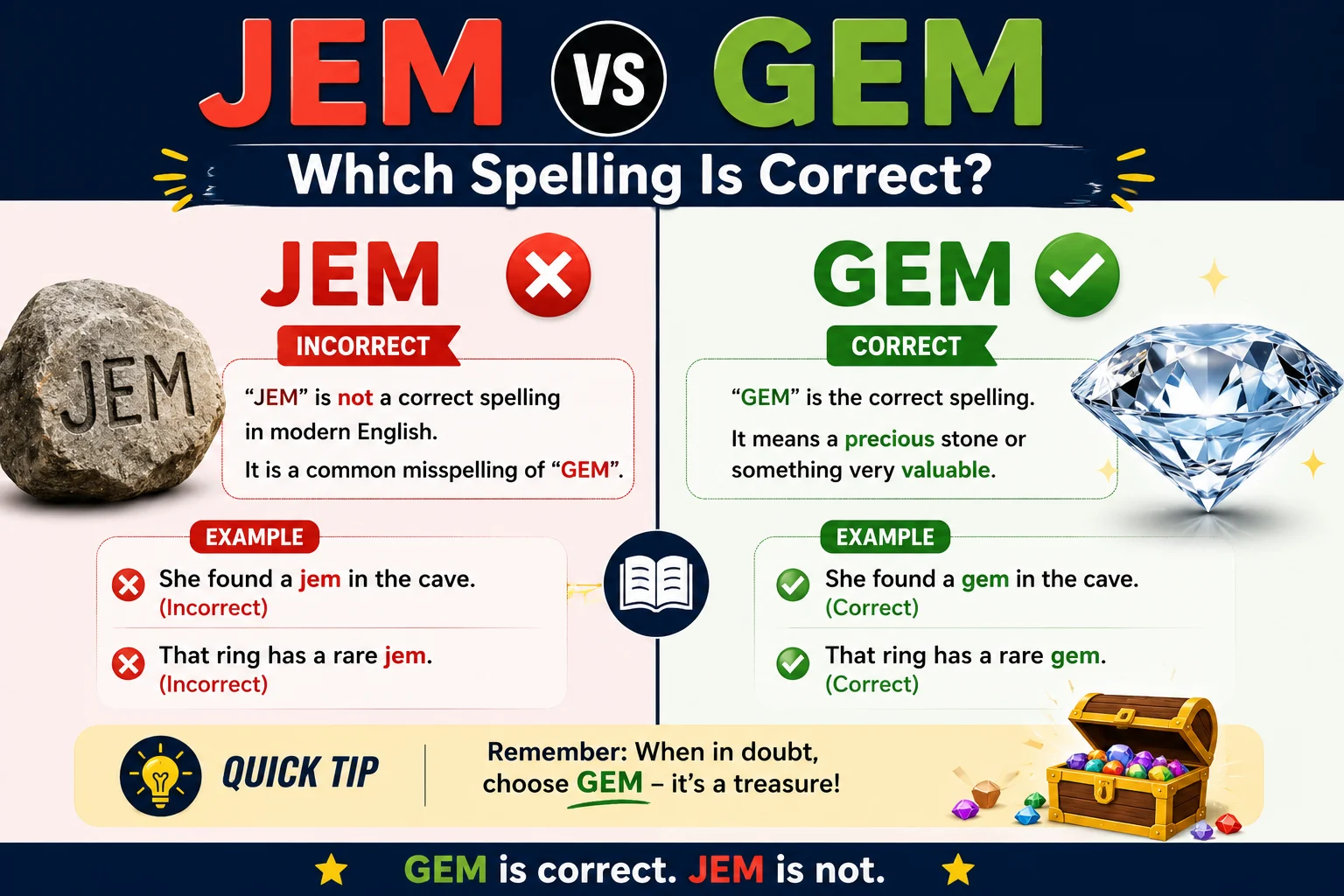
Gem is the correct spelling for a precious stone or something highly valued. Jem is usually a misspelling, although it can appear as a name or other proper noun.
Have you ever typed a word, looked at it twice, and thought, “Wait, is that really how it is spelled?” Jem or gem is one of those small spelling doubts that can make even a confident writer stop.
I have seen this kind of mistake many times while helping learners improve their English. The problem is easy to understand. The letters j and g can sometimes create similar sounds in English. Words such as gem, general, and giant use g to make a soft sound. That can make jem look possible.
But English spelling does not always follow sound alone.
If you are writing about a diamond, a ruby, a hidden treasure, or a person who is special and valuable, the standard spelling is gem. The word can also be used in a figurative way. For example, you might call a small restaurant “a hidden gem.”
So, which one should you use? When is jem acceptable? Where did gem come from? And why does this spelling cause confusion?
Let’s make the answer simple.
Jem or Gem – Quick Answer
The correct standard English spelling is gem.
Gem can mean a precious or semiprecious stone. It can also describe something that is especially good, beautiful, useful, or valuable.
Examples
- She wore a beautiful gem on her necklace.
- This little bookstore is a hidden gem.
- Your idea is a real gem.
Jem is not the standard spelling of this word.
However, Jem can be used as a proper name. For example, it may be a person’s name or part of a title. In that case, the spelling depends on the specific name.
The simple rule
Gem = standard English word
Jem = usually a name or a misspelling
If you are talking about a valuable stone or something special, choose gem.
The Origin and Background of Gem
The spelling gem has a long history.
English received the word through Old French, where forms related to gemme were used for a precious stone. The word ultimately goes back to Latin gemma, meaning a precious stone, jewel, or bud.
Over time, the word became established in English as gem.
That history helps explain why gem is the accepted spelling today. The g is part of the traditional spelling that English inherited and developed.
Why does “jem” look possible?
The confusion comes mainly from pronunciation.
In gem, the letter g has a soft sound:
gem → /dʒem/
That sound is similar to the sound represented by j in words such as:
- jam
- job
- jump
- just
So a learner may hear gem and naturally think it should be spelled jem.
English has many spelling patterns that do not match pronunciation perfectly. That is why listening to a word is not always enough to know its spelling.
A useful memory trick
Think of:
G + EM = GEM
You can connect it with other common words beginning with g:
- gem
- gentle
- general
- giant
- genuine
The pronunciation can change, but the spelling still matters.
Jem or Gem Explained — Key Differences
The two forms look almost identical, but they do not have the same status in standard English.
| Term | Meaning | When to Use | Region/Context |
|---|---|---|---|
| gem | A precious stone or something highly valued | Standard English writing | English worldwide |
| jem | Usually a proper name or misspelling of gem | Only when it is an established name | Specific names or informal contexts |
1. Gem as a precious stone
The most basic meaning of gem is a valuable stone used in jewelry.
For example:
The ring contains a blue gem.
A gem may be a diamond, ruby, sapphire, emerald, or another valued stone.
2. Gem as something valuable
Gem does not always refer to jewelry.
English speakers often use it to describe something that is excellent or special.
For example:
That old café is a hidden gem.
The café is not literally a stone. The phrase means that the café is a wonderful place that many people do not know about.
You can also describe a person as a gem:
My teacher is a gem.
Here, gem means a very kind, helpful, or valuable person.
3. Jem as a name
Jem can be a personal name.
For example:
Jem is coming to the meeting tomorrow.
Here, Jem is not being used to mean a precious stone. It is a person’s name, so the spelling can be correct.
This is an important distinction.
Jem is not automatically wrong. It is wrong when you use it as the ordinary spelling of the word meaning a precious stone or something valuable.
Which Version Should You Use?
For most English writing, the answer is simple:
For students → use gem
If you are writing an essay, homework, blog post, or exam answer, use gem when you mean a precious stone or something valuable.
Example:
The museum displayed a rare gem.
For professional writers → use gem
In emails, reports, articles, and business writing, gem is the standard form.
Example:
The report identified several gems of useful information.
For names → use Jem when that is the person’s established name
If someone is named Jem, do not change the spelling to Gem.
Example:
Jem sent the message this morning.
Names have their own spelling rules. A person’s chosen or official name should be kept as written.
For global English → use gem
If you mean the common English word, gem is the safest choice.
It is understood and accepted across major varieties of English, including British and American English.
Common Mistakes with Jem or Gem
The most common mistake is simple: using jem when you mean gem.
| Mistake | Correction | Why? |
|---|---|---|
| This ring has a rare jem. | This ring has a rare gem. | Gem is the standard spelling. |
| The museum displayed a precious jem. | The museum displayed a precious gem. | Use gem for a valuable stone. |
| That restaurant is a hidden jem. | That restaurant is a hidden gem. | Hidden gem is the standard phrase. |
| She is a real jem. | She is a real gem. | Gem can describe a wonderful person. |
| Jem is a precious stone. | Gem is a precious stone. | Jem is not the standard common noun. |
Mistake 1: Spelling by sound
You may hear /dʒem/ and think the word begins with j.
That is understandable. But the correct spelling is gem.
Mistake 2: Writing “hidden jem”
The phrase hidden gem is very common.
For example:
This beach is a hidden gem.
Do not write:
This beach is a hidden jem.
Mistake 3: Changing a person’s name
The opposite mistake can also happen.
If someone’s name is Jem, do not automatically change it to Gem.
For example:
Jem is my friend.
Here, Jem can be perfectly correct because it is a name.
Jem or Gem in Real-World Examples
Seeing the word in different settings makes the difference easier to remember.
1. Professional email
Subject: A Gem of an Idea
Thank you for sharing your proposal. I think you have found a real gem of an idea that could help the team.
Here, gem means something excellent or valuable.
2. News article
Local Library Becomes a Hidden Gem for Students
The word gem is used figuratively. It tells readers that the library is a valuable place that deserves more attention.
3. Social media post
Just found a little gem of a café downtown. Great food and a quiet atmosphere!
Again, gem means something especially good.
4. Formal report
The survey revealed several gems of information that may help improve the service.
The word means useful or valuable pieces of information.
5. Jewelry description
The necklace features a small emerald gem set in gold.
This is the literal meaning of gem.
6. Personal description
She has always been a gem of a friend.
Here, gem means someone wonderful and valuable.
Gem vs. Jewel: What’s the Difference?
Gem and jewel are close in meaning, but they are not always interchangeable.
A gem is usually a valuable or attractive stone. A jewel can refer to a valuable stone, but it can also refer to a piece of jewelry.
For example:
The jeweler examined the gem.
This focuses on the stone.
She wore a beautiful jewel.
This can refer more broadly to a valuable ornament or piece of jewelry.
You may also hear gemstone, which is a clear term for a stone used as a gem.
Related words
- gem
- gemstone
- jewel
- jewelry
- precious stone
- diamond
- ruby
- emerald
- sapphire
These words are related, but each has its own use.
Jem or Gem — Data, Trends & Usage
The search “jem or gem” has a clear informational and spelling-clarification intent.
People who search this phrase are usually not looking to buy a gemstone. They want a quick answer to a spelling question.
The confusion is easy to understand because gem and jem sound alike.
Searchers may also encounter Jem as a name. That creates another layer of confusion. Someone may see the spelling in a book, film, username, or personal profile and wonder whether it is a different form of gem.
The key insight is this:
Sound alone does not decide English spelling.
That lesson applies to many other words. English often has several ways to represent similar sounds. Learning the standard written form helps you avoid errors in school, work, and online writing.
For most readers, remembering one rule is enough:
If you mean a precious stone or something valuable, spell it “gem.”
Jem or Gem: Standalone Comparison Table
| Term/Variant | Meaning | Region/Context | Best Used When |
|---|---|---|---|
| Gem | Precious or valuable stone | Standard English | Talking about a gemstone |
| Gem | Something excellent or valuable | Standard English | Describing a person, place, idea, or thing |
| Jem | A personal name or other proper noun | Name-specific | When the established spelling is Jem |
| Jem | Misspelling of gem | Nonstandard English | Avoid in normal writing |
The most useful takeaway is simple: gem is the standard common word.
FAQs About Jem or Gem
Q: What is the correct spelling, jem or gem?
A: Gem is the correct standard spelling when you mean a precious stone or something valuable. Jem is usually a name or a misspelling.
Q: Is jem a word in English?
A: Jem can be used as a proper name, but it is not the standard spelling of the common noun gem. If you mean a precious stone, use gem.
Q: How do you use gem correctly?
A: Use gem for a precious stone or something considered very valuable or special. For example, “This ruby is a beautiful gem” or “That small café is a hidden gem.”
Q: Is gem acceptable in formal writing?
A: Yes. Gem is a standard English word and is perfectly acceptable in formal writing. However, in very formal contexts, you may choose a more exact word such as gemstone, jewel, or valuable item when needed.
Q: Is jem ever correct?
A: Yes, but usually as a proper name. If a person, character, business, or title is officially spelled Jem, keep that spelling.
Q: Where does the word gem come from?
A: Gem entered English through Old French and can ultimately be traced to Latin gemma, meaning a precious stone or jewel. Its established English spelling is gem.
Q: Is “hidden gem” correct?
A: Yes. Hidden gem is a common English phrase for something excellent that is not widely known. For example, “This quiet restaurant is a hidden gem.”
Conclusion: Jem or Gem?
When you are unsure about jem or gem, remember one simple rule: gem is the standard spelling.
Use gem when you mean a precious stone, such as a diamond, ruby, or emerald. You can also use it in a figurative way for something special, useful, or valuable. A wonderful person can be a gem, and a little-known restaurant can be a hidden gem.
Jem has a different role. It can be a person’s name or another proper noun. In that case, it may be completely correct. But it should not replace gem when you are writing about a precious stone or something valuable.
The easiest memory trick is to connect the word with gemstone. Both begin with gem.
So, if you are writing an essay, email, article, caption, or report, choose gem unless you are referring to a specific name spelled Jem.
Bookmark this guide so you never second-guess “jem or gem” again.