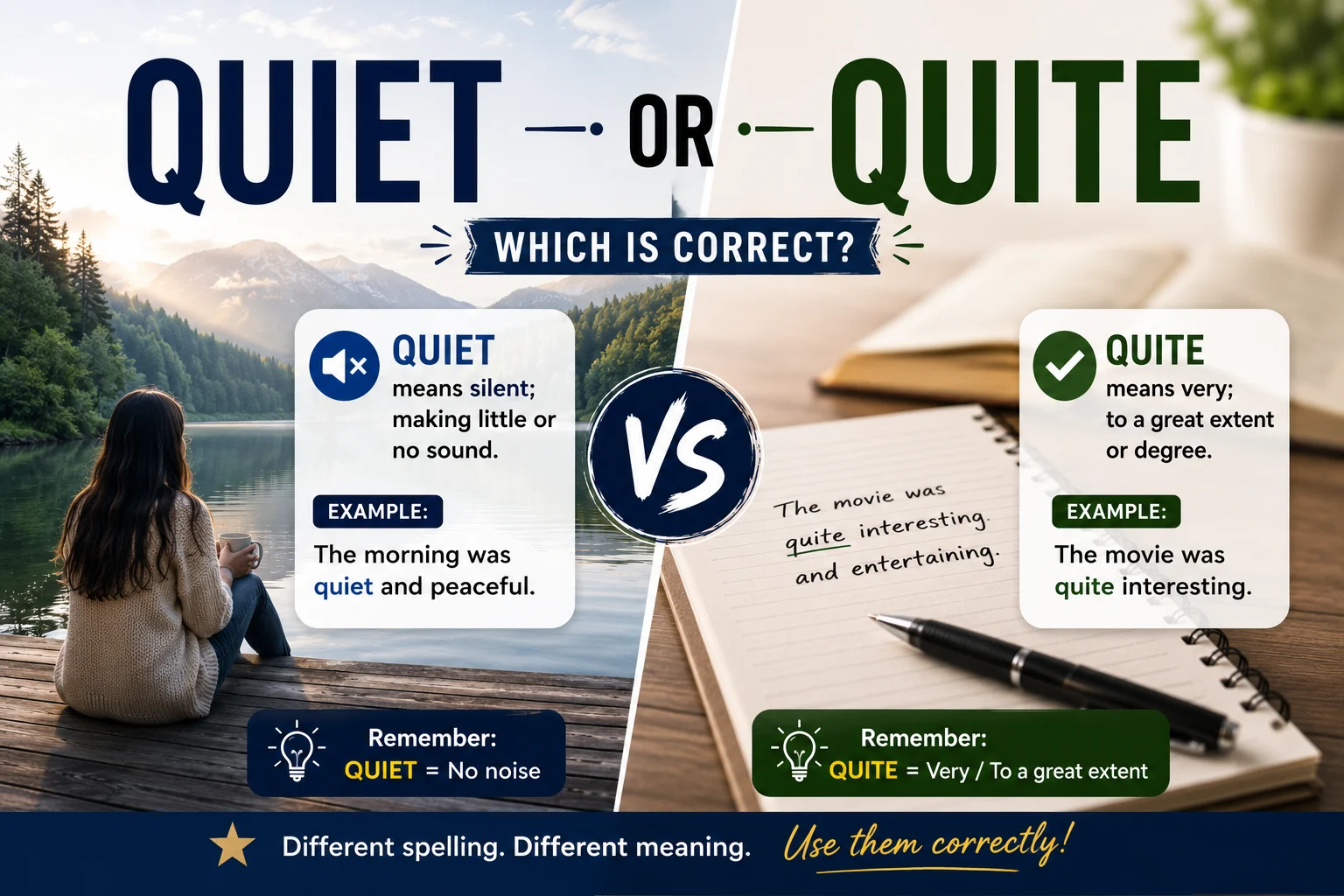
Quiet means calm or making little noise, while quite means fairly or completely—the two words have different meanings and are not interchangeable.
Have you ever typed a sentence and wondered whether you should use quiet or quite? You are not alone. These two words look very similar, but they have different meanings. Because they differ by only one letter, many English learners, students, and even native speakers mix them up.
The keyword quiet or quite is one of the most searched spelling and vocabulary questions in English. People often write “I am quiet happy” or “Please quite down,” which are common mistakes. Knowing the difference helps you write clearly and avoid confusion in emails, school assignments, social media posts, and everyday conversations.
This guide explains quiet and quite in simple English. You will learn what each word means, where it comes from, how to use it correctly, and how to remember the difference. By the end of this article, you will be able to choose the right word with confidence every time.
Quiet or Quite – Quick Answer
Quiet and quite are different words with different meanings.
- Quiet means calm, silent, or making little noise.
- Quite means fairly, completely, or very, depending on the sentence.
Examples
- Please be quiet in the library.
- The movie was quite interesting.
- My neighborhood is quiet at night.
The Origin of Quiet or Quite
Although quiet and quite look alike, they come from different historical uses.
The word quiet comes from the Latin word quietus, meaning “rest” or “peace.” It entered English through Old French and has always referred to silence or calmness.
The word quite developed from earlier English expressions meaning “completely” or “entirely.” Over time, it also came to mean “fairly” or “rather” in everyday speech.
The words are often confused because they are spelled almost the same. However, their meanings and grammar are different. Quiet is usually an adjective, while quite is an adverb.
British English vs American English Spelling
There is no spelling difference between British English and American English for these words.
Both countries use the same spellings and meanings.
| Version | Spelling | Region | Example Sentence |
|---|---|---|---|
| Standard English | Quiet | US and UK | The room is quiet today. |
| Standard English | Quite | US and UK | She is quite friendly. |
Which Spelling Should You Use?
The choice depends on the meaning, not your audience.
For a US Audience
Use quiet when talking about silence or calmness.
Use quite when you mean fairly, very, or completely.
For a UK or Commonwealth Audience
The same rule applies. British English uses quiet and quite exactly as American English does.
For a Global or SEO Audience
There is no regional difference. Choose the word that matches your meaning, and proofread carefully because these words are easy to confuse.
Common Mistakes with Quiet or Quite
Here are some mistakes people often make.
Incorrect
- I am quiet happy today.
- Please quite your phone.
- The classroom was quite during the exam.
Correct
- I am quite happy today.
- Please keep your phone quiet.
- The classroom was quiet during the exam.
Quiet or Quite in Everyday Examples
Emails
- Please keep the meeting room quiet.
- I am quite interested in your proposal.
News Headlines
- City Enjoys a Quiet Weekend
- Company Reports Quite Strong Growth
Social Media
- It is so quiet here today.
- That was quite an adventure!
Formal Writing
- The research was completed in a quiet environment.
- The results were quite encouraging.
Quiet or Quite – Google Trends & Usage
People often search for quiet or quite because they accidentally type one word instead of the other. These words are commonly confused in writing, especially by English learners.
Both words are widely used in English-speaking countries. Quiet appears more often when talking about places, people, or situations with little noise. Quite is common in everyday conversations because it helps describe the degree or strength of something.
Search interest stays steady because this spelling confusion affects writers of all skill levels.
Comparison Table
| Feature | Quiet | Quite |
|---|---|---|
| Meaning | Silent or calm | Fairly, very, or completely |
| Part of Speech | Adjective (sometimes noun or verb) | Adverb |
| Pronunciation | KWI-et | KWITE |
| Used for Noise? | Yes | No |
| Used for Degree? | No | Yes |
| Common Mistake | Used instead of quite | Used instead of quiet |
FAQs
Is quiet or quite correct?
Both are correct, but they have different meanings. Choose the one that fits your sentence.
What is the difference between quiet and quite?
Quiet means silent or calm. Quite means fairly, very, or completely.
Why do people confuse quiet or quite?
The words look similar and differ by only one letter, making typing mistakes very common.
Is there a spelling difference in British and American English?
No. Both countries spell quiet and quite the same way.
How can I remember quiet or quite?
Remember that quiet relates to silence, while quite is used to change the strength or degree of another word.
Can quiet and quite be used interchangeably?
No. They have different meanings and cannot replace each other.
Conclusion
Understanding the difference between quiet or quite is easier than it first seems. Although the words look almost identical, they serve different purposes in English. Quiet describes silence, peace, or little noise, while quite changes the meaning of another word by showing degree or emphasis.
There is no difference between British English and American English spelling for these words. The correct choice depends only on what you want to say. If you are talking about a calm place or a silent person, use quiet. If you mean fairly, very, or completely, use quite.
A quick proofread before sending an email or publishing an article can help you catch this common mistake. With a little practice, choosing between quiet and quite becomes natural. Remember the meaning of each word, stay consistent, and your writing will be clearer and more professional every time.