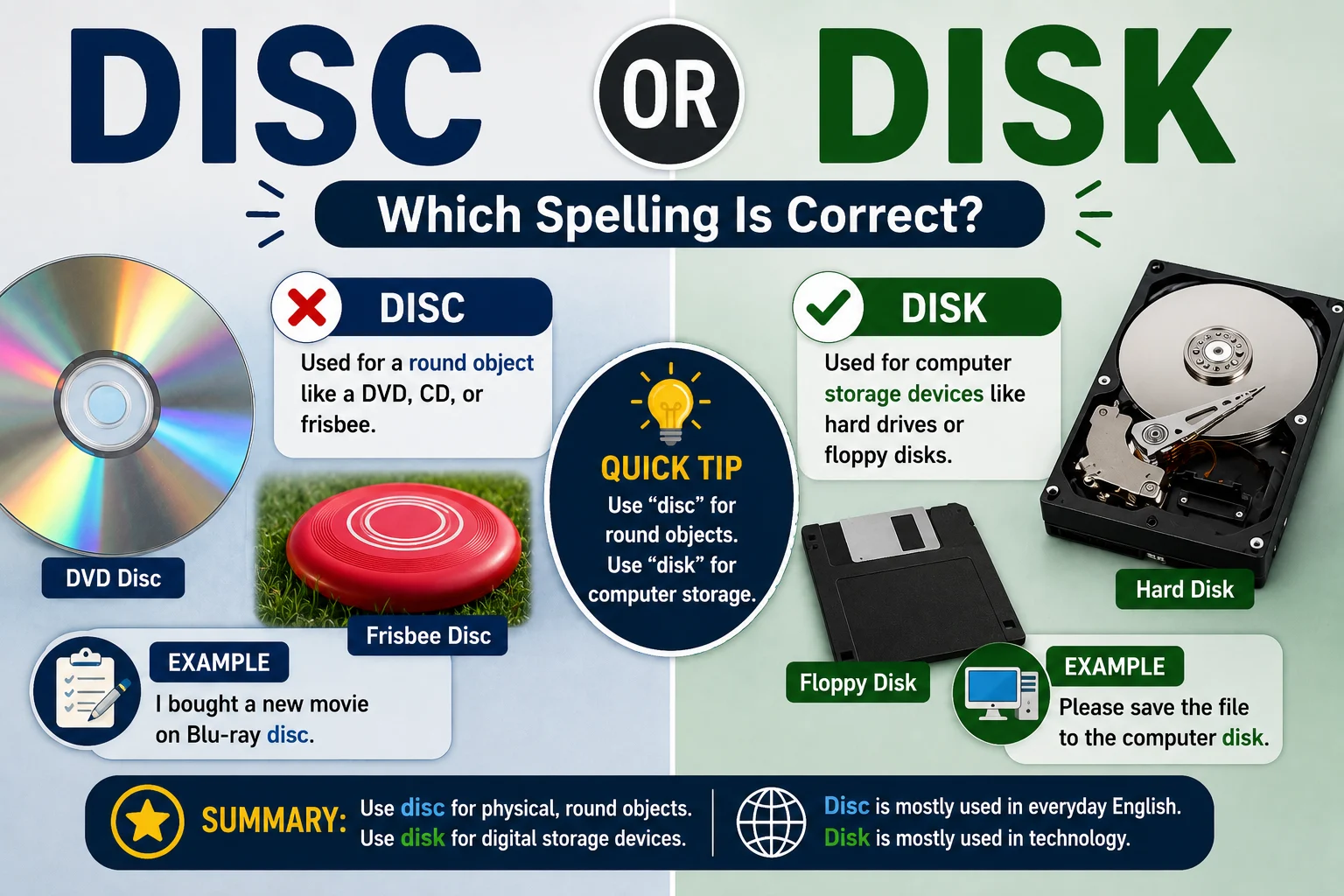
“Disk” is the standard spelling for computer storage devices, while “disc” is usually used for optical media like CDs and DVDs, although usage varies by context and region.
Have you ever wondered whether you should write disc or disk? You’re not alone. These two words look almost the same, sound exactly alike, and often refer to the same round, flat object. This is why many people become confused when writing emails, school assignments, blog posts, or technical documents.
The difference between disc or disk is not always about right or wrong. In many cases, it depends on the type of object you are describing, the industry you work in, or whether you are using British or American English. For example, a music CD is usually called a disc, while a computer hard drive is often called a disk. Because both spellings appear online and in everyday writing, choosing the correct one can be difficult.
This guide explains the difference in simple English. You’ll learn the history of both spellings, how they are used in different countries, common mistakes to avoid, and which spelling is best for your audience. By the end, you’ll know exactly when to use disc and when to use disk with confidence.
Disc or Disk – Quick Answer
Both disc and disk are correct, but they are used in different situations.
- Disc is commonly used for optical media such as CDs, DVDs, and Blu-ray Discs.
- Disk is commonly used in computing, especially for hard disks, floppy disks, and disk drives.
Examples
- I burned the photos onto a disc.
- My computer’s hard disk is almost full.
- The doctor said I have a slipped disc in my back.
The Origin of Disc or Disk
The words disc and disk come from the Latin word discus, meaning a round, flat object. Over time, English adopted both spellings.
Traditionally, disc became the preferred spelling in British English and for many medical and optical terms. Disk became more common in American English and later became the standard spelling in the computer industry.
Technology also influenced usage. Companies such as IBM and Microsoft widely adopted disk for computer storage, while the music and entertainment industries standardized disc for optical media like CDs and DVDs.
Today, both spellings remain correct, but their usage depends on context rather than simple regional differences.
British English vs American English Spelling
British and American English both recognize disc and disk, but they often prefer different spellings depending on the subject.
| Version | Spelling | Region | Example Sentence |
|---|---|---|---|
| British English | Disc | UK | The DVD disc contains the full movie. |
| American English | Disk | US | The hard disk stores all your files. |
| Medical English | Disc | Worldwide | The patient has a damaged spinal disc. |
| Computer English | Disk | Worldwide | Replace the damaged disk drive. |
Although these are common preferences, some exceptions exist because many industries have adopted their own standards.
Which Spelling Should You Use?
US Audience
Use disk when writing about computers, storage devices, or technology. Use disc for CDs, DVDs, Blu-ray Discs, and medical terms.
UK/Commonwealth Audience
British English generally prefers disc, but disk is still standard for many computer-related terms.
Global/SEO Audience
Follow industry standards:
- Use disc for optical media and medical writing.
- Use disk for computing and data storage.
This approach matches what readers expect and improves clarity.
Common Mistakes with Disc or Disk
Here are mistakes people often make.
❌ My hard disc is almost full. (Less common in computing.)
✅ My hard disk is almost full.
❌ I bought a music disk yesterday. (Less common for CDs.)
✅ I bought a music disc yesterday.
❌ The doctor examined my spinal disk. (Medical writing prefers disc.)
✅ The doctor examined my spinal disc.
❌ Every round object should be called a disc.
✅ The correct spelling depends on the context.
Disc or Disk in Everyday Examples
Emails
- Please save the files to the external disk.
- I mailed the installation disc yesterday.
News Headlines
- New Blu-ray disc collection released.
- Company introduces faster portable disk storage.
Social Media
- Finally found my old game disc!
- Time to clean my laptop’s hard disk.
Formal Writing
- The software is available on optical disc.
- The backup data is stored on a secure disk drive.
Disc or Disk – Google Trends & Usage
Search interest for disc and disk depends on the topic.
People searching for music, movies, DVDs, Blu-ray, or spinal health usually use disc. Those looking for computer storage, operating systems, or hardware typically search for disk.
In countries such as the United States, disk appears more often in technology-related content. In the United Kingdom and many Commonwealth countries, disc is common in general English, although disk remains standard in computing.
Because both spellings are widely accepted, understanding the context is more important than choosing one spelling for every situation.
Comparison Table
| Feature | Disc | Disk |
|---|---|---|
| Optical media (CD/DVD/Blu-ray) | ✅ Yes | ❌ Rare |
| Computer storage | ❌ Rare | ✅ Yes |
| Medical term (spinal disc) | ✅ Yes | ❌ Rare |
| British general preference | ✅ Yes | Sometimes |
| American computing preference | Sometimes | ✅ Yes |
| Common in technology | Limited | ✅ Yes |
| Common in entertainment | ✅ Yes | Limited |
FAQs
Is it disc or disk?
Both are correct. The right spelling depends on the context.
Why do computers use disk instead of disc?
The computer industry adopted disk as its standard spelling many years ago.
Is spinal disc or spinal disk correct?
Spinal disc is the standard spelling in medicine.
Should I write compact disc or compact disk?
The correct name is Compact Disc (CD).
Is hard disk correct?
Yes. Hard disk is the standard term in computing.
Which spelling is better for SEO?
Use the spelling your audience expects. For technology, use disk. For CDs, DVDs, and medical topics, use disc.
Conclusion
The difference between disc or disk is mainly about context, not correctness. Both spellings are accepted in English, but they have developed different uses over time. Disc is the preferred spelling for optical media like CDs, DVDs, and Blu-ray Discs. It is also the standard spelling for medical terms such as a spinal disc. Disk, however, is the accepted spelling in the world of computers and data storage, including hard disks, floppy disks, and disk drives.
When writing, think about your audience and the subject. If you’re discussing music, movies, or medicine, choose disc. If you’re writing about technology or computer hardware, choose disk. Following these simple guidelines makes your writing clearer and more professional.
By understanding the difference between disc and disk, you can avoid common spelling mistakes and communicate more effectively. The right spelling is easy to choose once you know the meaning.