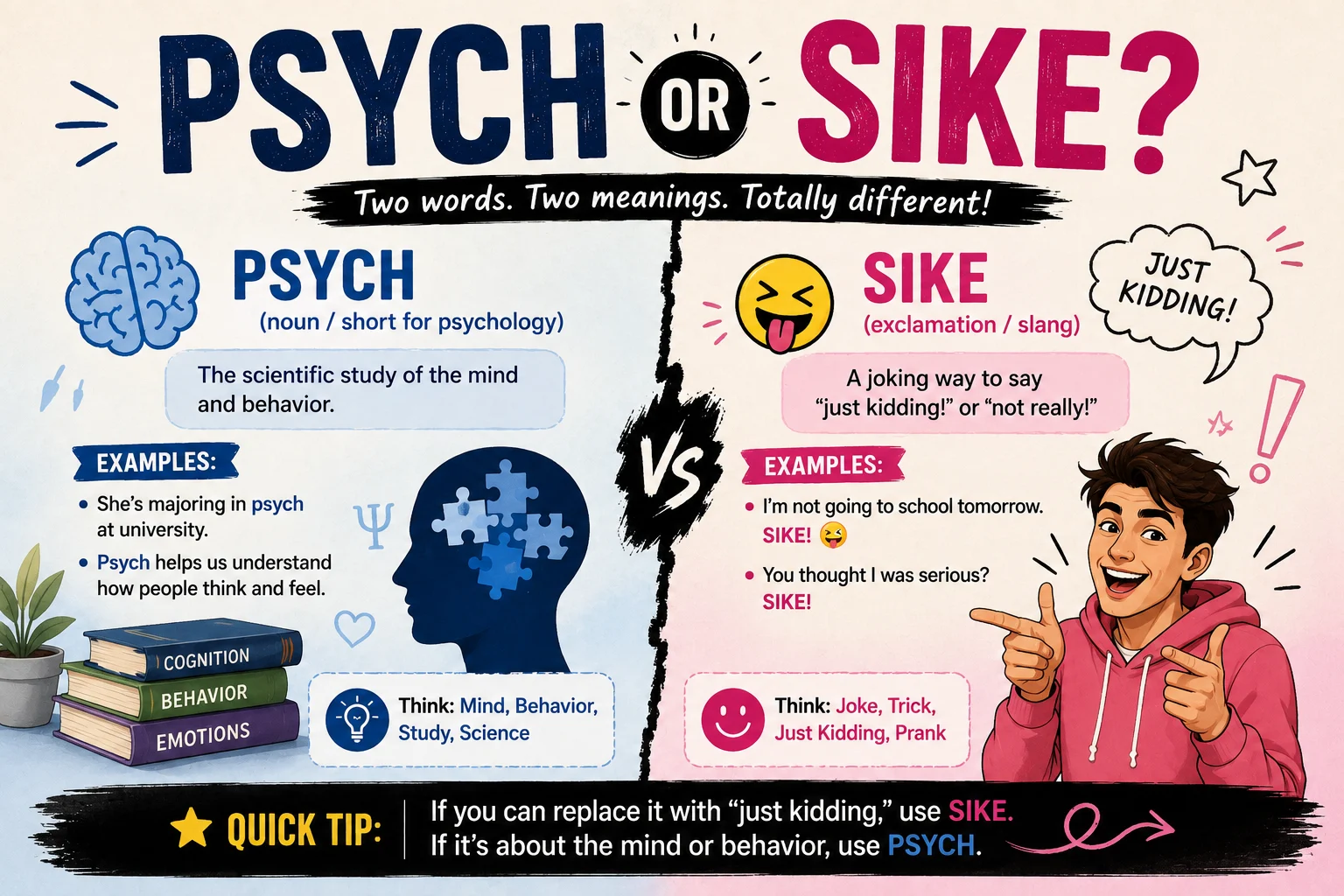
Psych is the standard spelling when you mean “just kidding” or “I fooled you.” Sike is a popular informal spelling used online and in casual speech, but it is nonstandard.
Have you ever sent a message like “I’m not coming to the party… psych!” and then wondered whether you should have written “sike” instead? This small word causes a surprising amount of confusion.
I have seen learners ask this question because psych and sike sound almost the same. Both can appear when someone makes a joke, tricks another person, or suddenly reveals that a statement was not serious. Online, however, sike has become very common.
The tricky part is that these spellings do not have exactly the same status. Psych has a long history in English and is linked to the verb psych, while sike is mainly an informal spelling that represents the way the word sounds.
If you are writing a school assignment, professional message, or formal document, knowing the difference matters. This guide explains psych or sike, their meanings, origins, correct uses, common mistakes, and real-life examples.
Psych or Sike – Quick Answer
Psych is the safer and more established spelling when you mean “I fooled you,” “just kidding,” or “I tricked you.”
Sike is an informal internet and slang spelling. It is often used because it matches the pronunciation more closely.
Examples
I got the last ticket. Psych! There are still five left.
You thought I forgot your birthday? Sike!
Both examples are understandable in casual conversation. However, psych has stronger support as the established spelling.
Simple rule
Use:
- Psych → standard or established spelling
- Sike → casual slang and internet writing
If you are unsure, choose psych.
The Origin / Background of Psych
The story of psych is more interesting than it first appears.
The word is connected to psych, a shortened form related to psychology and the Greek root psychē, associated with the mind or spirit.
But the slang expression “psych!” developed in a different way.
In informal American English, psych! became a way to tell someone that you had deliberately made them believe something that was not true.
For example:
I bought you a new phone. Psych!
The speaker creates a short moment of surprise. Then they reveal that the statement was a joke.
Why does “sike” exist?
Sike is mainly a phonetic or slang spelling.
People often spell words based on how they hear them. Since psych is commonly pronounced like “sike,” some speakers began writing it that way.
This is common in informal language.
Think about words and expressions that change online because people want writing to sound like speech. Sike fits that pattern.
Over time, the spelling became popular in texting, social media, memes, and casual conversations.
Psych and psychology
There is another meaning of psych that you should know.
Psych can be related to psychology or the mind.
For example:
She studied psych in college.
Here, psych is short for psychology.
It can also appear as a verb:
I need to psych myself up before the game.
This means to mentally prepare or excite yourself.
So, context matters.
Psych or Sike Explained — Key Differences
The biggest difference is formality and usage.
| Term | Meaning | When to Use | Region/Context |
|---|---|---|---|
| Psych! | “I fooled you” or “just kidding” | Casual speech and writing | Mainly informal English |
| Sike! | Informal spelling of “psych!” | Texts, memes, social media | Slang/internet English |
| Psych | Short form connected to psychology | Academic or everyday contexts | English-speaking contexts |
| Psych up | Mentally prepare or motivate yourself | Sports, work, daily speech | Informal English |
1. Psych!
This is the established spelling of the slang exclamation.
Example:
I ate the last cookie. Psych! It’s still in the kitchen.
The speaker first makes you believe something. Then they quickly reverse it.
2. Sike!
Sike communicates the same basic joke.
Example:
I deleted your game save. Sike!
It is easy to understand in casual settings.
However, sike is much less suitable for formal writing.
3. Psych as a short form of psychology
You may see psych used as a shortened form of psychology.
Example:
I’m taking psych next semester.
This meaning is completely different from the slang expression.
4. Psych up
The phrase psych up means to prepare yourself mentally.
Example:
She listened to music to psych herself up before the race.
This is another useful meaning of psych.
Which Version Should You Use?
Your choice depends on your audience.
For students
Use psych if you are discussing the slang expression.
But remember that slang itself may not be suitable for a formal essay.
For academic writing, you could simply write:
I was joking.
That is clearer and more formal.
For social media users
You can use either psych or sike in casual posts.
Sike can make the message feel more playful or internet-focused.
Example:
I said I was going to sleep early. Sike. 😂
For texting friends
Both can work.
Your choice depends on your personal style.
Psych! feels closer to the established spelling.
Sike! feels more like modern internet slang.
For professional writing
Avoid both when they mean “just kidding.”
Instead, use clear phrases such as:
- Just kidding.
- I was joking.
- I was only joking.
- That was a joke.
For global or neutral English
Choose psych if you must use the slang term.
It is the safer spelling for readers who may not know internet slang.
Common Mistakes with Psych or Sike
These words cause several common errors.
1. Using “sike” in formal writing
❌ I was sike. It was only a joke.
✅ I was joking. It was only a joke.
Why?
Sike is informal slang. It does not fit most formal writing.
2. Confusing psych with psychology
❌ The teacher told a joke and said psychology!
✅ The teacher told a joke and said psych!
Why?
In the slang expression, psych! is an exclamation. It is not the same as psychology.
3. Assuming “sike” is always wrong
❌ Sike can never be used.
✅ Sike is acceptable in some informal contexts.
Why?
Language changes with context. Sike is widely understood as slang, especially online.
4. Using slang in academic work
❌ I thought the test was canceled. Psych!
✅ I initially believed the test was canceled, but that information was false.
Why?
Academic writing usually requires a formal tone.
5. Confusing “psych up” with “psych!”
These expressions have different meanings.
I need to psych up before my interview.
This means prepare mentally.
I got you a gift. Psych!
This means I fooled you or was joking.
Psych or Sike in Real-World Examples
Understanding real examples makes the difference much easier.
1. Professional Email
For a professional email, avoid slang.
Instead of:
Psych! The meeting is still happening.
Write:
Just kidding. The meeting is still scheduled for 3 p.m.
This sounds clearer and more professional.
2. News Headline or Article
A news article about internet slang might say:
“Psych” and “Sike”: Why Two Spellings of the Same Slang Expression Exist
Here, the words are being discussed as language.
A serious news story would not normally use sike as formal prose unless it were quoting someone or discussing slang.
3. Social Media Post
Casual social media is different.
I said I was done buying coffee this week. Sike! ☕
This sounds playful and natural online.
You could also write:
I said I was done buying coffee this week. Psych! ☕
Both are easy to understand.
4. Formal Document
A formal report should avoid the slang expression.
Instead of:
Psych! The first result was incorrect.
Write:
The initial result was incorrect.
Formal writing values clarity over playful slang.
5. Text Message
A text between friends can be much more relaxed.
You really thought I forgot? Psych!
Or:
You really thought I forgot? Sike!
Both can work in this setting.
Psych — Data, Trends & Usage
The search query “psych or sike” has a clear informational and spelling-clarification intent.
People searching this phrase usually want to know:
- Which spelling is correct?
- What does the word mean?
- Is sike a real word?
- Should I write psych or sike?
- Can I use the word in formal writing?
The question is especially relevant to people who learn English through social media, texting, music, videos, and online communities.
Why is the confusion still common?
The main reason is pronunciation.
Psych and sike sound alike in the slang expression.
When people hear a word before they see it written, they may naturally create a spelling that matches its sound.
The internet makes this effect even stronger.
Social media encourages short, informal writing. Users often create spellings that reflect speech, humor, or group identity.
That is why sike can appear frequently online even though psych is the more established spelling.
Search intent
The search intent is mainly:
Informational → spelling → slang meaning → usage
It is not usually a commercial search.
The reader wants a quick answer first, followed by enough detail to feel confident about the choice.
Psych vs. Sike: Standalone Comparison Table
| Term/Variant | Meaning | Region/Context | Best Used When |
|---|---|---|---|
| Psych! | I fooled you; just kidding | Informal English | Casual speech and writing |
| Sike! | Informal spelling of psych | Internet slang | Texting, memes, social media |
| Psych | Short form related to psychology | Education and everyday English | When referring to psychology |
| Psych up | Prepare mentally | Informal English | Before a challenge or event |
| Just kidding | I was not serious | General English | Casual and neutral contexts |
| I was joking | The statement was not serious | Standard English | Formal and informal contexts |
Is “Psych!” a Real Word?
Yes, psych has several established uses in English.
As slang, psych! is used to reveal that someone has been tricked or that a previous statement was not serious.
But psych also appears in other expressions.
For example:
psychology
psychological
psych up
So the word has a much wider history than the slang expression alone.
Sike, on the other hand, is mainly used as an informal slang spelling.
Can You Use “Sike” in a Sentence?
Yes, but the context matters.
You can use sike in casual communication.
For example:
I said I wasn’t going to the concert. Sike! I’m already there.
This works because the tone is playful and informal.
Avoid it in:
- Academic essays
- Job applications
- Business reports
- Formal letters
- Professional documents
For those situations, choose a clearer phrase.
Psych vs. Just Kidding
These expressions can have similar effects, but they do not feel exactly the same.
Psych
I lost your keys. Psych!
This often creates a quick surprise.
Just kidding
I lost your keys. Just kidding.
This is clearer and more neutral.
If your reader may not understand slang, just kidding is the safer option.
FAQ: Psych or Sike
Q: What does “psych” mean in slang?
A: Psych! is an informal expression used after tricking someone or making them believe something that is not true. It can mean “I fooled you” or “just kidding.”
Q: Is “psych” or “sike” correct?
A: Psych is the more established spelling for the slang expression. Sike is a common informal spelling that reflects the pronunciation.
Q: Is “sike” a real word?
A: Sike is widely used as slang, especially online. However, it is not the standard spelling of the slang expression represented by psych!
Q: Can I use “psych” in formal writing?
A: It depends on the meaning. Psych can be appropriate in terms related to psychology, but the slang psych! is usually too informal for formal writing.
Q: Can I use “sike” on social media?
A: Yes. Sike is common in casual online communication. It can make a post or message sound playful and informal.
Q: Where does “psych” come from?
A: The word psych has connections to Greek roots related to the mind and appears in words such as psychology. The slang expression psych! developed as an informal way to reveal a trick or joke.
Q: Is “psych” the same as “just kidding”?
A: They can have a similar meaning in casual speech. Psych! often has a stronger “I fooled you” feeling, while just kidding is more direct and neutral.
Q: What does “psych up” mean?
A: Psych up means to prepare yourself mentally for something. For example, an athlete may psych herself up before a race.
Q: Which spelling should English learners use?
A: Psych is the safer choice if you want the established spelling. In formal writing, however, it is often better to use I was joking or just kidding.
Conclusion
The difference between psych or sike becomes easy once you understand the context.
Psych is the more established spelling of the slang expression used to mean “I fooled you” or “just kidding.” It also has other meanings linked to psychology and expressions such as psych up.
Sike is a popular informal spelling. You will often see it in texts, memes, comments, and social media posts. It works well when the tone is playful, but it is not the best choice for formal writing.
If you are writing an essay, report, application, or professional message, avoid slang. Use I was joking, just kidding, or another clear phrase instead.
For casual communication, both psych and sike can be understood. If you want the safer spelling, choose psych.
Now you know exactly when to use psych or sike. Bookmark this guide so you never second-guess the spelling again, and share it with someone who still wonders which version is right.