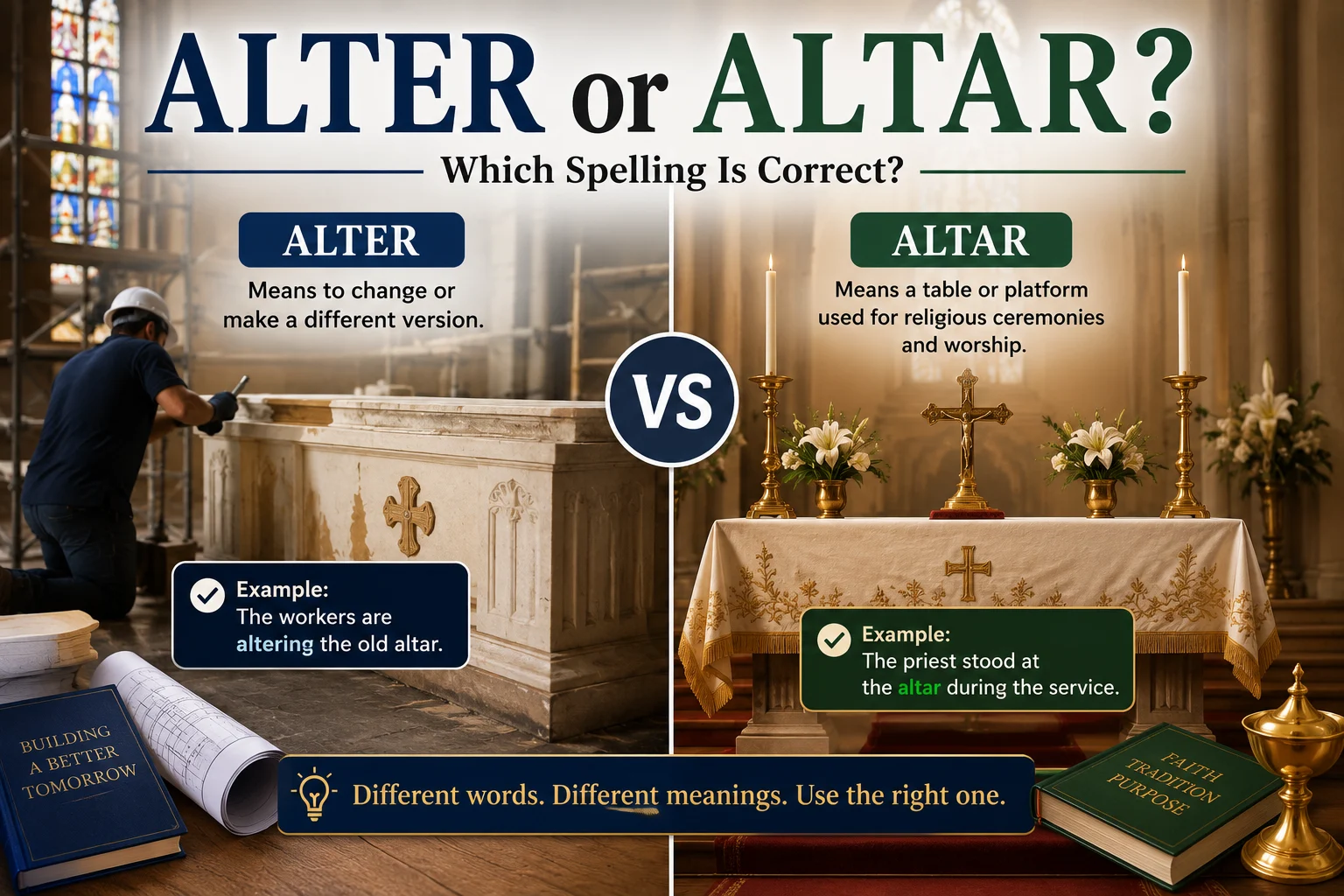
“Alter” means to change something, while “altar” is a sacred table or structure used for religious ceremonies and worship.
Have you ever stopped while writing and wondered whether to use alter or altar? You are not alone. These two words sound almost the same, but they have very different meanings. Because they are homophones, many people accidentally use one when they mean the other. This mistake often appears in emails, school assignments, social media posts, and even professional writing.
Understanding the difference between alter or altar is easier than you might think. Alter is a verb that means to change or modify something. Altar is a noun that refers to a sacred table or structure used in religious ceremonies. Although they sound alike, they are never interchangeable.
This guide explains the meaning, history, pronunciation, and correct usage of both words. You’ll also find simple examples, comparison tables, common mistakes, and practical writing tips. By the end, you’ll know exactly when to use alter and when to use altar, helping you write with confidence and avoid embarrassing spelling mistakes.
Alter or Altar – Quick Answer
Quick Answer:
- Alter means to change, modify, or adjust something.
- Altar is a sacred table or structure used for worship or religious ceremonies.
Examples
- We need to alter the meeting schedule.
- The tailor will alter your jacket.
- The couple stood before the altar during the wedding ceremony.
The Origin of Alter or Altar
Although alter and altar sound alike, they come from different Latin words.
- Alter comes from the Latin word alterare, meaning “to change.”
- Altar comes from the Latin word altare, meaning a raised place used for sacrifice or worship.
Their similar pronunciation causes confusion, but they have always had separate meanings. They are homophones, not spelling variations.
British English vs American English Spelling
Unlike words such as colour/color or licence/license, alter and altar are not British and American spelling differences.
| Version | Spelling | Region | Example Sentence |
|---|---|---|---|
| Verb | Alter | Used worldwide | Please alter the document before sending it. |
| Noun | Altar | Used worldwide | Flowers decorated the church altar. |
Both British and American English use the same spellings.
Which Spelling Should You Use?
US Audience
Use alter when talking about making changes. Use altar when referring to a religious structure.
UK/Commonwealth Audience
The same rule applies. There is no spelling difference between British and American English.
Global/SEO Audience
Choose the word based on its meaning, not your location. Search engines recognize alter and altar as different words with different purposes.
Common Mistakes with Alter or Altar
People often confuse these words because they sound alike.
| Incorrect | Correct |
|---|---|
| Please altar the report. | Please alter the report. |
| The tailor will altar my pants. | The tailor will alter my pants. |
| The bride walked to the alter. | The bride walked to the altar. |
| We prayed at the alter. | We prayed at the altar. |
Easy Tip:
- Alter = Change
- Altar = Church or worship
Alter or Altar in Everyday Examples
Emails
“Please alter the proposal before tomorrow’s meeting.”
News Headlines
“City officials plan to alter traffic rules.”
“The historic altar was restored after decades.”
Social Media
“I had to alter my travel plans.”
“The wedding photos at the altar were beautiful.”
Formal Writing
“The committee agreed to alter the policy.”
“The ancient altar remains an important religious site.”
Alter or Altar – Google Trends & Usage
Searches for alter or altar are common because many writers hear the words but are unsure which spelling fits their sentence.
Alter appears more often in business, education, legal writing, healthcare, and everyday communication because people frequently discuss making changes.
Altar is commonly searched around weddings, churches, religious events, history, and architecture.
Most confusion comes from pronunciation rather than grammar or regional spelling.
Comparison Table
| Feature | Alter | Altar |
|---|---|---|
| Part of Speech | Verb | Noun |
| Meaning | To change or modify | Sacred table for worship |
| Used in Religion | No | Yes |
| Used in Daily Writing | Very common | Less common |
| British English | Same | Same |
| American English | Same | Same |
FAQs
Is it alter or altar?
It depends on the meaning. Alter means to change, while altar is a religious structure.
What is the difference between alter and altar?
Alter is a verb meaning “to change.” Altar is a noun used for religious worship.
Is altar used only in churches?
No. Altars are found in many religions and places of worship, not only churches.
Can alter be used as a noun?
No. Alter is mainly used as a verb meaning to change.
Why do people confuse alter and altar?
They sound almost identical, making them common homophones.
Are alter and altar different in British English?
No. Both British and American English use the same spellings.
Conclusion
The difference between alter or altar is simple once you know what each word means. Even though they sound almost the same, they have completely different uses. Alter means to change, modify, or adjust something. Altar refers to a sacred table or structure used in religious ceremonies and places of worship.
There is no British or American spelling difference between these words. The correct choice depends entirely on your sentence. If you are talking about changing a document, schedule, plan, or clothing, use alter. If you are referring to a wedding ceremony, church, temple, or religious ritual, use altar.
A simple memory trick can help: Alter changes things. Altar is found in worship. Keeping this rule in mind will help you avoid one of the most common homophone mistakes in English. With regular practice, choosing between alter and altar will become quick, easy, and natural.