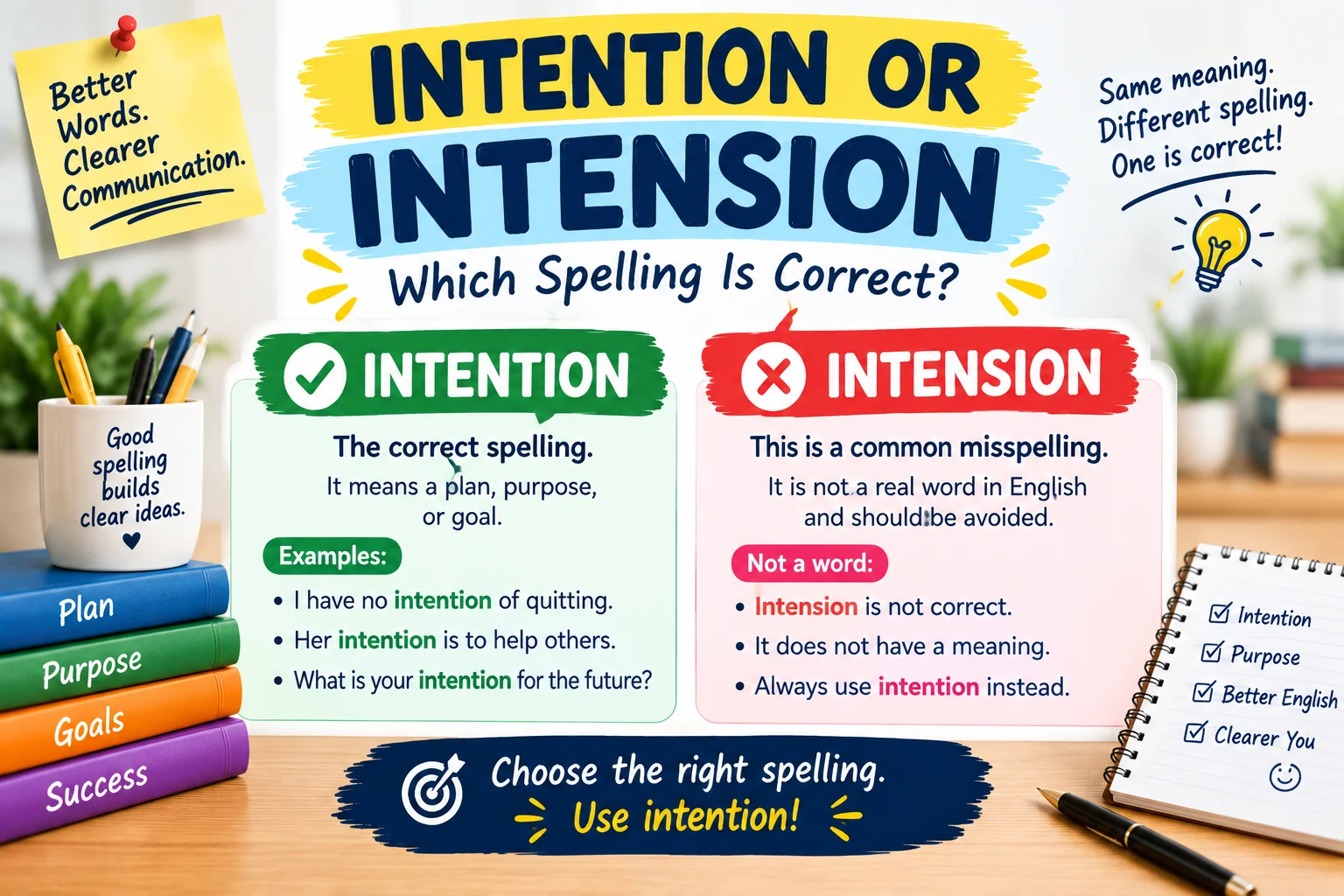
Intention means a plan, purpose, or aim. Intension is a rare technical term used in logic and philosophy to describe the qualities or characteristics that make up a concept.
Have you ever typed “intension” when you really meant “intention”? You are not alone. These two words look almost the same, sound very similar, and have related histories. Yet they have very different uses.
As an English teacher, I have seen this mix-up many times in student writing. A learner may write, “My intension was to help,” when the correct word is intention. The mistake is easy to make because both words contain tension, and spell-check may not always catch it.
The good news is that the difference is simple once you know what to look for.
Intention is the word you will use in normal English when you talk about a plan, purpose, or reason for doing something. Intension has a much narrower meaning. It appears mainly in technical fields such as logic, philosophy, linguistics, and semantics.
This guide explains the difference, shows real examples, and gives you an easy way to remember which word to choose.
intention or intension – Quick Answer
The correct word for a plan, purpose, or aim is intention.
- Intention: “My intention was to call you.”
- Intension: a technical term for the qualities or properties that define a concept.
The easiest rule
If you mean “what someone plans or wants to do,” use intention.
She had no intention of leaving early.
If you are discussing logic, philosophy, or the meaning of a concept, intension may be the word you need.
The intension of a concept refers to the properties that define it.
For everyday writing, intention is almost always the correct choice.
The Origin and Background of intention and intension
The two words are related to the Latin verb intendere, which means “to stretch toward,” “direct,” or “aim.”
Over time, English developed both intention and intension. Their meanings then moved in different directions.
What does intention mean?
Intention developed the sense of a purpose or plan. It describes what someone means to do.
For example:
His intention was to finish the project today.
You can also use it when talking about someone’s motives.
I did not hurt her on purpose. That was never my intention.
Today, intention is a common English word. You will see it in conversations, emails, books, news stories, school work, and business writing.
What does intension mean?
Intension is much less common.
It has a special meaning in areas such as logic, philosophy, linguistics, and semantics. It refers to the set of qualities or characteristics associated with a concept.
For example, the intension of a word or concept can describe the properties that help define it.
This is different from someone’s personal plan.
Why do people confuse them?
The confusion comes from several things:
- They look very similar.
- They sound almost the same.
- Both are connected to the same Latin root.
- Intention is common, while intension is rare.
- Spellings such as intension can look logical to someone who has heard “intense.”
That last point is especially tricky. If you know the word intense, you may naturally think intension is the noun. But when you mean a plan or purpose, the correct noun is intention.
intention or intension Explained — Key Differences
The biggest difference is meaning and context.
Intention
Intention means a plan, purpose, aim, or desired action.
It is used when someone plans to do something.
Examples:
My intention is to study tonight.
She had good intentions when she offered help.
What was your intention?
The word can be singular or plural:
- intention
- intentions
Intension
Intension is a specialized term.
In logic and philosophy, it refers to the defining properties or characteristics of a concept.
It is not normally used to describe someone’s plan.
Example:
The philosopher discussed the intension of the term.
You are unlikely to need this word in ordinary conversation.
Quick comparison
| Term | Meaning | When to Use | Region/Context |
|---|---|---|---|
| Intention | A plan, purpose, or aim | Everyday writing and speech | General English |
| Intension | Defining qualities of a concept | Technical discussions | Logic, philosophy, linguistics |
A simple pair
Compare these sentences:
My intention was to help.
This means I planned or wanted to help.
The intension of the term was discussed.
This refers to the qualities that define a concept.
The words are not interchangeable.
Which Version Should You Use?
For most readers, the answer is easy.
For students → use intention
If you are writing an essay, assignment, application, or school email, intention is usually the correct word.
My intention was to explain the problem clearly.
For business writers → use intention
Business communication often discusses plans and goals.
Our intention is to improve customer service.
The company has no intention of changing the policy.
For everyday English → use intention
Use intention when talking about what you plan or want to do.
I had every intention of calling you.
For philosophy or logic → intension may be correct
If you are writing about the technical meaning of concepts, intension can be the right term.
The study examines the intension of the concept.
Always check the field and context before using this rare word.
For global English → use intention
If your readers are from different countries, intention is the safer choice when you mean purpose or plan.
Common Mistakes with intention or intension
Here are some common errors and their corrections.
| Mistake | Correct | Why? |
|---|---|---|
| My intension was to help. | My intention was to help. | You mean a purpose or plan. |
| What is your intension? | What is your intention? | You are asking about someone’s purpose. |
| She had good intensions. | She had good intentions. | The common word is intention. |
| His intension was clear. | His intention was clear. | The sentence refers to his aim. |
| I had no intension of leaving. | I had no intention of leaving. | The phrase is “no intention of.” |
Mistake 1: Using intension for a plan
❌ My intension is to start a business.
✅ My intention is to start a business.
The sentence is about a plan. Use intention.
Mistake 2: Confusing intention with intense
The adjective intense means very strong.
She felt intense pain.
The noun for a plan is intention, not intension.
Mistake 3: Writing “good intensions”
❌ He had good intensions.
✅ He had good intentions.
Good intentions is a very common phrase.
She had good intentions, even though her plan failed.
intention or intension in Real-World Examples
Seeing the words in context makes the difference easier to remember.
1. Professional email
Thank you for your feedback. My intention was to make the report easier to understand. I appreciate your suggestions.
Here, intention means purpose.
2. News headline
New Policy Aims to Reduce Costs
A related article might say:
The government stated that its intention was to reduce costs for families.
Again, intention means a planned goal.
3. Social media post
My intention this week is to spend less time on my phone and read more books.
This is a personal goal, so intention is correct.
4. Formal report
The intention of the project is to improve access to education.
The word describes the project’s purpose.
5. Academic philosophy
The researcher examined the intension of the concept and compared it with its extension.
Here, intension is appropriate because the sentence uses a technical philosophical meaning.
Intension vs. Extension
If you meet intension in a philosophy or logic text, you may also see the word extension.
These terms are useful to understand together.
Intension
The intension of a concept concerns its defining characteristics.
Extension
The extension concerns the things or objects that fall under that concept.
For example, think about the concept “bird.”
Its intension could include characteristics such as being an animal with feathers and wings.
Its extension would include actual members of the category, such as:
- eagle
- sparrow
- penguin
- robin
This technical distinction is one reason you may encounter intension in academic writing.
intention or intension — Data, Trends & Usage
The search “intention or intension” has a clear informational purpose. People usually search it because they are unsure which spelling is correct.
For normal English, intention is overwhelmingly the word you need.
It appears in common phrases such as:
- good intentions
- intention to do something
- with the intention of
- no intention of
- original intention
- true intention
- hidden intention
- intention behind an action
Intension has a much smaller area of use. It mainly appears in specialized academic discussions.
This difference matters for writers because using intension in everyday writing can make a sentence look like a spelling mistake. If your meaning is simply plan, purpose, or aim, choose intention.
Search intent
The main search intent for this topic is:
Informational + spelling clarification.
Readers want a quick answer first. They then want examples that show why one spelling works and the other does not.
Standalone Comparison Table
| Term/Variant | Meaning | Region/Context | Best Used When |
|---|---|---|---|
| Intention | Plan, purpose, or aim | General English | Talking about what someone plans to do |
| Intensions | Plural of intension | Technical/academic | Discussing defining qualities of concepts |
| Intend | Plan or mean to do something | General English | Describing an intended action |
| Intentional | Done on purpose | General English | Describing a deliberate action |
| Intensive | Very strong or concentrated | General English | Describing effort, care, training, etc. |
The key pair is simple:
Plan or purpose → intention
Technical concept properties → intension
FAQs About intention or intension
Q: What is the correct spelling, intention or intension?
A: Both are real words, but they have different meanings. Intention is correct when you mean a plan, purpose, or aim. Intension is mainly a technical term used in fields such as logic and philosophy.
Q: What does intention mean?
A: Intention means a plan, purpose, or aim. For example, “My intention was to help” means “My plan or purpose was to help.”
Q: What does intension mean?
A: Intension is a specialized term for the qualities or characteristics that define a concept. It is mostly found in philosophy, logic, linguistics, and related academic fields.
Q: Is “intension” a misspelling of “intention”?
A: Not always. Intension is a real word, but it has a different and much narrower meaning. If you are talking about someone’s purpose or plan, intention is the correct word.
Q: Can I use intention in formal writing?
A: Yes. Intention is completely acceptable in formal writing. You can use it in essays, reports, business letters, applications, and academic work.
Q: What is the difference between intention and intension?
A: Intention means a plan or purpose. Intension refers to the defining properties of a concept in a technical sense.
Q: Is “good intentions” correct?
A: Yes. Good intentions is a common English phrase. It describes a desire or plan to do something helpful or right.
Q: What is the difference between intention and intend?
A: Intention is a noun, while intend is a verb. For example, “My intention is to leave early” and “I intend to leave early.”
Q: Should I use intension in everyday English?
A: Usually, no. If you mean a plan, purpose, or aim, use intention. Save intension for technical contexts where its special meaning is required.
Conclusion
The difference between intention or intension is much easier once you focus on meaning.
Intention is the everyday word. It means a plan, purpose, or aim. You can use it when talking about your goals, someone’s motives, or the purpose of an action.
Intension is also a real word, but it is rare. It has a technical meaning linked to the defining qualities of a concept. You may see it in philosophy, logic, linguistics, and semantics.
The best rule is simple: if you mean “plan” or “purpose,” write intention.
For example:
My intention was to help.
That one rule will solve most spelling questions about these two words.
Now you know the difference. Bookmark this guide so you never second-guess intention or intension again.