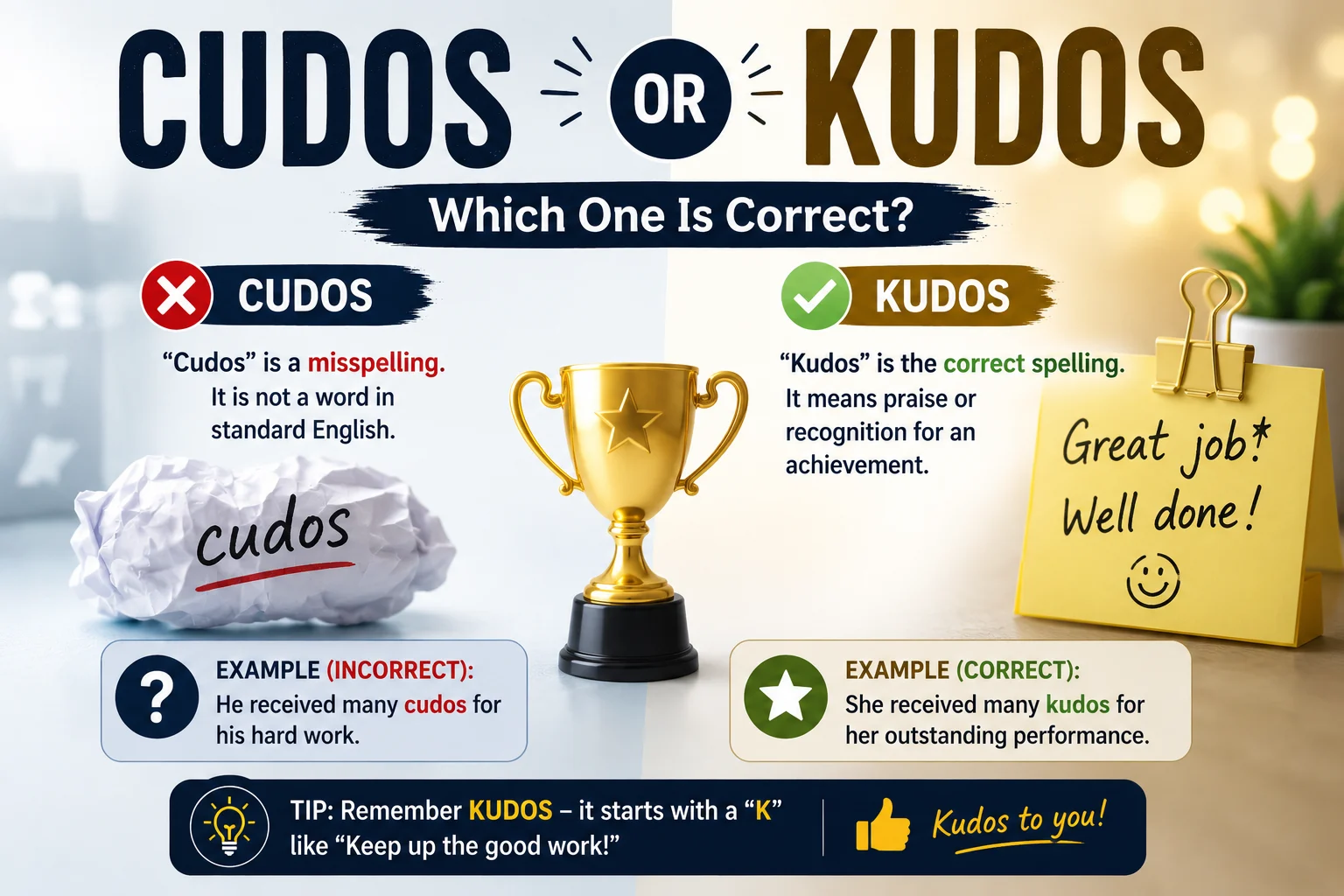
Have you ever typed cudos or kudos and wondered which spelling is correct? You’re not alone. This is one of the most common spelling questions in English because many people hear the word in conversations but rarely see it written. As a result, it’s easy to assume that cudos is the correct spelling.
The truth is simple: kudos is the correct spelling, while cudos is a common misspelling. People often use the word to praise someone’s success, congratulate a colleague, or recognize excellent work. Whether you’re writing an email, posting on social media, or preparing a business report, using the right spelling helps you sound professional and confident.
In this guide, you’ll learn the difference between cudos or kudos, where the word comes from, why people confuse the spelling, and how to use it correctly. You’ll also find comparison tables, real-life examples, common mistakes, and FAQs to help you remember the correct form every time.
Cudos or Kudos – Quick Answer
Kudos is the correct spelling.
The word kudos means praise, recognition, or admiration for an achievement.
Cudos is incorrect and should be avoided in both formal and informal writing.
Real-Life Examples
- Kudos to the team for finishing the project early.
- She received kudos for her excellent presentation.
- Everyone gave him kudos after winning the competition.
The Origin of Cudos or Kudos
The word kudos comes from the Greek word kydos, which means glory, honor, or praise.
It entered the English language in the 1800s and quickly became a popular way to recognize someone’s success or achievement.
The confusion happens because people often hear the word before they see it written. Since many English words begin with c, some mistakenly write cudos instead of kudos.
Remember:
- Kudos = correct
- Cudos = misspelling
British English vs American English Spelling
Unlike many English words, kudos is spelled the same in both British and American English.
| Version | Spelling | Region | Example Sentence |
|---|---|---|---|
| Standard | Kudos | United States | Kudos to everyone who helped today. |
| Standard | Kudos | United Kingdom | She earned kudos for her research. |
| Incorrect | Cudos | None | ❌ He deserves cudos for his work. |
Key Point
Both British and American English use kudos. There is no regional spelling difference.
Which Spelling Should You Use?
For a US Audience
Always write kudos.
It is the accepted spelling in American English.
For a UK or Commonwealth Audience
Also use kudos.
British English follows the same spelling.
For a Global or SEO Audience
Use kudos throughout your content.
Avoid cudos, as readers and search engines recognize it as a spelling mistake.
Common Mistakes with Cudos or Kudos
Many writers confuse the spelling because they only hear the word spoken.
| Incorrect | Correct |
|---|---|
| cudos | kudos |
| kudo | kudos |
| kudose | kudos |
| koodos | kudos |
Other Common Mistakes
- Thinking cudos is an American spelling.
- Removing the final s and writing kudo.
- Using kudos as if it were a plural noun.
Although kudos ends with s, it is treated as a singular mass noun in English.
Cudos or Kudos in Everyday Examples
Emails
Kudos to everyone who completed the project ahead of schedule.
News Headlines
Local Teacher Receives Kudos for Inspiring Students
Social Media
Huge kudos to my best friend for graduating today!
Formal Writing
The employee earned kudos for outstanding customer service throughout the year.
Cudos or Kudos – Google Trends & Usage
People around the world search for cudos or kudos because they are unsure which spelling is correct.
The correct spelling, kudos, is widely used in business writing, education, newspapers, blogs, and social media. It appears in dictionaries and style guides across English-speaking countries.
The spelling cudos mainly appears in online searches because users are checking whether it is correct. Search engines usually understand that people searching for cudos are actually looking for information about kudos.
For clear and professional writing, always use kudos.
Cudos vs Kudos Comparison Table
| Feature | Cudos | Kudos |
|---|---|---|
| Correct spelling | ❌ No | ✅ Yes |
| Dictionary word | No | Yes |
| Meaning | None | Praise or recognition |
| Used in US English | No | Yes |
| Used in UK English | No | Yes |
| Formal writing | No | Yes |
| Informal writing | No | Yes |
| Recommended for SEO | No | Yes |
Frequently Asked Questions
Is cudos or kudos correct?
Kudos is correct. Cudos is a spelling mistake.
Why do people write cudos?
Many people hear the word before seeing it written, leading them to guess the spelling incorrectly.
Is kudos singular or plural?
Although it ends with s, kudos is usually treated as a singular mass noun.
Can I write kudo instead of kudos?
No. The standard English word is kudos.
Is kudos used in British English?
Yes. Both British and American English use kudos.
Does cudos appear in dictionaries?
No. Standard dictionaries list kudos but not cudos as the correct spelling.
Can I use kudos in professional emails?
Yes. Kudos is commonly used in workplaces to recognize good work and achievements.
Conclusion
If you’ve ever wondered whether to write cudos or kudos, the answer is straightforward. Kudos is the only correct spelling in standard English. It means praise, recognition, or admiration for someone’s achievement and is accepted in both American and British English. The spelling cudos is simply a common mistake that happens because the word is often heard more than it is seen in writing.
Whether you’re congratulating a coworker, praising a student, writing a report, or posting on social media, using kudos will help your writing look polished and professional. There is no regional difference, so you can confidently use the same spelling for readers anywhere in the world.
To remember the correct form, think of kudos as one complete word—not a plural noun and not a word that starts with c. Stick with kudos, stay consistent in your writing, and you’ll never have to question the spelling again.