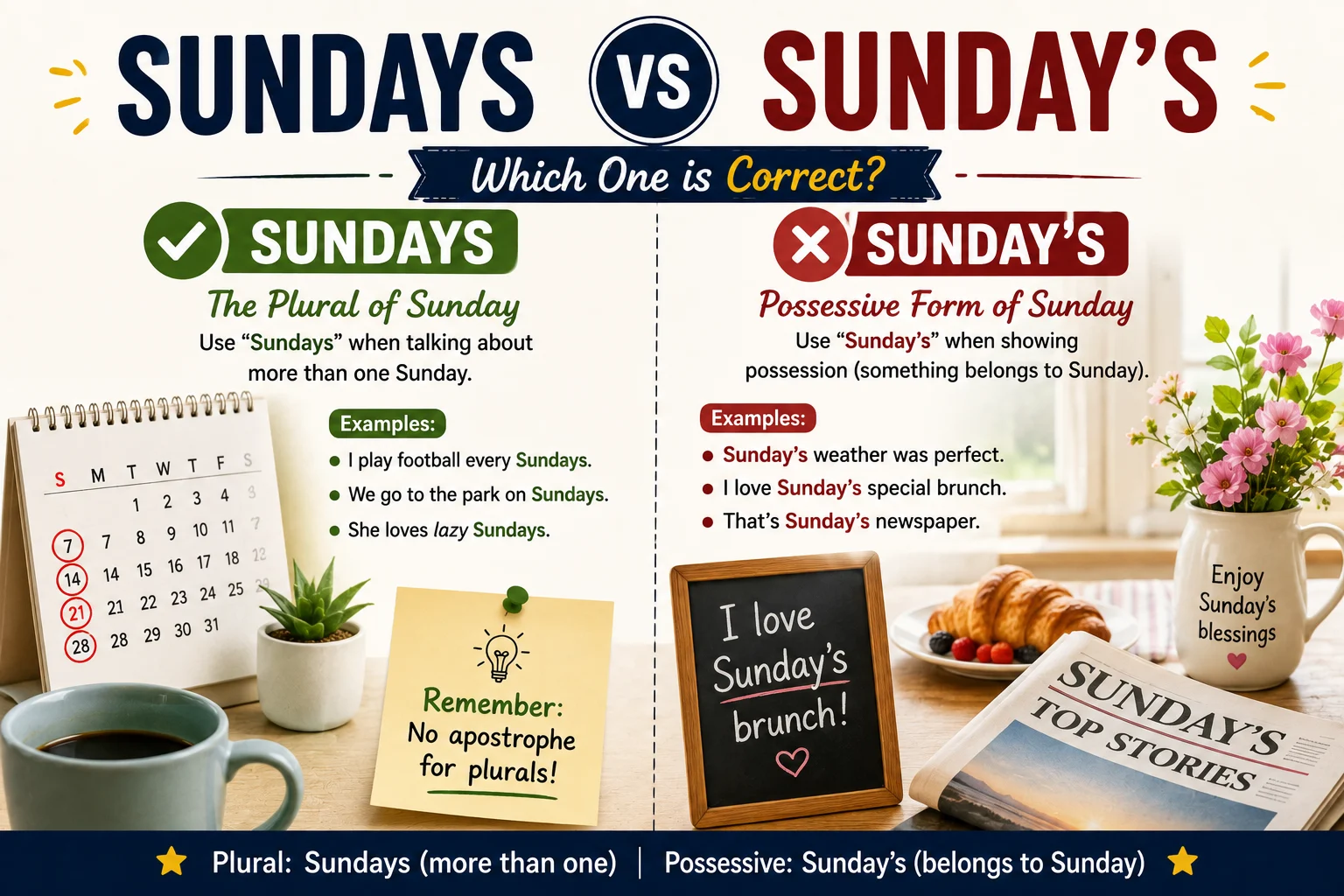
Sundays is the correct plural form of Sunday. Sunday’s is the possessive form, used when something belongs to or is connected with one Sunday.
Have you ever written a sentence like “I love Sunday’s” and then stopped to wonder if that apostrophe really belongs there? This tiny mark causes a surprising number of grammar mistakes.
As an English teacher, I have seen this confusion in school assignments, emails, social posts, and even business writing. The problem is easy to understand. An apostrophe can show ownership, but it can also appear in contractions. Many learners are unsure when to use it with days of the week.
The good news is that the rule is simple once you separate plural from possession.
If you mean more than one Sunday, write Sundays. If you mean something connected to or belonging to one Sunday, write Sunday’s. If you mean something connected to several Sundays, you may need Sundays’.
That final form is often missed.
This guide explains Sundays or Sunday’s, shows the difference with simple examples, and gives you a quick way to choose the right form every time. Let’s start with the basic rule.
Sundays or Sunday’s – Quick Answer
The correct choice depends on what you want to say.
- Sundays = more than one Sunday.
- Sunday’s = something belonging to or associated with one Sunday.
- Sundays’ = something belonging to or associated with several Sundays.
Examples
I work on Sundays.
Here, Sundays means more than one Sunday.
Sunday’s weather was beautiful.
Here, Sunday’s means the weather of one particular Sunday.
The Sundays’ schedules were different.
Here, Sundays’ shows possession involving multiple Sundays.
So the quick rule is:
More than one → Sundays
One Sunday + possession → Sunday’s
Several Sundays + possession → Sundays’
The Origin / Background of Sundays
The word Sunday comes from Old English Sunnandæg, meaning “day of the sun.”
It was linked to the older idea of naming days after celestial bodies and gods. Similar forms appeared in other Germanic languages.
Over time, the word developed into the modern English Sunday.
The word is also connected with the Latin tradition of dies Solis, meaning “day of the Sun.” In many languages, however, the day received a different religious or cultural name.
English kept the older Germanic connection to the sun.
Why Does Sunday Become Sundays?
The plural form is simple.
Sunday → Sundays
Unlike words such as baby → babies, the final y in Sunday stays unchanged.
Why?
Because Sunday ends with a vowel + y sound and spelling pattern.
Compare:
- Sunday → Sundays
- Monday → Mondays
- Friday → Fridays
- day → days
- boy → boys
- toy → toys
This is different from:
- baby → babies
- city → cities
- story → stories
The key point is that Sunday does not become “Sundies.”
The correct plural is always Sundays.
Sundays or Sunday’s Explained — Key Differences
The biggest difference is the apostrophe.
An apostrophe is not normally used just because a noun is plural.
That means:
Sundays ✅
not:
Sunday’s ❌
when you simply mean more than one Sunday.
1. Sundays
Use Sundays when you mean two or more Sundays.
Examples:
I visit my grandparents on Sundays.
The shop is closed on Sundays.
We play football on Sundays.
No apostrophe is needed.
2. Sunday’s
Use Sunday’s when you are showing possession or a close connection to one Sunday.
Examples:
Sunday’s meeting starts at 10 a.m.
Sunday’s match was exciting.
I enjoyed Sunday’s dinner.
Here, the apostrophe tells us that the noun after it is connected to one Sunday.
You can often rewrite the sentence using of:
Sunday’s weather
means:
the weather of Sunday
Likewise:
Sunday’s event
means:
the event connected with Sunday
3. Sundays’
Use Sundays’ when you have more than one Sunday and need to show possession.
Examples:
The Sundays’ schedules were different.
The Sundays’ events were popular.
This form is less common, but it is grammatically possible.
Comparison Table
| Term | Meaning | When to Use | Region/Context |
|---|---|---|---|
| Sundays | More than one Sunday | Talking about multiple Sundays | Standard English |
| Sunday’s | Possession or connection to one Sunday | One Sunday owns or relates to something | Standard English |
| Sundays’ | Possession or connection to several Sundays | Multiple Sundays own or relate to something | Standard English |
Which Version Should You Use?
The easiest way to choose is to ask yourself one question:
Am I talking about more than one Sunday, or am I showing possession?
If You Mean Several Sundays → Use Sundays
For students:
We have classes on Sundays.
For schedules:
The library is open on Sundays.
For habits:
I usually sleep late on Sundays.
No apostrophe is needed.
If One Sunday Has Something → Use Sunday’s
For a specific Sunday:
Sunday’s concert was amazing.
For weather:
Sunday’s forecast looks sunny.
For an event:
Sunday’s meeting has been moved.
The apostrophe shows a relationship between Sunday and the next noun.
If Several Sundays Have Something → Use Sundays’
This form is needed when several Sundays are treated as possessors.
For example:
The Sundays’ programs were different.
However, this construction can sound awkward. A clearer rewrite is often better:
The programs for the different Sundays were different.
For global and beginner-friendly writing, clarity is usually more useful than forcing a possessive construction.
Common Mistakes with Sundays or Sunday’s
Mistake 1: Using Sunday’s for the Plural
Wrong:
I work on Sunday’s.
Correct:
I work on Sundays.
The sentence talks about repeated Sundays. It does not show possession.
Mistake 2: Writing “Sunday” When You Mean Several
Wrong:
I go hiking every Sunday.
This sentence can actually be grammatically correct because every Sunday means each Sunday.
But if you write:
I go hiking on Sunday.
you may mean one particular Sunday.
For a repeated habit, both of these can work:
I go hiking every Sunday.
I go hiking on Sundays.
The meaning is slightly different in structure, but both describe a regular habit.
Mistake 3: Adding an Apostrophe Before S
Wrong:
Sunday’s are relaxing.
Correct:
Sundays are relaxing.
Apostrophes do not normally make English nouns plural.
This rule applies to many other words too:
books ✅
books’ ❌
unless you are showing possession.
Mistake 4: Confusing Sunday’s With a Contraction
Sunday’s can also look like a contraction.
For example:
Sunday’s the best day of the week.
Here, Sunday’s can mean Sunday is.
Compare:
Sunday’s weather is warm.
Here, it means the weather of Sunday.
So context matters.
Mistake 5: Forgetting the Plural Possessive
Wrong:
The Sundays schedules were changed.
Correct:
The Sundays’ schedules were changed.
However, a smoother version might be:
The schedules for the Sundays were changed.
This is often easier to understand.
Sundays or Sunday’s in Real-World Examples
Professional Email
Sunday’s meeting has been moved to 11 a.m. Please confirm that you can attend.
Here, Sunday’s refers to one specific meeting connected with Sunday.
For a recurring schedule:
Our office is closed on Sundays.
News Headline
Sunday’s Final Match Draws Thousands of Fans
The headline refers to one specific Sunday and its match.
Another example:
Shops Remain Closed on Sundays
Here, Sundays means multiple Sundays.
Social Media Post
Lazy Sundays are my favorite. ☕
This is a general statement about Sundays.
Another example:
Sunday’s sunset was beautiful!
This refers to one particular Sunday.
Formal Document or Report
The center will remain closed on Sundays.
This refers to every Sunday or Sundays in general.
For a specific event:
The results of Sunday’s inspection will be reviewed on Monday.
The inspection happened on one Sunday.
How to Remember Sundays vs Sunday’s
A simple test can save you from most mistakes.
Step 1: Remove the Apostrophe
Look at the sentence:
I relax on Sunday’s.
Remove the apostrophe:
I relax on Sundays.
The second version makes sense because you mean several Sundays.
Step 2: Ask “Does Something Belong to Sunday?”
Consider:
Sunday’s weather was pleasant.
Ask:
Whose weather?
The answer is Sunday’s weather.
That tells you the apostrophe is correct.
Step 3: Look for a Noun After Sunday’s
Possessive Sunday’s often comes before another noun:
- Sunday’s weather
- Sunday’s meeting
- Sunday’s game
- Sunday’s event
- Sunday’s schedule
If you simply mean the plural day:
- on Sundays
- many Sundays
- several Sundays
- most Sundays
No apostrophe.
Sundays — Data, Trends & Usage
The search intent behind Sundays or Sunday’s is mainly informational and grammatical.
People usually search this phrase when they are unsure about:
- the plural of Sunday
- apostrophe use
- possessive nouns
- Sunday grammar
- writing dates and schedules
- whether Sunday’s means one or many Sundays
The confusion is common because Sunday’s has two possible grammatical roles.
It can be:
- A possessive form of Sunday.
- A contraction of Sunday is.
For example:
Sunday’s weather is perfect.
Here, it is possessive.
Sunday’s going to be busy.
Here, it means Sunday is going to be busy.
This is why reading the whole sentence matters.
The good news is that Sundays itself is straightforward. It is simply the plural form of Sunday.
Standalone Comparison Table
| Term/Variant | Meaning | Region/Context | Best Used When |
|---|---|---|---|
| Sunday | One day of the week | Standard English | Referring to one Sunday |
| Sundays | More than one Sunday | Standard English | Referring to repeated or multiple Sundays |
| Sunday’s | Possession or “Sunday is” | Standard English | One Sunday has something or forms a contraction |
| Sundays’ | Possession involving multiple Sundays | Standard English | Several Sundays have something |
| every Sunday | Each Sunday | Standard English | Describing a repeated weekly event |
| on Sundays | On multiple/repeated Sundays | Standard English | Describing a regular habit or schedule |
FAQ: Sundays or Sunday’s
Q: Which is correct, Sundays or Sunday’s?
A: Both can be correct, but they have different meanings. Use Sundays for the plural and Sunday’s for possession involving one Sunday or as a contraction of Sunday is.
Q: Is “Sundays” the plural of Sunday?
A: Yes. The correct plural is Sundays. For example, We visit our family on Sundays.
Q: When should I use Sunday’s?
A: Use Sunday’s when something belongs to or is connected with one Sunday. For example, Sunday’s weather was warm.
Q: Is “Sunday’s” ever a contraction?
A: Yes. Sunday’s can mean Sunday is in informal writing. For example, Sunday’s going to be busy means Sunday is going to be busy.
Q: Should I write “Sunday’s” when talking about every Sunday?
A: No. Use Sundays or every Sunday. For example, write The store is closed on Sundays, not The store is closed on Sunday’s.
Q: Is Sundays’ grammatically correct?
A: Yes. Sundays’ is the plural possessive form. It can show that something is connected with several Sundays, although rewriting the sentence may often sound clearer.
Q: Do British and American English use different forms?
A: No. Sunday, Sundays, and Sunday’s follow the same basic rules in both British and American English.
Conclusion
The choice between Sundays or Sunday’s becomes easy once you know what the apostrophe means.
Use Sundays when you mean more than one Sunday. For example, I work on Sundays. There is no apostrophe because the word is simply plural.
Use Sunday’s when something is connected with or belongs to one Sunday. For example, Sunday’s weather was beautiful. The apostrophe shows possession.
There is also a third form: Sundays’. This is the plural possessive form. It is correct when several Sundays are treated as possessors, though a rewrite may often sound more natural.
One final trick can help. Plural does not normally need an apostrophe. Possession does.
So remember:
Sunday → one
Sundays → more than one
Sunday’s → one + possession
Sundays’ → several + possession
Once you learn this pattern, you can use these forms with confidence in emails, schoolwork, reports, schedules, and social posts. Bookmark this guide so you never second-guess Sundays or Sunday’s again.