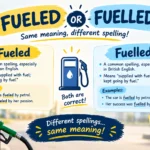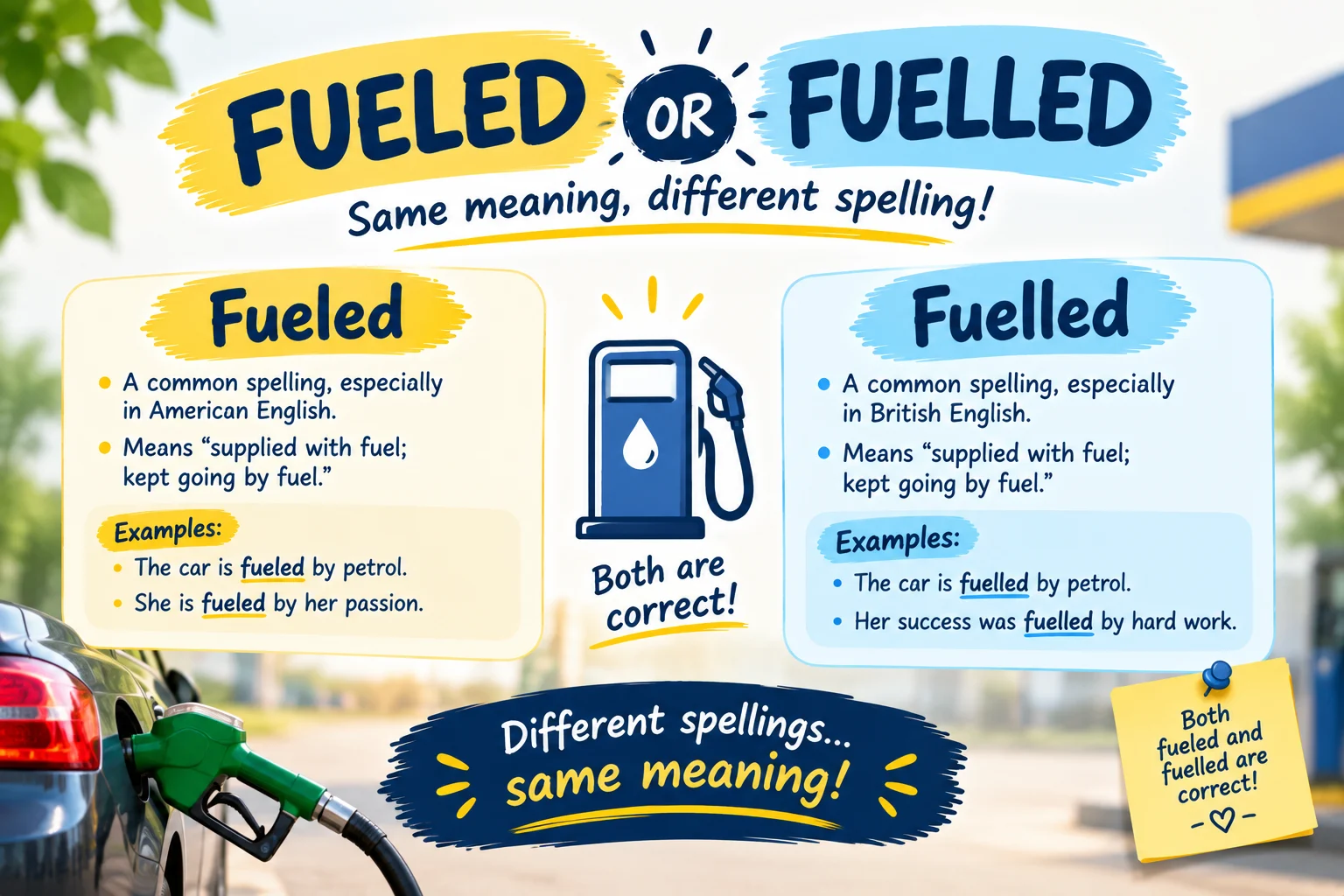
Fueled and fuelled are both correct spellings. Fueled is standard American English, while fuelled is standard British English.
Have you ever typed fueled and then noticed someone else writing fuelled? One extra letter can make you wonder if your spelling is wrong. The good news is that both forms are correct.
In my years of helping students and writers with English spelling, I have seen this question come up in essays, news articles, business writing, and online content. The confusion usually starts because British and American English follow different rules for some words ending in -ed.
The word fuel is a good example. When you add -ed, American English normally writes fueled with one l. British English commonly writes fuelled with two l’s.
Both words have the same meaning. They can mean supplied with fuel, or they can describe something that caused or increased a feeling, action, or event.
So, should you write fueled or fuelled? The answer depends on your audience and the English style you follow. Once you understand the spelling pattern, this choice becomes very easy.
fueled or fuelled – Quick Answer
Fueled and fuelled are both correct.
The main difference is regional spelling:
- Fueled → American English
- Fuelled → British English
Both forms are the past tense and past participle of fuel.
Simple examples
The car was fueled before the trip.
This spelling is common in American English.
The car was fuelled before the trip.
This spelling is common in British English.
The meaning is exactly the same.
Fueled and fuelled can also be figurative
The word does not only relate to cars, planes, or machines.
His success was fueled by hard work.
Her anger was fuelled by the unfair decision.
In these examples, fueled/fuelled means caused, encouraged, or made something stronger.
The Origin and Background of Fueled and Fuelled
The word fuel comes from an older word meaning a substance that can be burned to produce heat or energy.
Today, fuel can refer to many things, including:
- Petrol or gasoline
- Diesel
- Natural gas
- Coal
- Wood
- Aviation fuel
- Other energy sources
The verb fuel developed from this idea.
To fuel something can mean to provide it with fuel so it can work.
Workers fueled the aircraft before takeoff.
The verb later developed a wider, figurative meaning.
To fuel an emotion, event, or situation means to make it stronger or help it continue.
The rumor fueled public concern.
This meaning is now very common in news and everyday writing.
Why are there two spellings?
The difference comes from British and American spelling conventions.
American English often uses a single consonant in words such as:
fueled
British English often doubles the l:
fuelled
This pattern can also appear in related forms.
| American English | British English |
|---|---|
| fueled | fuelled |
| fueling | fuelling |
| refueled | refuelled |
| refueling | refuelling |
The noun fuel itself does not change.
fueled or fuelled Explained — Key Differences
The meaning of fueled and fuelled is the same.
The main difference is the spelling convention.
| Term | Meaning | When to Use | Region/Context |
|---|---|---|---|
| Fueled | Supplied with fuel or made stronger | American English | US English |
| Fuelled | Supplied with fuel or made stronger | British English | UK and British-style English |
| Fueling | Providing fuel or making stronger | American English | US English |
| Fuelling | Providing fuel or making stronger | British English | UK and British-style English |
| Refueled | Given fuel again | American English | US English |
| Refuelled | Given fuel again | British English | UK and British-style English |
Fueled in American English
Use fueled when writing in American English.
The truck was fueled before leaving the station.
Her ambition was fueled by a desire to succeed.
The debate was fueled by new evidence.
These examples all use the American spelling.
Fuelled in British English
Use fuelled when following British English spelling.
The truck was fuelled before leaving the station.
Her ambition was fuelled by a desire to succeed.
The debate was fuelled by new evidence.
The meaning does not change.
Physical vs. Figurative Uses of Fueled and Fuelled
Understanding the two main meanings can make the word much easier.
Physical meaning
The physical meaning relates to supplying fuel.
The plane was fueled before takeoff.
The workers fuelled the generator.
Here, fuel is something that provides energy.
Figurative meaning
The figurative meaning means to increase, encourage, or make something stronger.
The news fueled public anger.
The rumor fuelled fears about the economy.
Here, nobody is adding petrol or diesel. The word describes an increase in an emotion or situation.
Common figurative phrases
You may often see:
- fueled by anger
- fueled by fear
- fueled by passion
- fueled by ambition
- fueled by curiosity
- fueled by demand
- fueled by social media
- fueled by controversy
British English simply doubles the l:
- fuelled by anger
- fuelled by fear
- fuelled by passion
- fuelled by ambition
Which Version Should You Use?
Your audience should decide which spelling you choose.
For American readers → use fueled
If your readers are mainly in the United States, use fueled.
The campaign was fueled by strong public support.
This matches other common American spellings.
For British readers → use fuelled
If you are writing for readers in the UK, choose fuelled.
The campaign was fuelled by strong public support.
This fits standard British spelling.
For students → follow your school style
If you are writing a school assignment, check which English variety your teacher expects.
For American English:
fueled
For British English:
fuelled
Neither form should be marked wrong simply because the other exists.
For global content → stay consistent
If your website serves an international audience, either form can work.
The important thing is to keep your spelling style consistent.
For example, if you use British forms such as:
- colour
- organise
- travelled
- fuelled
then fuelled fits the style.
If you use American forms such as:
- color
- organize
- traveled
- fueled
then fueled fits better.
Common Mistakes with fueled or fuelled
Mistake 1: Thinking one spelling is wrong
❌ Fuelled is always wrong.
✅ Fuelled is standard British English.
❌ Fueled is always wrong.
✅ Fueled is standard American English.
Both are correct in the right regional style.
Mistake 2: Mixing related forms
❌ The machine was fuelled and is now fueling properly.
This mixes British and American forms.
British style:
✅ The machine was fuelled and is now fuelling properly.
American style:
✅ The machine was fueled and is now fueling properly.
Mistake 3: Using fueled and fuelled randomly
A document can look inconsistent if it uses both spellings without a clear reason.
Choose one style and use it throughout.
Mistake 4: Thinking fueled only relates to vehicles
The word has a strong figurative use.
Her passion was fueled by her love of music.
Here, fueled does not refer to petrol or another physical fuel.
Mistake 5: Confusing fuel with fueled
Fuel can be a noun or a verb.
Gasoline is a type of fuel.
Fueled/fuelled is a past-tense or past-participle form of the verb.
The car was fueled before the journey.
Fueled or Fuelled in Real-World Examples
1. Professional Email
American English:
The vehicle was fueled and is ready for tomorrow’s delivery.
British English:
The vehicle was fuelled and is ready for tomorrow’s delivery.
Both are correct.
2. News Headline
American English:
New Evidence Fueled Debate Over Climate Policy
British English:
New Evidence Fuelled Debate Over Climate Policy
The spelling changes, but the meaning stays the same.
3. Social Media Post
American English:
My passion for writing is fueled by learning something new every day.
British English:
My passion for writing is fuelled by learning something new every day.
The figurative meaning is natural in both varieties.
4. Formal Report
American English:
The increase in demand was fueled by lower prices.
British English:
The increase in demand was fuelled by lower prices.
Both versions are suitable for formal writing.
5. Everyday Conversation
The team was fueled by the support of its fans.
Or in British English:
The team was fuelled by the support of its fans.
The word works naturally in both casual and formal contexts.
Fueled vs. Refueled
Another useful spelling question is fueled vs. refueled.
The same regional rule applies.
American English
The aircraft was refueled before takeoff.
British English
The aircraft was refuelled before takeoff.
The British form doubles the l.
This pattern can help you remember related words.
| American | British |
|---|---|
| fueled | fuelled |
| fueling | fuelling |
| refueled | refuelled |
| refueling | refuelling |
Why Does British English Double the L?
This is part of a broader spelling pattern.
British English often doubles the final l when certain verbs form words with endings such as -ed or -ing.
For example:
- travel → travelled
- cancel → cancelled
- label → labelled
- fuel → fuelled
American English often keeps one l in these forms:
- travel → traveled
- cancel → canceled
- label → labeled
- fuel → fueled
There are exceptions and style differences, but this pattern explains why fuelled looks different from fueled.
fueled or fuelled — Data, Trends & Usage
The search intent behind “fueled or fuelled” is mainly informational and spelling clarification.
People often search for this phrase when they are checking writing for:
- School assignments
- Business reports
- News articles
- Blog posts
- Academic writing
- Professional emails
- SEO content
- Social media posts
The question is especially common because English-language content is shared across countries.
A US reader may expect:
fueled
A UK reader may expect:
fuelled
Both forms remain widely useful.
The word also appears often in figurative phrases such as fueled by demand, fueled by anger, and fuelled by controversy. This means the spelling question is not limited to transport or energy topics.
For writers, the biggest lesson is simple: match the spelling to your target audience and keep the whole document consistent.
Standalone Comparison Table
| Term/Variant | Meaning | Region/Context | Best Used When |
|---|---|---|---|
| Fueled | Supplied with fuel or made stronger | American English | US-focused writing |
| Fuelled | Supplied with fuel or made stronger | British English | UK-focused writing |
| Fueling | Providing fuel or increasing something | American English | US-focused writing |
| Fuelling | Providing fuel or increasing something | British English | UK-focused writing |
| Refueled | Supplied with fuel again | American English | US-focused writing |
| Refuelled | Supplied with fuel again | British English | UK-focused writing |
| Fuel | A substance that provides energy; also a verb | All major English varieties | General use |
FAQs About fueled or fuelled
Q: Which is correct, fueled or fuelled?
A: Both are correct. Fueled is the standard American English spelling, while fuelled is the standard British English spelling.
Q: What does fueled mean?
A: Fueled means supplied with fuel or made stronger. It can describe a vehicle receiving fuel or an emotion, event, or action becoming stronger.
Q: What does fuelled mean?
A: Fuelled has the same meaning as fueled. It is the spelling commonly used in British English.
Q: Is fueled American or British?
A: Fueled is mainly the American English spelling. British English normally uses fuelled.
Q: Is fuelled a correct English word?
A: Yes. Fuelled is a standard British English spelling. It is not a spelling mistake.
Q: What is the difference between fueled and fuelled?
A: There is no difference in meaning. The difference is regional spelling: fueled is American, while fuelled is British.
Q: Should I use fueled or fuelled in formal writing?
A: Use the form that matches your English style. American formal writing uses fueled, while British formal writing uses fuelled.
Q: Can fueled be used for emotions?
A: Yes. Fueled can mean made stronger or encouraged. For example, “His anger was fueled by the unfair decision.”
Q: Is fueling or fuelling correct?
A: Both are correct. Fueling is the common American spelling, while fuelling is the common British spelling.
Q: What is the British spelling of refueled?
A: The British spelling is refuelled. American English normally uses refueled.
Q: Does fueled mean powered?
A: Sometimes. When something is fueled, it may receive the energy source needed to operate. In figurative use, fueled by can mean supported, encouraged, or driven by something.
Conclusion
The choice between fueled or fuelled is not about right versus wrong. It is about American and British English spelling.
Use fueled when writing in American English. Use fuelled when following British English. Both forms mean the same thing.
The word can have a physical meaning. A car can be fueled with gasoline, and a plane can be fuelled before takeoff. It can also have a figurative meaning. Anger, passion, demand, fear, or debate can be fueled/fuelled by something.
The same spelling pattern appears in related words. American English uses fueling and refueled, while British English uses fuelling and refuelled.
Your best strategy is simple: know your audience, choose one spelling style, and stay consistent.
If you write for US readers, choose fueled. For UK readers, choose fuelled.
Bookmark this guide so you never second-guess “fueled or fuelled” again.