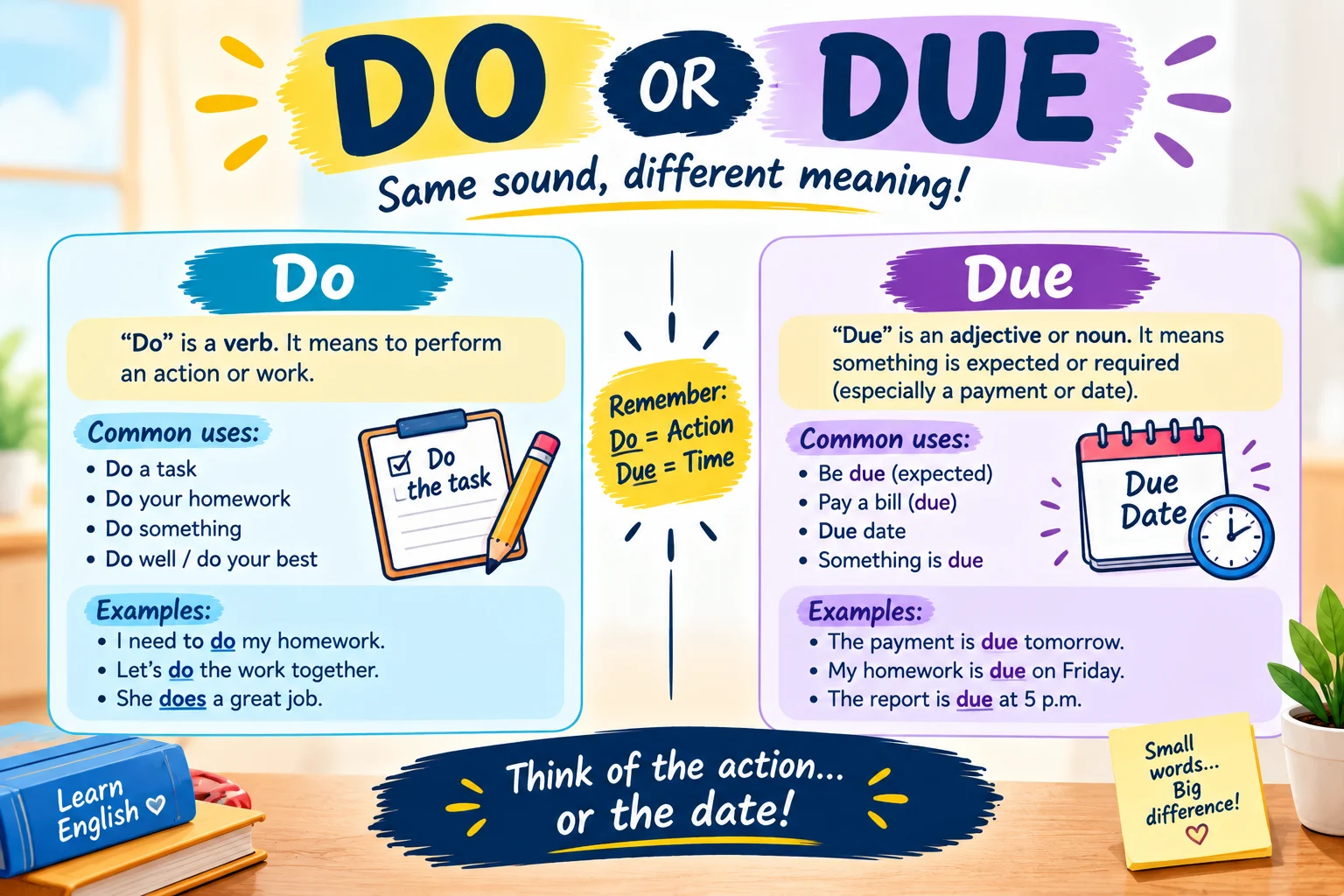
Do is a verb meaning to perform or complete an action. Due usually means expected, owed, or scheduled for a certain time.
Have you ever typed a sentence and stopped at two tiny words: do or due? You are not alone. These words sound different in some accents, but they can still cause confusion when you write quickly.
I have seen this mistake often in student writing, emails, messages, and online posts. A learner may write, “I have some work due,” when they mean “I have some work to do.” In another sentence, due is exactly the right word: “The payment is due tomorrow.”
The problem is not only spelling. Do and due have completely different jobs and meanings.
Do is mainly a verb. It talks about an action or task. Due is usually an adjective. It can describe something that is expected, owed, or scheduled.
Once you learn what each word means, the difference becomes easy. This guide gives you simple rules, real examples, common mistakes, and useful memory tricks. By the end, you will know exactly when to use do and when to use due.
do or due – Quick Answer
Do and due are both correct English words, but they have different meanings.
Do means to perform, complete, or carry out an action.
I need to do my homework.
Due means expected, owed, or scheduled to happen at a certain time.
My homework is due tomorrow.
A simple way to remember the difference is:
Do = action
Due = expected time or obligation
More examples
What should I do now?
Here, do refers to an action.
The report is due Friday.
Here, due tells us when the report is expected.
The Origin and Background of do and due
The words do and due have different histories, even though both are very common in English.
Where does do come from?
Do comes from Old English dōn, meaning to put, place, make, or perform.
Over many centuries, the word became one of the most useful verbs in English.
Today, do can mean many things:
- Perform an action
- Complete a task
- Carry out work
- Behave in a certain way
- Take part in an activity
- Help form questions and negatives
For example:
I do my work every morning.
What do you want?
I do not understand.
Because do has so many uses, it appears constantly in everyday English.
Where does due come from?
Due entered English through Anglo-French and Middle English forms connected with the idea of being owed or appropriate.
It is related to the Latin word debere, meaning to owe.
That history helps explain a major meaning of due.
When something is due, it is often owed or expected.
For example:
The rent is due on Monday.
The money is owed by Monday.
Another example is:
The train is due at 6:30.
The train is expected at that time.
Why do people confuse do and due?
The main problem is that both words are short and common.
They also appear in many phrases.
For example:
- do your work
- work is due
- do a task
- payment is due
- do something
- something is due
The meaning of the whole sentence tells you which word you need.
do or due Explained — Key Differences
The easiest way to understand do or due is to look at their main functions.
| Term | Meaning | When to Use | Region/Context |
|---|---|---|---|
| Do | Perform or complete an action | Tasks, activities, actions | Standard English |
| Due | Expected, owed, or scheduled | Deadlines, payments, arrivals | Standard English |
| Do | Auxiliary verb in questions and negatives | Questions and negative sentences | Standard English |
| Due | Caused by or resulting from | Explaining a cause | Formal and standard English |
When to use do
Use do when you are talking about an action or task.
I need to do my homework.
She will do the dishes.
What should we do next?
He did a great job.
Notice that do can change form:
- do
- does
- did
- done
- doing
When to use due
Use due when something is expected or required at a particular time.
The payment is due today.
The assignment is due next week.
The baby is due in July.
The bus is due at 9:00.
Due can also mean “caused by”
Due to is another common phrase.
The flight was delayed due to bad weather.
Here, due to means because of.
The match was canceled due to rain.
The rain caused the cancellation.
This use is different from the meaning of do.
The Most Useful Memory Trick
Here is a quick trick that works well:
Think about an action? Use do.
I have work to do.
Think about a deadline or expected event? Use due.
The work is due tomorrow.
Compare these two sentences:
I have a report to do.
My report is due tomorrow.
The first sentence tells you about the task.
The second tells you about the deadline.
That simple difference can solve many do or due questions.
Which Version Should You Use?
There is no single “correct” version between do and due. Both are correct. Your choice depends on the meaning.
For students → use do for tasks
When talking about completing schoolwork, use do.
I have to do my assignment tonight.
Use due when talking about the deadline.
My assignment is due tomorrow.
For professionals → use due for deadlines
Business writing often uses due for payments, documents, reports, and deadlines.
The invoice is due by Friday.
Use do when describing an action.
Please do the required checks before sending the report.
For everyday conversation → use do
Do is extremely common in normal speech.
What do you want to do?
I have nothing to do today.
But due is also common when discussing dates and obligations.
The bill is due next week.
For global or neutral English
Use both words according to their meaning.
Do not replace due with do, or do with due.
Remember:
Do = perform an action.
Due = expected or owed.
Common Mistakes with do or due
Mistake 1: Using due for an action
❌ I have homework to due.
✅ I have homework to do.
Homework is something you perform or complete.
Mistake 2: Using do for a deadline
❌ My assignment is do tomorrow.
✅ My assignment is due tomorrow.
The assignment has a deadline, so due is correct.
Mistake 3: Confusing “due to” with “do to”
❌ The delay was do to traffic.
✅ The delay was due to traffic.
Due to means because of.
Mistake 4: Writing “due” when you mean “do”
❌ What should I due?
✅ What should I do?
The sentence asks about an action, so do is correct.
Mistake 5: Forgetting that due can describe something expected
❌ The train is do at 8 p.m.
✅ The train is due at 8 p.m.
The train is expected to arrive at that time.
do or due in Real-World Examples
Seeing these words in real situations makes the difference easier to remember.
1. Professional email
Please do the final review before sending the document. The report is due by 4 p.m.
Here, do refers to an action.
Due refers to a deadline.
2. News headline
New Safety Rules Due to Take Effect Next Month
Here, due means expected or scheduled.
Another headline might say:
Officials Do More to Improve Road Safety
Here, do refers to taking action.
3. Social media post
I have so much work to do today, and my biggest project is due tomorrow!
Both words work naturally in the same sentence.
4. Formal report
The delay was due to a technical problem.
Here, due to gives the reason for the delay.
5. School assignment
I need to do my science project because it is due on Monday.
This is an excellent example because both words have different jobs.
Do vs. Due in Common Phrases
Learning common phrases can make these words much easier.
Common phrases with do
- do homework
- do work
- do business
- do exercise
- do the dishes
- do your best
- do something
- do nothing
- do a job
- do research
Examples:
I need to do some research.
She always does her best.
Common phrases with due
- due date
- due today
- due tomorrow
- payment due
- amount due
- due to
- due soon
- due by Friday
- due at 5 p.m.
- baby due in June
Examples:
What is the due date?
Your payment is due today.
The event was canceled due to rain.
Do or Due in Questions
One reason do can be confusing is that it can work as a helping verb.
For example:
Do you like coffee?
Do they live here?
What do you want?
In these sentences, do does not mean “perform.” It helps form the question.
The same thing happens in negative sentences:
I do not know.
She does not agree.
They did not arrive.
Due does not work this way.
You cannot use due as the helping verb in these sentences.
❌ Due you like coffee?
✅ Do you like coffee?
Do or Due — Data, Trends & Usage
The search intent behind “do or due” is mainly informational and spelling clarification.
People usually search the phrase when they are unsure which word belongs in a sentence.
The confusion appears often in situations involving:
- School assignments
- Work deadlines
- Emails
- Payments
- Grammar exercises
- Online messages
- Professional documents
One reason this pair matters is that both words are highly useful. You are likely to meet them often, especially when writing about tasks, deadlines, payments, schedules, and responsibilities.
There is also a useful learning pattern here.
Many English learners try to remember words by sound. That does not always work. Instead, connect the word to its meaning and function.
If you are talking about performing something, think do.
If you are talking about something expected, owed, or scheduled, think due.
That method is more reliable than simply memorizing the spelling.
Standalone Comparison Table
| Term/Variant | Meaning | Region/Context | Best Used When |
|---|---|---|---|
| Do | Perform an action | Everyday and formal English | Talking about tasks or actions |
| Due | Expected or scheduled | Everyday and formal English | Talking about deadlines or arrivals |
| Due | Owed or required | Business and finance | Talking about payments |
| Due to | Because of | Standard English | Giving a reason |
| Do | Helping verb | Questions and negatives | Forming questions or negatives |
| Did | Past form of do | Standard English | Talking about past actions |
| Done | Past participle of do | Standard English | Used with helping verbs |
| Doing | -ing form of do | Standard English | Talking about an action in progress |
FAQs About do or due
Q: What is the difference between do and due?
A: Do usually means to perform or complete an action. Due usually means expected, owed, or scheduled.
Q: Is it “work to do” or “work to due”?
A: The correct phrase is “work to do.” You use do because work is an action or task you need to complete.
Q: Is it “the work is due” or “the work is do”?
A: The correct phrase is “the work is due.” Here, due tells you that the work is expected by a certain time.
Q: What does “due to” mean?
A: Due to usually means because of. For example, “The flight was delayed due to bad weather.”
Q: Is do used in formal writing?
A: Yes. Do is a standard English verb and is completely acceptable in formal writing. It is also used as an auxiliary verb in questions and negative sentences.
Q: Is due used in formal writing?
A: Yes. Due is common in formal writing, especially when discussing deadlines, payments, schedules, and causes.
Q: Which is correct: “assignment is due” or “assignment is do”?
A: “The assignment is due” is correct when you mean that the assignment must be submitted by a certain deadline.
Q: Can do and due appear in the same sentence?
A: Yes. For example, “I need to do my homework because it is due tomorrow.” The two words have different meanings.
Q: Does due always refer to a deadline?
A: No. Due can also mean owed or caused by something. For example, “The payment is due,” or “The delay was due to rain.”
Q: How can I remember do or due?
A: Think do = action and due = expected or owed. For example, “I have work to do” and “The work is due Friday.”
Conclusion
The difference between do or due becomes easy when you focus on meaning.
Use do when you mean perform, complete, or carry out an action. You can do homework, do your job, do research, or do your best. Do also works as a helping verb in questions and negative sentences.
Use due when something is expected, owed, or scheduled. A payment can be due. An assignment can be due. A train can be due at a certain time. The phrase due to can also mean because of.
The most useful memory trick is short:
Do = action.
Due = deadline, expectation, or obligation.
Both words are correct. The key is choosing the one that matches your meaning.
Bookmark this guide and share it with someone who often gets “do or due” mixed up.