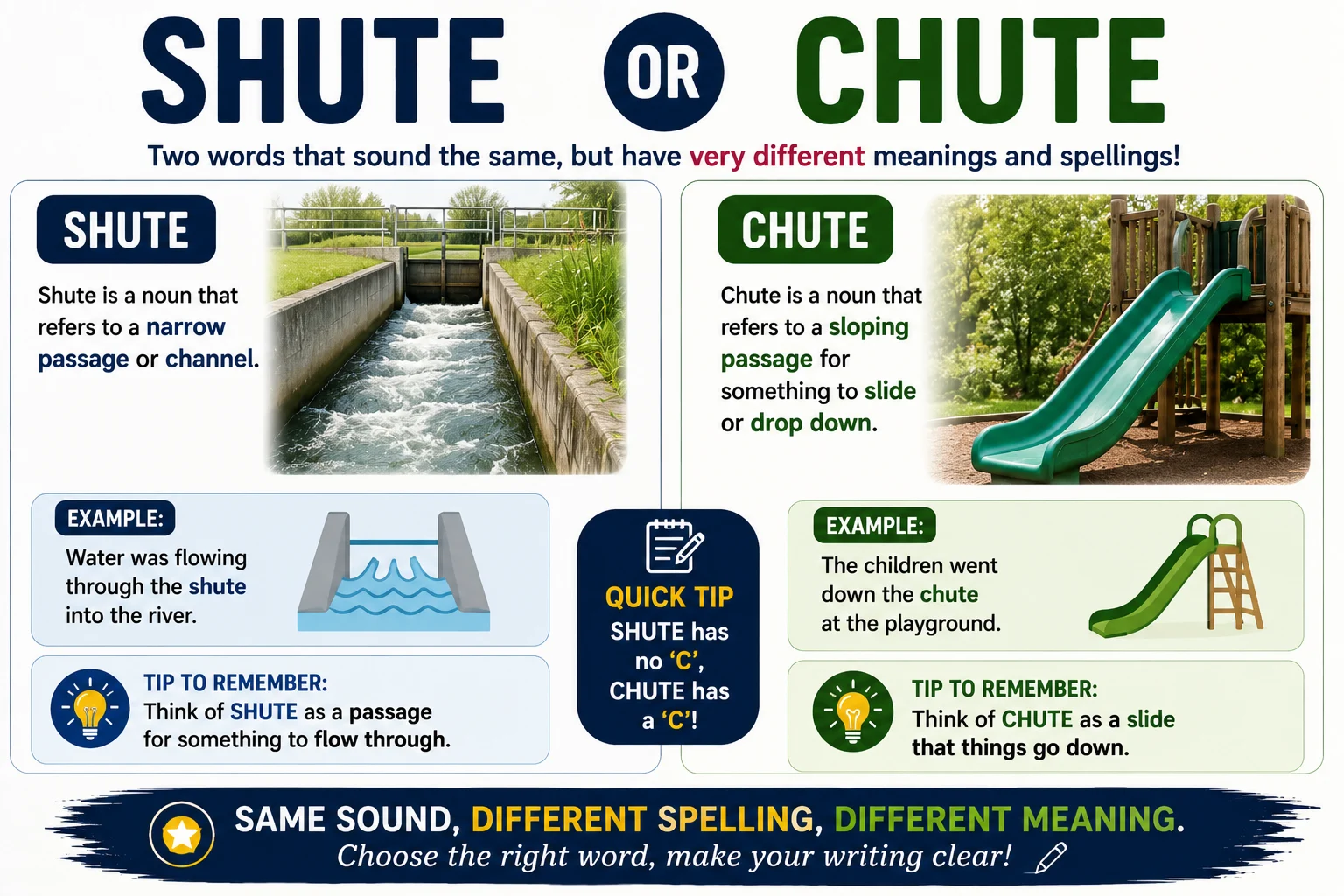
Chute is the standard spelling for a slide, sloping passage, or channel. Shute is also a dictionary-listed variant, but it is much less common, so chute is usually the best choice.
Have you ever written a sentence, looked at the word, and thought, “Is that really how it is spelled?” Shute or chute is one of those small spelling questions that can stop you in the middle of a sentence.
I have seen this confusion many times when helping English learners check words in emails, school work, reports, and everyday writing. The problem is easy to understand. Both spellings are pronounced the same, /ʃuːt/, so your ear cannot help you choose between them.
For example, you may want to write about a garbage chute, a water chute, or a steep passage used to move objects. You may then wonder if shute is an accepted spelling.
The answer has a useful twist. Shute is a real word, and major dictionaries list it as a less common spelling or variant of chute. Still, chute is the spelling you will normally want in modern English.
Let’s make the difference simple.
Shute or Chute – Quick Answer
When you mean a narrow, steep passage or slide through which people or things move, use chute.
Examples:
- The clothes fell down the chute.
- The miners sent the material down a chute.
- The children raced down the water chute.
Shute is not simply a spelling mistake. Merriam-Webster lists it as a less common spelling of chute.
So the quick rule is:
Chute = standard and preferred spelling.
Shute = valid but uncommon variant.
If you are writing for school, work, a website, or a general audience, chute is the safest choice.
The Origin and Background of Chute
The story behind chute is quite interesting.
The English word comes from French chute, meaning “fall.” The French word is related to an older French verb meaning “to fall,” which ultimately traces back to Latin. Merriam-Webster gives the first known English use of chute as 1805.
The meaning makes sense.
A chute is often a structure that lets something fall or slide downward.
Think about a laundry chute in an apartment building. You put clothes into the opening, and gravity carries them down. The same idea applies to a garbage chute or an industrial chute.
Cambridge defines a chute as a narrow, steep slope down which people or objects can slide. It also uses the word for a device associated with a parachute.
Why does “shute” exist?
English spelling has never been perfectly regular.
Words were often written in different ways before modern spelling became more fixed. In the case of shute, the spelling survived as a variant of chute.
Merriam-Webster still records shute as a variant.
This does not mean both spellings are equally common today.
That is the key point.
Chute is the normal modern spelling. Shute is much less common.
Shute or Chute Explained — Key Differences
The two words can refer to the same basic thing when shute is being used as a variant of chute.
The difference is mainly about standard usage and frequency.
| Term | Meaning | When to Use | Region/Context |
|---|---|---|---|
| chute | A sloping passage or slide | Use for normal modern writing | General English |
| shute | Variant spelling of chute | Use only when the variant is intended | Less common English |
| Shute | A proper name or surname | Use when referring to a person or place | Proper nouns |
1. Chute
Chute is the word you should normally choose.
It can describe many kinds of structures:
- garbage chute
- laundry chute
- water chute
- emergency chute
- coal chute
- mail chute
For example:
The workers moved the stones through the chute.
The word can also be used for a parachute in informal English. Cambridge lists chute as an informal short form of “parachute.”
2. Shute
Shute is a recognized variant of chute.
Merriam-Webster defines it as a “less common spelling of chute.”
So this sentence can be understood:
The boxes moved down the shute.
However, most readers today will expect chute.
For clear writing, especially in professional or academic work, chute is the better choice.
3. Shute as a Name
There is another important point.
Shute can be a proper name.
For example, Nevil Shute was the pen name of English novelist and aeronautical engineer Nevil Shute Norway.
There are also places and surnames called Shute.
In these cases, do not change Shute to Chute.
A name is a name.
Which Version Should You Use?
The easiest recommendation is simple:
For students → use chute
If you are writing an essay, homework answer, or school project, choose chute.
It is familiar and easy for your reader to recognize.
Example:
The water flowed through the chute.
For professional writers → use chute
In emails, reports, manuals, websites, and business documents, chute is the safer choice.
It avoids unnecessary questions about spelling.
Example:
Please check the delivery chute before operating the machine.
For global or neutral English → use chute
If your readers come from different English-speaking countries, chute is the clearest option.
It is the standard form shown in major English dictionaries. Cambridge, for example, defines chute as a narrow, steep slide or passage.
When should you use shute?
Use shute when:
- You are quoting an original source.
- You are discussing the spelling variant itself.
- The word appears as part of a proper name.
- A specific name, place, or title uses Shute.
Otherwise, chute is the better choice.
Common Mistakes with Shute or Chute
These words cause a few common errors.
| Mistake | Correction | Why |
|---|---|---|
| The clothes went down the shute. | The clothes went down the chute. | Chute is the usual spelling. |
| The Chute family lives nearby. | The Shute family lives nearby. | A proper name must keep its spelling. |
| We used the water shute. | We used the water chute. | Chute is standard here. |
| Put the boxes into the chute. | Correct. | Chute is the normal noun. |
| The writer was Nevil Chute. | The writer was Nevil Shute. | Shute is his name. |
Mistake 1: Thinking “shute” is always wrong
This is not quite true.
Shute is a recognized variant of chute. Merriam-Webster lists it as a less common spelling.
The better rule is:
Not wrong, but usually not preferred.
Mistake 2: Using “shute” because it sounds natural
English spelling cannot always be guessed from sound.
Both chute and shute have the same basic pronunciation, so listening alone will not tell you which spelling to use.
When in doubt, remember:
Chute = normal spelling.
Mistake 3: Changing a person’s name
If you see Nevil Shute, do not “correct” it to Nevil Chute.
Proper names keep their own spelling.
Shute or Chute in Real-World Examples
Knowing the rule is useful. Seeing it in context is even better.
1. Professional Email
Subject: Laundry Chute Maintenance
Please inspect the chute before the maintenance team begins work. We want to make sure there are no blocked areas.
Here, chute is the natural professional choice.
2. News Headline
New Safety Rules Introduced for Emergency Chutes
A news headline would normally use chutes, the plural of chute.
The spelling is direct and familiar.
3. Social Media Post
The water chute was the best part of the trip!
This is casual writing, but chute is still the usual spelling.
4. Formal Report
The inspection found a blockage in the waste chute on the third floor.
Again, chute is the right choice for standard modern English.
5. A Proper Name
Nevil Shute wrote several well-known novels.
Here, Shute is correct because it is a name.
Shute or Chute — Data, Trends & Usage
People usually search shute or chute because they know how the word sounds but are unsure about its spelling.
This makes the query mainly informational.
The most common search needs are likely to be:
- spelling checks
- dictionary definitions
- grammar questions
- writing corrections
- word comparisons
- vocabulary learning
There is also a practical reason this question continues to appear.
English has many words with unusual spellings. When two forms sound identical, writers often rely on memory or autocorrect. That can lead to uncertainty.
Dictionary evidence gives us a clear answer. Chute is the main modern form, while shute remains a recognized variant.
Cambridge also gives several common compounds, including water chute, laundry chute, garbage chute, and emergency chute.
A useful insight
The spelling question is not really about whether shute exists.
It does.
The real question is:
Which spelling will make your writing clear to the largest number of readers?
The answer is chute.
Shute or Chute: Comparison Table
| Term/Variant | Meaning | Region/Context | Best Used When |
|---|---|---|---|
| chute | Sloping passage or slide | Modern general English | Almost all normal writing |
| shute | Less common variant of chute | Less common usage | When specifically using the variant |
| Shute | Surname or proper name | Names and titles | When referring to a person or place |
| chutes | Plural of chute | General English | More than one chute |
| shutes | Plural of shute | Rare/variant usage | When preserving the variant |
The safest everyday rule is:
If you mean a slide or sloping passage, write “chute.”
Chute vs. Shoot: Do Not Mix Them Up
There is another word that can cause confusion: shoot.
Although shoot, chute, and shute may sound similar in some contexts, they do not have the same modern meaning.
Chute
A chute is a passage or slide.
The packages moved down the chute.
Shoot
Shoot has many meanings.
It can mean to fire a weapon, take a photograph, send something quickly, or produce a new plant stem.
We will shoot the video tomorrow.
So remember:
Chute = a slide or passage.
Shoot = a verb with several different meanings.
This distinction is especially useful for English learners.
FAQ About Shute or Chute
Q: Is “shute” a correct spelling?
A: Yes. Shute is a recognized variant spelling of chute. However, it is much less common, so chute is usually the better choice in modern writing.
Q: Which is correct, shute or chute?
A: Both can be valid when referring to the same type of sloping passage. Chute is the standard and more common spelling, so use it unless you have a specific reason to use shute.
Q: What does “chute” mean?
A: A chute is a narrow, steep passage or slide through which people or objects can move downward. Examples include a laundry chute, garbage chute, and water chute.
Q: Is “chute” acceptable in formal writing?
A: Yes. Chute is completely acceptable in formal writing when the word fits the meaning. It is the preferred spelling for most professional, academic, and general contexts.
Q: Is “shute” a spelling mistake?
A: Not always. Dictionaries recognize shute as a less common variant of chute. Still, using chute will usually be clearer and more familiar to modern readers.
Q: Where does the word “chute” come from?
A: Chute comes from French and is linked to the idea of falling. Merriam-Webster traces it through Old French to a Latin root meaning “to fall.” Its first known English use dates to 1805.
Q: Is “Shute” also a name?
A: Yes. Shute can be a surname and a proper name. A well-known example is novelist Nevil Shute. When it is a name, keep the spelling Shute rather than changing it to Chute.
Final Verdict: Shute or Chute?
When you are choosing between shute or chute, the decision is easier than it first appears.
Chute is the standard spelling you should normally use. It describes a sloping passage, channel, or slide. You will see it in phrases such as garbage chute, laundry chute, water chute, and emergency chute.
Shute is not simply a made-up spelling. It is a recognized, less common variant of chute.
There is one more detail to remember. Shute may also be a surname or another proper name. In that case, its spelling should stay exactly as given.
So, for most everyday writing, use this simple rule:
Chute = preferred.
Shute = uncommon variant or proper name.
Once you remember that, this spelling question becomes much easier.
Bookmark this guide so you never second-guess “shute or chute” again.