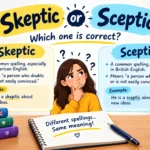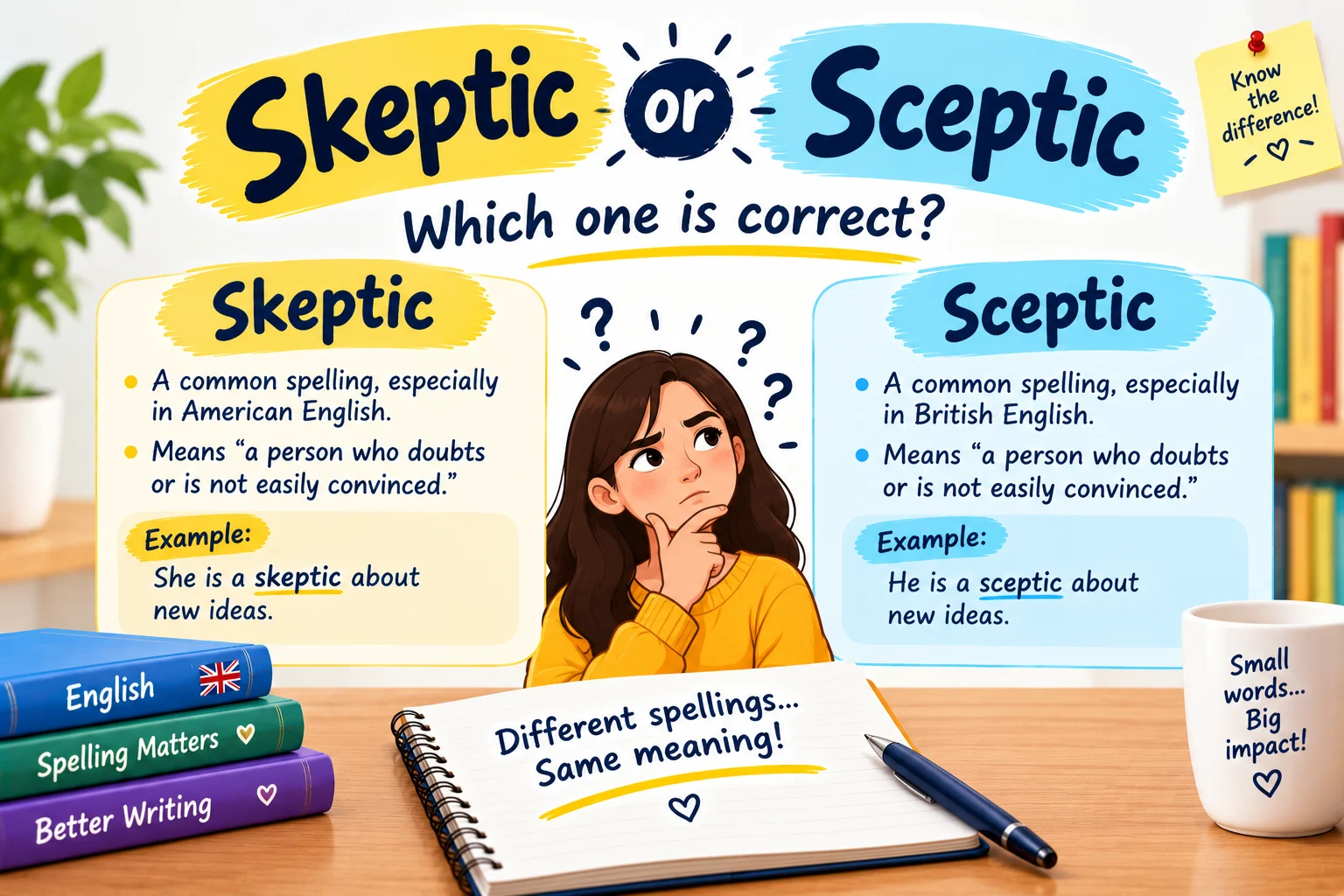
Skeptic and sceptic are both correct spellings. Skeptic is standard in American English, while sceptic is standard in British English.
Have you ever written skeptic and then wondered if you should have written sceptic instead? That one letter can make even confident English writers stop and check.
I have seen this question many times while helping students with essays, emails, articles, and everyday English. The confusion is understandable because both spellings look almost identical and both have the same meaning.
The good news is that neither spelling is wrong.
The difference comes from British and American English. American English normally uses skeptic, with a k. British English normally uses sceptic, with a c.
Both words describe a person who does not easily believe a claim and wants proof before accepting it. A skeptic may question a new idea, a surprising story, or a claim that sounds too good to be true.
So, which spelling should you use? That depends on your audience and the type of English you are writing. Let’s make the choice simple.
skeptic or sceptic – Quick Answer
Skeptic and sceptic are both correct.
The main difference is regional spelling:
- Skeptic → American English
- Sceptic → British English
Both mean a person who questions claims instead of accepting them without evidence.
Simple examples
She is a skeptic who wants to see proof.
American English uses skeptic.
He is a sceptic about the new treatment.
British English uses sceptic.
The meaning does not change. Only the spelling changes.
The Origin and Background of Skeptic and Sceptic
The words skeptic and sceptic come from the same historical source.
They are related to the Greek word skeptikos, which refers to someone who investigates, considers, or examines things carefully.
The idea behind the word is simple: do not accept a claim without thinking about it first.
The word entered English through different historical forms and spelling traditions. Over time, British and American English developed different preferences.
American English settled on skeptic.
British English kept the spelling sceptic.
This is similar to other spelling differences between the two varieties of English.
For example:
- American: color / British: colour
- American: center / British: centre
- American: realize / British: realise
- American: skeptic / British: sceptic
The pronunciation and meaning remain essentially the same.
Why does one use “k” and the other use “c”?
The difference comes from spelling traditions.
The k in skeptic reflects the Greek-based form more directly. British English commonly uses sceptic, following a different historical spelling pattern.
Neither version is a misspelling when used in its proper regional variety.
skeptic or sceptic Explained — Key Differences
The biggest point is easy:
Skeptic = American English
Sceptic = British English
Here is a quick comparison.
| Term | Meaning | When to Use | Region/Context |
|---|---|---|---|
| Skeptic | A person who questions claims | American English writing | United States and contexts using US English |
| Sceptic | A person who questions claims | British English writing | UK and contexts using British English |
| Skeptical | Doubting or questioning | American English | US English |
| Sceptical | Doubting or questioning | British English | UK English |
| Skepticism | A questioning attitude | American English | US English |
| Scepticism | A questioning attitude | British English | UK English |
Skeptic in American English
If you are following American English, use skeptic.
The skeptic asked for scientific evidence.
Many skeptics questioned the claim.
The related adjective is:
skeptical
Example:
I am skeptical about that story.
The noun is:
skepticism
Example:
There was some skepticism about the new product.
Sceptic in British English
If you are following British English, use sceptic.
The sceptic asked for more evidence.
Several sceptics challenged the claim.
The related adjective is:
sceptical
Example:
She was sceptical about the proposal.
The noun is:
scepticism
Example:
His scepticism was understandable.
Skeptic vs. Sceptic: The Related Spellings
One useful thing to remember is that the spelling difference continues into related words.
| American English | British English |
|---|---|
| skeptic | sceptic |
| skeptical | sceptical |
| skepticism | scepticism |
| skeptically | sceptically |
This helps you stay consistent.
If your article uses American English, write skeptic, skeptical, and skepticism.
If your article uses British English, write sceptic, sceptical, and scepticism.
Try not to mix the systems without a reason.
Which Version Should You Use?
Your audience should guide your choice.
For American readers → use skeptic
If you are writing for readers in the United States, skeptic is the natural choice.
For example:
The skeptic wanted more proof before accepting the claim.
American newspapers, websites, schools, and businesses generally use this spelling.
For British readers → use sceptic
If your audience is in the United Kingdom, use sceptic.
The sceptic refused to accept the claim without evidence.
The same spelling is also common in other English varieties that follow British spelling traditions.
For students → follow your school style
Students should check which form their teacher or school expects.
If your course follows American English, use skeptic.
If it follows British English, use sceptic.
The key is consistency.
For global readers → choose one style and stay consistent
If you are writing for an international audience, either spelling can work.
However, choose a main English style for the whole document.
For example, if the rest of your article uses:
- color
- center
- organize
then skeptic fits the American style.
If you use:
- colour
- centre
- organise
then sceptic fits the British style.
Common Mistakes with skeptic or sceptic
Mistake 1: Calling one spelling wrong
❌ Sceptic is incorrect.
✅ Sceptic is the British spelling.
Both forms are correct. The choice depends on the English variety.
Mistake 2: Mixing related forms
❌ She is a sceptic who is very skeptical.
✅ She is a sceptic who is very sceptical.
Or:
✅ She is a skeptic who is very skeptical.
Mixing the forms is not always a serious error, but consistent spelling looks cleaner.
Mistake 3: Using “skeptic” in a British-style article
If your article consistently follows British English, sceptic is usually the better choice.
For example:
The sceptic questioned the evidence.
Mistake 4: Thinking skeptic means “negative person”
A skeptic is not necessarily negative.
A skeptic may simply want evidence before believing something.
For example:
Maria was skeptical about the claim until she saw the research.
She did not reject the claim forever. She wanted proof first.
Mistake 5: Confusing skeptic with cynic
These words are related but not identical.
A skeptic asks for evidence.
A cynic often expects people or situations to have selfish or dishonest motives.
The skeptic asked, “Where is the evidence?”
The cynic said, “They are probably lying.”
That difference matters.
skeptic or sceptic in Real-World Examples
1. Professional Email
American English:
I understand your concern, but even the most careful skeptic would need to review the available evidence.
British English:
I understand your concern, but even the most careful sceptic would need to review the available evidence.
Both sentences are correct.
2. News Headline
American English:
Skeptics Question New Health Claim
British English:
Sceptics Question New Health Claim
The meaning is exactly the same.
3. Social Media Post
American English:
I was a skeptic at first, but the results surprised me.
British English:
I was a sceptic at first, but the results surprised me.
This is a natural way to describe a change in belief.
4. Formal Report
American English:
The study addressed concerns raised by skeptics.
British English:
The study addressed concerns raised by sceptics.
The correct version depends on the report’s style guide.
5. Academic Writing
A scientific skeptic should ask whether the evidence supports the conclusion.
For British academic writing:
A scientific sceptic should ask whether the evidence supports the conclusion.
Both are suitable when the regional spelling matches the rest of the document.
Skeptic or Sceptic: Meaning in Different Contexts
The word can appear in many areas of life.
Science
A skeptic may ask for strong evidence before accepting a scientific claim.
The skeptic requested more data.
Business
A business leader may be skeptical about a new plan.
The manager was skeptical about the proposal.
News
Journalists may question claims that lack evidence.
Sceptics challenged the statement.
Everyday conversation
You can also use the word in simple daily speech.
I’m a skeptic when someone promises easy money.
The idea is always similar: question first, believe after checking.
Skeptic vs. Cynic
Many English learners confuse these words.
Skeptic
A skeptic wants evidence.
The skeptic asked for proof.
The person may accept the claim once good evidence is provided.
Cynic
A cynic tends to distrust people’s motives.
The cynic believed the company only wanted money.
So, being skeptical can be healthy.
It can encourage careful thinking without automatically rejecting an idea.
skeptic or sceptic — Data, Trends & Usage
The search intent behind “skeptic or sceptic” is mainly informational and spelling clarification.
People often search the phrase when writing:
- School assignments
- Academic papers
- Blog posts
- News articles
- Business reports
- Emails
- Social media content
The regional difference is the main reason for the search.
Skeptic is strongly associated with American English.
Sceptic is strongly associated with British English.
The same pattern appears in the related words skeptical/sceptical and skepticism/scepticism.
This matters more than ever for online writers because a single article can reach readers from many countries. A writer who understands regional spelling can choose the right form and keep the entire article consistent.
The best SEO approach is not to force one spelling everywhere. Instead, explain both forms naturally and use the spelling that matches your target audience.
Standalone Comparison Table
| Term/Variant | Meaning | Region/Context | Best Used When |
|---|---|---|---|
| Skeptic | Person who questions a claim | American English | Writing for US readers |
| Sceptic | Person who questions a claim | British English | Writing for UK readers |
| Skeptical | Doubting or questioning | American English | US-style writing |
| Sceptical | Doubting or questioning | British English | UK-style writing |
| Skepticism | A questioning attitude | American English | US-style writing |
| Scepticism | A questioning attitude | British English | UK-style writing |
| Cynic | Person who distrusts motives | All major varieties | Talking about distrust of people or motives |
FAQs About skeptic or sceptic
Q: Which is correct, skeptic or sceptic?
A: Both are correct. Skeptic is the standard American spelling, while sceptic is the standard British spelling.
Q: What does skeptic mean?
A: A skeptic is someone who does not easily believe a claim without evidence. The British spelling is sceptic.
Q: Is skeptic American or British?
A: Skeptic is mainly the American English spelling. British English normally uses sceptic.
Q: Is sceptic a correct English word?
A: Yes. Sceptic is the standard British English spelling. It is not a spelling mistake.
Q: What is the difference between skeptic and sceptic?
A: There is no major difference in meaning. The main difference is spelling: skeptic is American English, while sceptic is British English.
Q: Which spelling should I use in formal writing?
A: Use the spelling that matches your audience or required style guide. American formal writing normally uses skeptic, while British formal writing normally uses sceptic.
Q: What is the difference between skeptic and cynic?
A: A skeptic asks for evidence before believing something. A cynic tends to distrust people’s motives or expect bad intentions.
Q: What is the British spelling of skeptical?
A: The British spelling is sceptical. American English uses skeptical.
Q: What is the American spelling of scepticism?
A: The American spelling is skepticism. British English normally uses scepticism.
Q: Can I use skeptic in a British English article?
A: Readers will understand skeptic, but sceptic is the normal British spelling. If your article follows British English, use sceptic for consistency.
Conclusion
The choice between skeptic or sceptic is much easier once you know that both spellings are correct.
Skeptic is the standard American English form. Sceptic is the standard British English form. Both describe a person who questions a claim and wants evidence before accepting it.
The difference also appears in related words. American English uses skeptical and skepticism, while British English uses sceptical and scepticism.
The best rule is simple: match the spelling to your audience.
If you are writing for Americans, choose skeptic. If you are writing for British readers, choose sceptic. For global content, either can work, but keep your spelling style consistent throughout the piece.
Also remember that a skeptic is not the same as a cynic. A skeptic asks for proof. A cynic may distrust people’s motives.
Now you know exactly when to use skeptic or sceptic. Bookmark this guide, and share it with someone who is unsure about this common spelling difference.