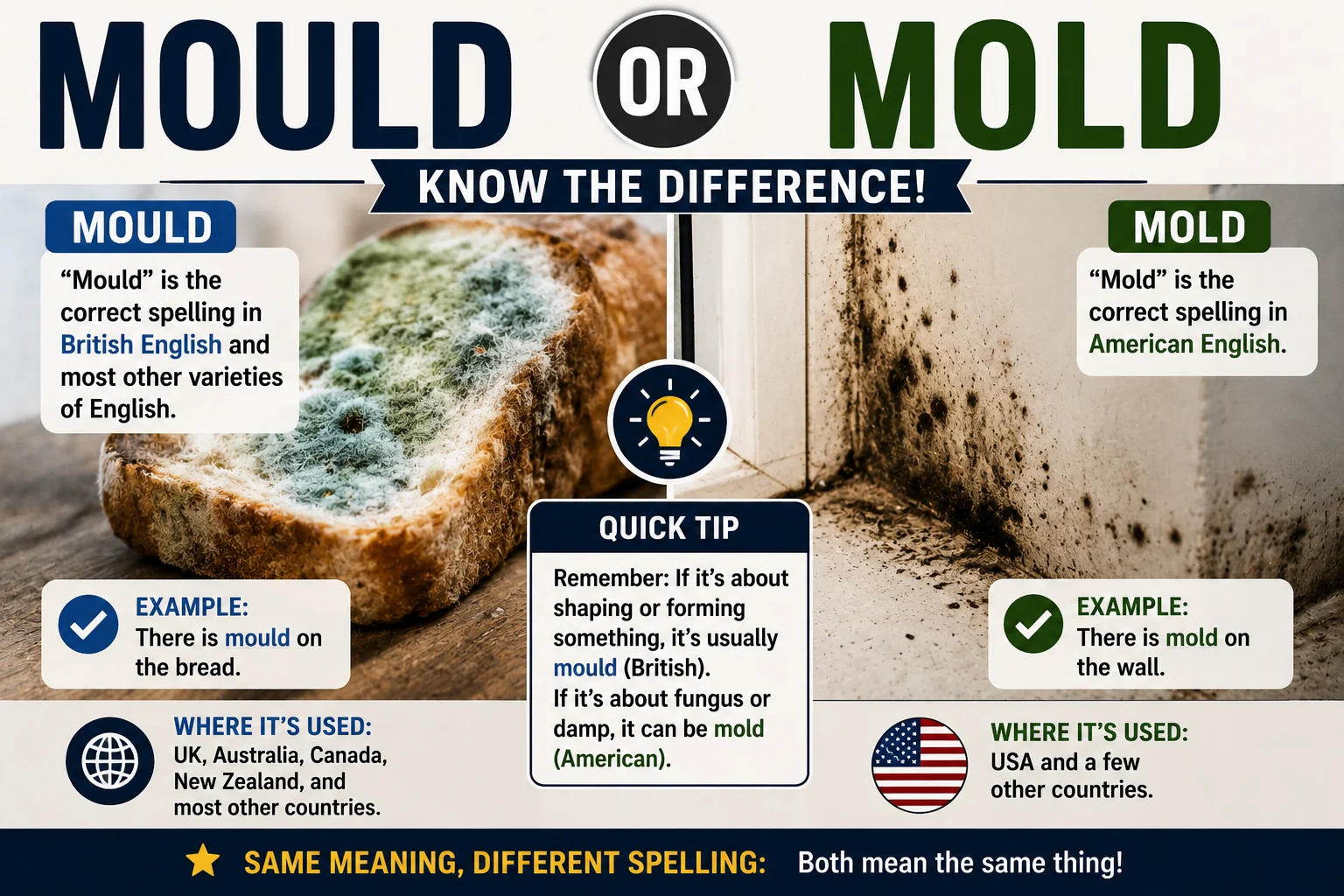
“Mould” is the British spelling, while “mold” is the American spelling; both refer to the same thing or process.
Have you ever seen the words mould and mold and wondered which one is correct? You are not alone. Many English learners, writers, and business owners search for mould or mold because they see both spellings online, in books, and in everyday communication.
The good news is that both spellings are correct. The difference depends mainly on the type of English you use. In British English, mould is the standard spelling. In American English, mold is the preferred spelling.
The words have the same meaning. They can refer to a fungus that grows in damp places or a hollow container used to shape materials such as plastic, metal, or food.
This guide explains the difference between mould and mold, their history, regional usage, common mistakes, and real-life examples. By the end, you will know exactly which spelling to choose for your audience.
Mould or Mold – Quick Answer
Mould and mold are different spellings of the same word.
- Mould = British English spelling
- Mold = American English spelling
Both can mean:
- A fungus that grows in damp places.
- A shape or container used to form something.
Examples
- There is mould on the bathroom wall. (UK)
- There is mold on the bathroom wall. (US)
- The cake was made using a silicone mould. (UK)
- The cake was made using a silicone mold. (US)
The meaning stays the same. Only the spelling changes.
The Origin of Mould or Mold
The word comes from Old French and Germanic languages. It entered Middle English many centuries ago and developed different spelling forms over time.
Originally, English spelling was not standardized. Writers often spelled words in different ways. As British and American English evolved separately, some words adopted different spellings.
British English kept mould, while American English simplified the spelling to mold. This change followed a broader trend in American English, where some silent letters were removed from words.
Despite the spelling difference, both forms share the same history and meaning. Today, the choice depends mainly on your audience and location.
British English vs American English Spelling
The difference between mould and mold follows a common pattern seen in many British and American spelling variations.
British English often keeps older spellings, while American English prefers simplified forms.
| Version | Spelling | Region | Example Sentence |
|---|---|---|---|
| British English | Mould | UK, Australia, New Zealand, Commonwealth countries | The bread developed mould after a few days. |
| American English | Mold | United States | The bread developed mold after a few days. |
The rule is simple:
- Use mould in British English.
- Use mold in American English.
Neither spelling is more correct than the other.
Which Spelling Should You Use?
US Audience
Use mold.
American readers expect this spelling and may see mould as unusual or foreign.
Example:
- The inspector found mold in the basement.
UK/Commonwealth Audience
Use mould.
Readers in the UK, Australia, New Zealand, and many Commonwealth countries are more familiar with this spelling.
Example:
- The inspector found mould in the basement.
Global/SEO Audience
Choose one spelling and stay consistent.
If your audience is mostly American, use mold. If your audience is international or focused on the UK, use mould.
For SEO, consider the region you want to target because users often search using the spelling common in their country.
Common Mistakes with Mould or Mold
Here are some common errors people make.
1. Mixing Both Spellings in One Article
Incorrect:
- The wall has mold.
- The bathroom has mould.
Correct:
Choose one spelling style and use it throughout the document.
2. Thinking One Spelling Is Wrong
Incorrect:
- Mold is incorrect English.
Correct:
- Both mould and mold are correct.
3. Using the Wrong Regional Spelling
Incorrect for US audience:
- The house has mould damage.
Better:
- The house has mold damage.
4. Assuming the Meaning Changes
Incorrect assumption:
- Mould and mold have different meanings.
Correct:
- They mean the same thing.
5. Switching Spellings for SEO
Some writers repeatedly use both spellings in the same paragraph.
Better approach:
Use the spelling that matches your target audience and mention the alternative only when necessary.
Mould or Mold in Everyday Examples
Emails
UK Example:
We found mould behind the kitchen cabinet.
US Example:
We found mold behind the kitchen cabinet.
News Headlines
UK Style:
Mould Found in Several Apartment Buildings
US Style:
Mold Found in Several Apartment Buildings
Social Media
Just discovered mold in my bathroom. Time for a deep clean!
Found mould on the window frame after the rainy season.
Formal Writing
UK Style:
The report identified mould growth in several areas of the property.
US Style:
The report identified mold growth in several areas of the property.
Mould or Mold – Google Trends & Usage
Search interest in mould and mold generally follows regional language patterns.
People in the United States usually search for mold, especially when discussing home repairs, health concerns, food safety, and construction.
In the United Kingdom and many Commonwealth countries, mould is more common in online searches, educational materials, and news articles.
The choice also depends on context. Health-related topics, household cleaning guides, and property maintenance articles often use the spelling preferred by local readers.
For global businesses and websites, understanding these regional preferences can help improve user experience and search visibility.
Comparison Table
| Feature | Mould | Mold |
|---|---|---|
| Correct Spelling | Yes | Yes |
| Main Region | UK & Commonwealth | United States |
| Meaning | Fungus or shaping form | Fungus or shaping form |
| Formal Usage | Yes | Yes |
| Common in UK Search Results | Yes | Less Common |
| Common in US Search Results | Less Common | Yes |
FAQs
1. Is mould or mold correct?
Both are correct. Mould is British English, and mold is American English.
2. What is the difference between mould and mold?
There is no difference in meaning. The only difference is regional spelling.
3. Should I use mould or mold for a US audience?
Use mold for American readers.
4. Should I use mould or mold in the UK?
Use mould in British English writing.
5. Is mould the older spelling?
Yes. Mould reflects the traditional British spelling, while mold became the standard American form.
6. Can mould and mold refer to both fungus and shaping tools?
Yes. Both spellings can describe fungal growth or a container used for shaping materials.
7. Which spelling is better for SEO?
The best spelling depends on your target audience. Use mold for US traffic and mould for UK-focused content.
Conclusion
The answer to mould or mold is simple: both spellings are correct. The choice depends on where your audience lives and which version of English you use.
If you write for American readers, use mold. If your audience is in the United Kingdom, Australia, New Zealand, or other Commonwealth countries, use mould. The meaning remains exactly the same regardless of spelling.
Both words can describe fungal growth in damp places or a form used to shape materials such as food, plastic, or metal. The spelling difference comes from the natural development of British and American English over time.
When writing articles, emails, reports, or social media posts, consistency is important. Pick one spelling style and use it throughout your content. This creates a more professional and polished reading experience.
Remember this simple rule: mould for British English, mold for American English. Once you know your audience, choosing the correct spelling becomes easy and confident.