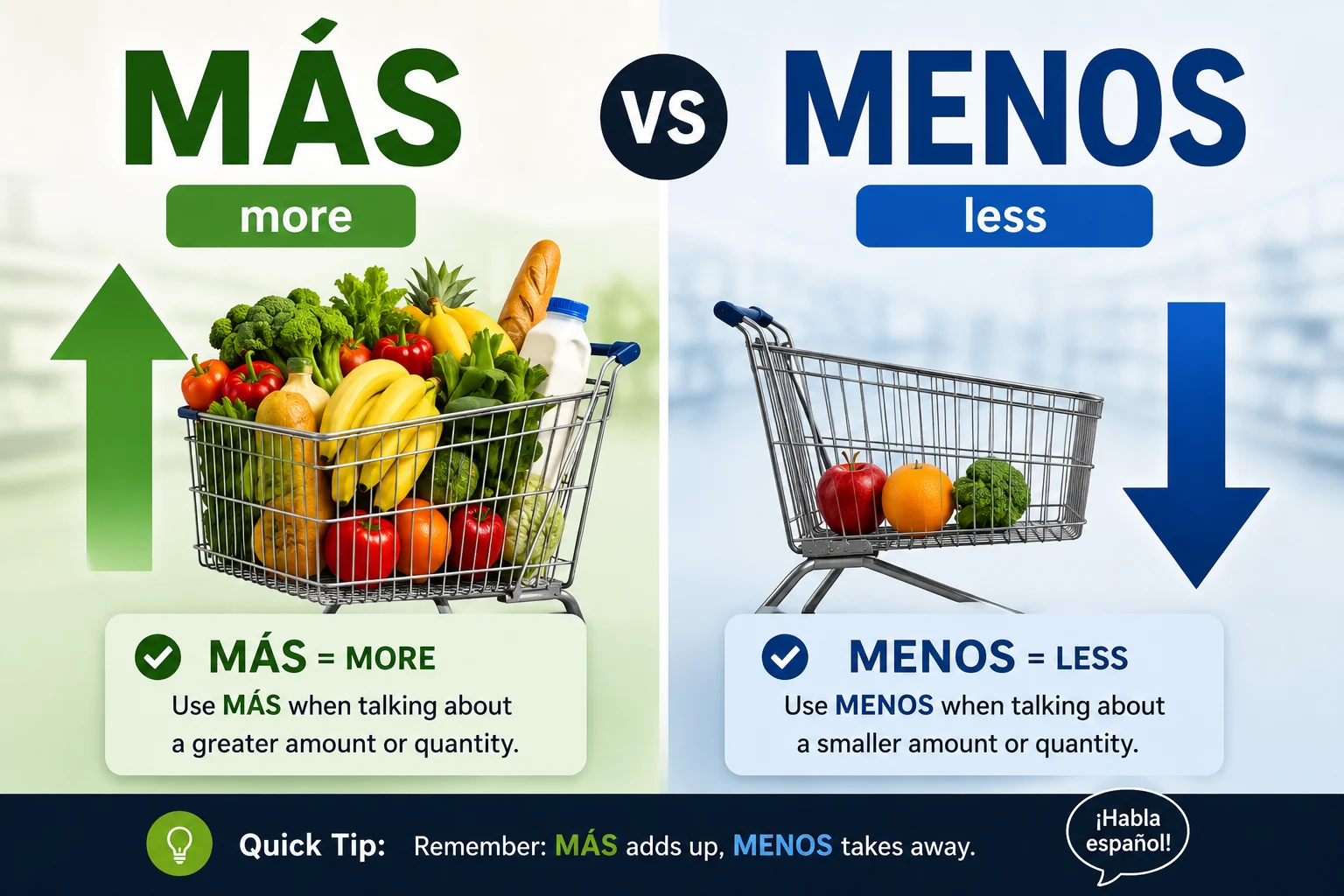
“Más” means “more,” while “menos” means “less” in Spanish, often used to compare amounts, qualities, or degrees.
Have you seen mas or menos and wondered if it is spelled correctly? You are not alone. This Spanish phrase appears often in English conversations, social media posts, messages, travel writing, and everyday speech. Many people search for mas or menos because they want to know what it means, whether it needs an accent mark, and how to use it correctly.
The correct Spanish spelling is más o menos. It usually means “more or less,” “approximately,” “about,” or “roughly” in English.
The phrase is common because it can make a statement less exact. For example, you can use it when you do not know the exact price, time, amount, or answer.
In this guide, we will explain the meaning of más o menos, its origin, correct spelling, common mistakes, and everyday examples. We will also explain whether British English and American English use different forms.
Mas or Menos – Quick Answer
Más o menos is a Spanish phrase that means “more or less,” “approximately,” “about,” or “roughly.”
The correct Spanish spelling is:
más o menos ✅
The word más has an accent mark over the a.
The phrase can describe an amount that is not exact:
- Cuesta más o menos diez dólares.
= It costs about ten dollars. - Llegaré más o menos a las cinco.
= I will arrive around five. - Estoy más o menos bien.
= I am more or less okay.
The unaccented form mas o menos is commonly seen in informal writing, searches, and text without accent marks. However, in standard Spanish writing, más o menos is the preferred form.
The Origin of Mas or Menos
Más o menos comes from Spanish.
The phrase is made of three parts:
- más = more
- o = or
- menos = less
Together, más o menos literally means “more or less.”
Spanish has used the words más and menos for centuries. The combination developed as a natural way to show an approximate amount or an answer that is not completely exact.
The accent mark in más is important. In Spanish, más means “more” or “plus.” The word mas without an accent can have a different grammatical function and is used as a formal conjunction meaning “but.”
For this reason, más o menos is the standard spelling when you mean “more or less.”
When people write mas o menos, they may be leaving out accent marks because of typing habits, keyboard settings, or informal online communication.
British English vs American English Spelling
There is no British English vs American English spelling difference for the Spanish phrase más o menos.
Both British and American English speakers can use the Spanish phrase in the same way. The main spelling point is the Spanish accent:
más o menos ✅
If you translate the phrase into English, both British and American English can use more or less, about, around, or approximately, depending on the sentence.
| Version | Spelling | Region | Example Sentence |
|---|---|---|---|
| Spanish | más o menos | Spanish-speaking countries | Son más o menos diez minutos. |
| English | more or less | US & UK | It takes more or less ten minutes. |
| English | about | US & UK | It takes about ten minutes. |
| English | approximately | US & UK | It takes approximately ten minutes. |
The Spanish form does not change between British and American English.
Which Spelling Should You Use?
US audience
If you are writing for a US audience, you can use más o menos when the Spanish phrase fits your content.
For an English-only text, more or less, about, or approximately may be easier for readers.
Example:
Spanish: The meeting will last más o menos one hour.
English: The meeting will last about one hour.
UK/Commonwealth audience
The same rule applies to UK and Commonwealth readers.
There is no special British spelling of más o menos. Keep the Spanish spelling if you are using the original phrase.
Global/SEO audience
For global content, más o menos is the safest Spanish form.
If your article targets people searching for mas or menos, you can mention the unaccented search phrase naturally. However, use más o menos as the standard form throughout most of the article.
This helps readers understand both the search query and the correct Spanish spelling.
Common Mistakes with Mas or Menos
Here are some common mistakes learners make.
1. Writing “mas o menos” as standard Spanish
Incorrect: Mas o menos diez minutes.
Correct: Más o menos diez minutos.
The accent belongs on más.
2. Confusing “más” and “mas”
Más means more.
Mas can be a formal Spanish conjunction meaning but.
For the phrase meaning “more or less,” use más o menos.
3. Translating every use as “more or less”
Sometimes más o menos is better translated as about, around, or approximately.
For example:
Más o menos veinte personas.
Natural English:
About twenty people.
4. Forgetting that Spanish nouns and numbers follow Spanish grammar
When using the phrase in a full Spanish sentence, the rest of the sentence should also follow Spanish grammar.
Correct: Más o menos diez minutos.
Not:
Incorrect: Más o menos ten minutes.
5. Assuming it is an English spelling variation
Mas or menos is not a British or American spelling variation.
It is a Spanish phrase. The standard Spanish form is más o menos.
Mas or Menos in Everyday Examples
Emails
You may see the phrase in an informal or bilingual email:
The delivery should arrive más o menos at 3 p.m.
For a fully English professional email, a clearer option is:
The delivery should arrive around 3 p.m.
News Headlines
A headline or article about a Spanish-speaking country may use the original phrase:
Más o menos 500 people attended the event.
In English news writing, about 500 people may sound more natural.
Social Media
The phrase is common in casual posts and captions:
I have been learning Spanish for más o menos two years.
It can also appear in bilingual posts:
My Spanish is más o menos good!
Formal Writing
In formal English, consider using approximately when precision matters:
The project will take approximately six months.
In Spanish formal writing, más o menos can still be correct, but another expression such as aproximadamente may be more precise in some contexts.
Mas or Menos – Google Trends & Usage
Search interest for mas or menos can appear in many countries because people search for the phrase in several different contexts.
Spanish-speaking users may search for its meaning, spelling, translation, or correct use. English-speaking users may search for the phrase after hearing it in conversation, music, films, travel, or social media.
The unaccented search form mas or menos can also be popular because many people do not type Spanish accent marks when searching online.
Usage is especially relevant in bilingual and multilingual settings. The phrase is widely understood across Spanish-speaking regions, although local speech and pronunciation can vary.
For SEO, it is useful to understand the difference between a search query and the standard spelling. Someone may search for mas or menos, but the correct Spanish form is más o menos.
Mas or Menos: Comparison Table
| Variation | Correct? | Meaning | Best Use |
|---|---|---|---|
| más o menos | ✅ Yes | More or less; about | Standard Spanish |
| mas o menos | ⚠️ Not standard for this meaning | Intended as “more or less” | Common unaccented search/typing form |
| more or less | ✅ Yes | Más o menos | English |
| about | ✅ Yes | Approximately | Natural English |
| approximately | ✅ Yes | About | Formal English |
| around | ✅ Yes | About | Natural English, especially with time/amounts |
The key point is simple: más o menos is the standard Spanish phrase.
FAQs About Mas or Menos
1. What does “mas or menos” mean?
Más o menos means “more or less,” “about,” “approximately,” or “roughly.”
2. Is “mas o menos” correct?
For standard Spanish, write más o menos with an accent on más. The unaccented form is common in informal typing and online searches.
3. Why does “más” have an accent?
The accent helps distinguish más, meaning “more,” from mas, a formal conjunction meaning “but.”
4. Is más o menos Spanish?
Yes. Más o menos is a Spanish phrase.
5. Do British and American English spell más o menos differently?
No. The Spanish phrase remains más o menos in both British and American English.
6. Can I use más o menos in English?
Yes. English speakers sometimes use Spanish phrases in conversation, writing, travel, social media, and bilingual content. However, more or less or about may be clearer in general English writing.
7. What is the English translation of más o menos?
The most direct translation is “more or less.” Depending on the sentence, about, around, roughly, or approximately may sound more natural.
Conclusion
If you searched for mas or menos, the main spelling point is easy to remember: the standard Spanish phrase is más o menos. The accent mark on más is important because it identifies the word meaning “more.”
Más o menos can mean “more or less,” “about,” “around,” “roughly,” or “approximately.” It is useful when you want to give an estimate instead of an exact number, time, amount, or description.
There is no separate British or American spelling of the Spanish phrase. Both British and American English speakers can use más o menos when using Spanish. If you are writing completely in English, you can usually replace it with more or less, about, or approximately.
For SEO content, remember that people may search without the accent as mas or menos. That does not make the unaccented version the standard Spanish spelling. Use the search phrase naturally when helpful, but prefer más o menos in correct Spanish.
The simple rule is: more or less in Spanish = más o menos. Once you remember the accent on más, you can use the phrase with confidence.