“Whit” is a real word meaning a tiny amount, while “whitout” is a misspelling of “without.”
Have you ever typed whit or whitout and wondered which spelling is correct? This is a common problem for English learners because whit and whitout look like they may be related to the word without. However, the answer is simple: whitout is not a correct standard English word, and whit is a real word with a completely different meaning.
The correct word for expressing the absence of something is without. For example, you can say, “I cannot live without my phone” or “She left without her bag.”
The word whit does exist, but it is uncommon in everyday English. It means a very small amount or the smallest bit of something. You may see it in the phrase “not a whit,” which means “not at all” or “not even a little.”
In this guide, we will explain whit or whitout, their meanings, origins, common mistakes, regional usage, and simple examples. By the end, you will know which word to use with confidence.
Whit or Whitout – Quick Answer
The correct answer depends on what you are trying to say.
- Whit ✅ is a real English word meaning a tiny amount.
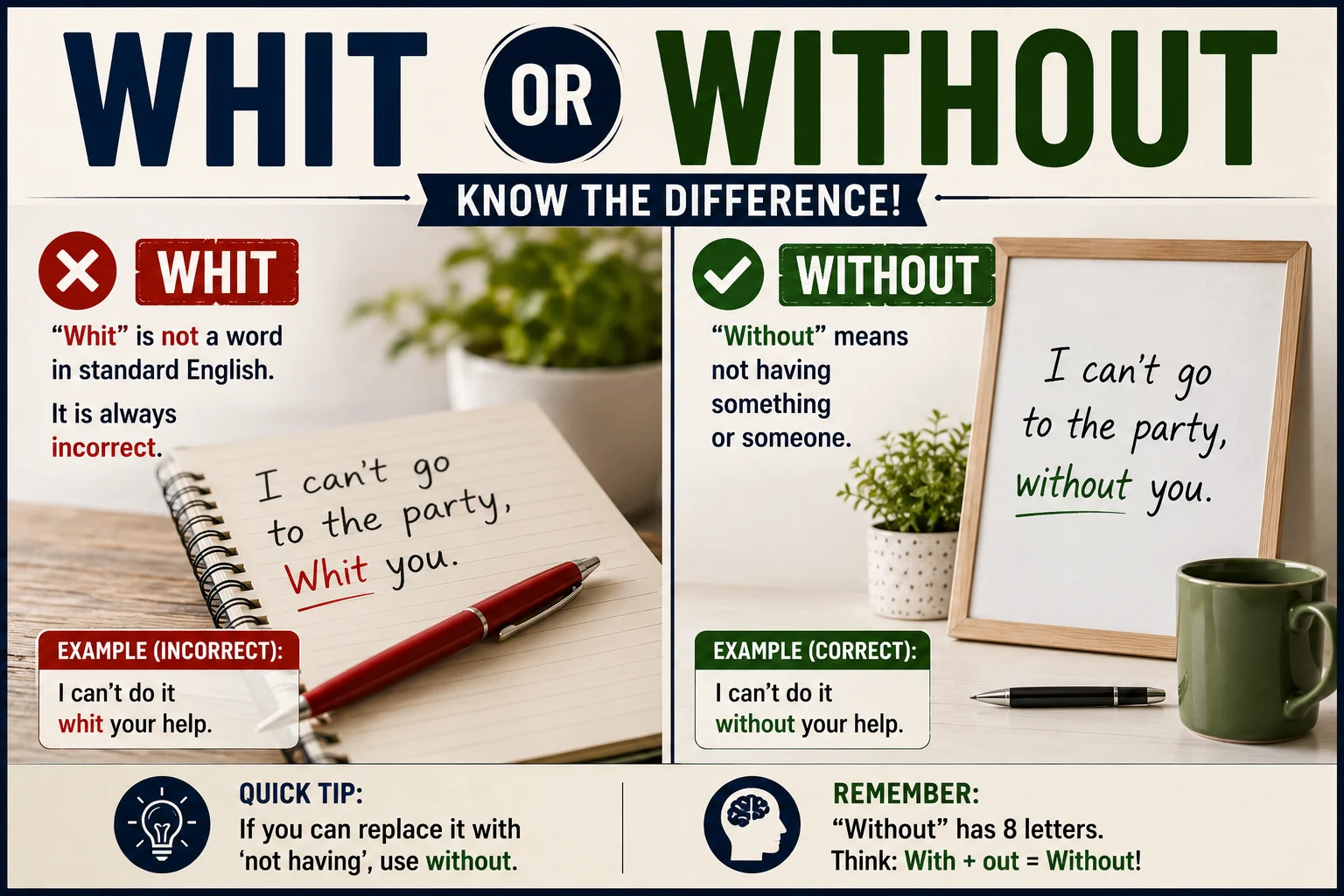
- Whitout ❌ is not a standard English word.
- Without ✅ is the correct word when you mean “with no” or “in the absence of.”
Simple examples
Whit:
It did not help a whit.
This means it did not help even a little.
Without:
I cannot work without my computer.
Without:
She left without saying goodbye.
So, if you are trying to write whitout, you probably mean without.
The Origin of Whit or Whitout
The word whit has a long history in English. It comes from Old English wiht, which meant a thing, creature, or something. Over time, its meaning developed into a tiny amount or particle.
Today, whit is mostly found in older, formal, or fixed expressions. One common example is:
not a whit
This means not at all or not even slightly.
The word without has a different history. It developed from older English expressions meaning outside or without something. It combines the idea of being with no particular thing.
Whitout is simply a spelling mistake. It is often created when someone accidentally removes the h from without or mixes up whit and without.
There is no British or American spelling rule that makes whitout correct. The standard word is always without.
British English vs American English Spelling
There is no British-versus-American spelling difference for without.
Both British English and American English use:
without ✅
The word whit is also spelled the same way in both varieties of English. However, it is not a common everyday word.
| Version | Spelling | Region | Example Sentence |
|---|---|---|---|
| Standard English | without | UK, US, and other English-speaking regions | She left without her phone. |
| Standard English | whit | UK, US, and other English-speaking regions | It did not change things a whit. |
| Incorrect spelling | whitout | Not standard | ❌ She left whitout her phone. |
The key rule is simple:
Use “without” when you mean “with no.”
Do not use whitout as a spelling variation.
Which Spelling Should You Use?
US Audience
Use without when you mean “with no” or “in the absence of.”
Example:
He went to school without his lunch.
You can also use whit when its meaning fits, although it is uncommon in modern American English.
UK/Commonwealth Audience
The same rule applies. Use without.
Example:
She completed the task without any help.
Whit is also a valid word, but it is more likely to appear in formal, literary, or traditional expressions.
Global/SEO Audience
For global content, use without when that is the word you mean.
If your keyword is whit or whitout, you can explain the spelling confusion once. This helps readers who searched for the misspelled form while keeping the article grammatically correct.
Do not repeatedly use whitout just to target the keyword. Clear and natural writing is better for readers and SEO.
Common Mistakes with Whit or Whitout
1. Writing “whitout” instead of “without”
Incorrect:
I cannot do this whitout you.
Correct:
I cannot do this without you.
2. Using “whit” when you mean “without”
Incorrect:
She went to work whit her coat.
Correct:
She went to work without her coat.
3. Thinking “whitout” is a British spelling
Incorrect:
“Whitout” is the British spelling of “without.”
Correct:
Without is used in both British and American English.
4. Confusing “whit” with “without”
Whit means a very small amount.
Without means with no or in the absence of.
5. Adding the word “out” to “whit”
Incorrect:
whitout
Correct:
without
The spelling without does not contain whit.
Whit or Whitout in Everyday Examples
Emails
Correct:
We cannot complete the project without your approval.
Incorrect:
We cannot complete the project whitout your approval.
News Headlines
A news headline might say:
City Opens New Park Without Extra Funding
The word without clearly shows that something happened in the absence of something else.
The word whit is rare in modern headlines.
Social Media
Correct:
I cannot imagine this trip without my friends!
Incorrect:
I cannot imagine this trip whitout my friends!
You may also see whit in a humorous or literary post:
That made not a whit of difference.
Formal Writing
Without is common in formal writing:
The report was completed without additional funding.
Whit can appear in formal or literary language:
His opinion did not change a whit.
For most modern writing, however, without is much more common.
Whit or Whitout – Google Trends & Usage
Searches for whit or whitout are usually caused by spelling confusion. People may type whitout when they mean without, especially when writing quickly or learning English.
The correct word without is used widely across English-speaking countries. It appears in everyday speech, education, business writing, news, books, and online content.
The word whit has much lower everyday usage. It is mainly found in expressions such as “not a whit” and in literary or formal writing.
There is no major regional difference between the United States and the United Kingdom for without. Both use the same spelling.
For SEO content, it is useful to explain the misspelled search term whitout, but the main focus should remain on the correct word without.
Comparison Table
| Word | Correct? | Meaning | Example |
|---|---|---|---|
| whit | ✅ Yes | A tiny amount | It did not help a whit. |
| whitout | ❌ No | Misspelling | ❌ She left whitout me. |
| without | ✅ Yes | With no; in the absence of | She left without me. |
The easiest way to remember the difference is:
whit = a tiny amount
without = with no
whitout = incorrect spelling
FAQs
1. Is whit or whitout correct?
Whit is a correct English word, but whitout is not. If you mean “with no,” the correct word is without.
2. Is “whitout” a word?
No. Whitout is not a standard English word. It is usually a misspelling of without.
3. What does “whit” mean?
Whit means a very small amount or the smallest bit of something.
4. What is the correct spelling of whitout?
The correct spelling is without if you mean “with no” or “in the absence of.”
5. Is “whit” used in American and British English?
Yes. Whit is recognized in both varieties, but it is uncommon in everyday speech.
6. Is “without” spelled differently in British English?
No. Without has the same spelling in British and American English.
7. Why do people write “whitout”?
It is usually a typing or spelling mistake. People may accidentally mix whit with without or leave out part of the word.
Conclusion
The whit or whitout confusion is easy to solve once you know what each word means. Whit is a real English word, but it means a very small amount. It is most often found in expressions such as “not a whit,” which means “not at all.”
Whitout, however, is not a correct standard English word. If you want to say that something happens with no person or thing, use without.
For example, write:
She left without her keys.
Do not write:
She left whitout her keys.
The spelling without is the same in British English, American English, and other major forms of English. There is no regional spelling that makes whitout correct.
For SEO and online writing, you can mention whit or whitout when explaining the common search mistake. But always use without when that is the meaning you need.
The simple rule to remember is: whit means a tiny amount, without means with no, and whitout is incorrect. Once you remember this, you can avoid the mistake with ease.