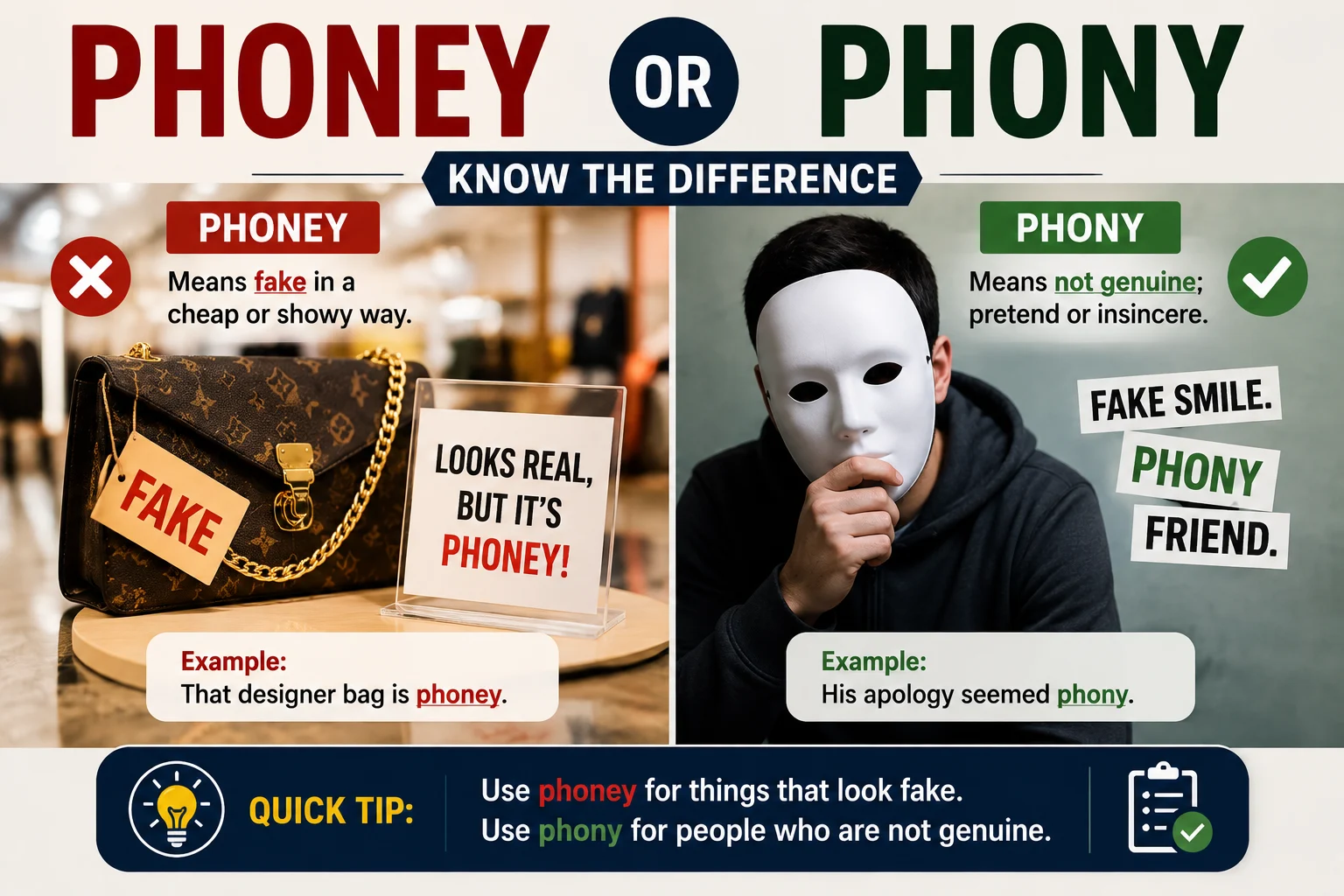
Phony is the preferred American English spelling, while phoney is the more common British English variant—both mean fake or not genuine.
Have you ever wondered whether you should write phoney or phony? You’re not alone. These two spellings look almost identical, sound exactly the same, and have the same meaning. Because both appear in books, websites, and everyday writing, many people are unsure which one is correct.
The good news is that both phoney and phony are correct spellings. The difference is mainly based on regional preference and style. In most cases, phony is the more common spelling, especially in American English, while phoney appears more often in British English and some older publications.
This guide explains the difference between phoney or phony in simple English. You’ll learn where the words came from, how British and American English use them, common mistakes to avoid, and which spelling is best for your audience. By the end, you’ll know exactly when to use phony or phoney with confidence.
Phoney or Phony – Quick Answer
Both phoney and phony are correct spellings.
They mean:
- Fake or not genuine.
- Dishonest or pretending to be something.
- Not real or authentic.
However:
- Phony is the standard spelling in American English.
- Phoney is less common but accepted, especially in British English.
Examples
- That email looks phony.
- Be careful of phoney websites.
- His excuse sounded completely phony.
The Origin of Phoney or Phony
The word phony appeared in American English during the late nineteenth century. Although its exact origin is uncertain, it has long been used to describe something fake, dishonest, or counterfeit.
The spelling phoney developed later as an alternative form. Since English often has multiple accepted spellings, both versions became recognized by dictionaries.
Today, phony is much more common worldwide, while phoney survives mainly in British English and some traditional publications.
British English vs American English Spelling
The difference is mainly regional.
| Version | Spelling | Region | Example Sentence |
|---|---|---|---|
| American English | Phony | US | That phone call was phony. |
| British English | Phoney | UK | He received a phoney message. |
| International English | Phony | Worldwide | The website looked phony. |
Both spellings are understood by English speakers.
Which Spelling Should You Use?
US Audience
Use phony. It is the preferred spelling in American English and appears in newspapers, books, and official writing.
UK/Commonwealth Audience
Both spellings are accepted, but phoney appears more often in British English. However, phony is also widely understood.
Global/SEO Audience
Use phony because it is the most common spelling worldwide and is more familiar to online readers.
Common Mistakes with Phoney or Phony
Here are common mistakes people make.
❌ Phoney is always incorrect.
✅ Both phoney and phony are correct.
❌ Only British English accepts phony.
✅ British English understands both spellings.
❌ The two words have different meanings.
✅ They have the same meaning.
❌ Every fake message should be called phoney.
✅ Phony is usually the better choice for global readers.
Phoney or Phony in Everyday Examples
Emails
- We received a phony payment request.
- Ignore any phoney emails asking for passwords.
News Headlines
- Police warn about phony online scams.
- Officials investigate phoney charity websites.
Social Media
- Don’t fall for phony giveaways!
- That account looks completely phoney.
Formal Writing
- The company identified several phony invoices.
- Security teams monitor phoney websites that imitate trusted brands.
Phoney or Phony – Google Trends & Usage
Search interest strongly favors phony, especially in the United States and international online content.
People often search for phony when reading about fake phone calls, scams, fraudulent websites, counterfeit products, or dishonest behavior.
The spelling phoney appears less often and is mainly found in British English publications, older books, and traditional writing styles.
For most online content, phony is the spelling readers are more likely to recognize.
Comparison Table
| Feature | Phony | Phoney |
|---|---|---|
| Correct spelling | ✅ Yes | ✅ Yes |
| American English | ✅ Preferred | Rare |
| British English | Common | ✅ More Common |
| Same meaning | ✅ Yes | ✅ Yes |
| Used in formal writing | ✅ Yes | Sometimes |
| Best for SEO | ✅ Yes | Less Common |
| Global recognition | ✅ Higher | Lower |
FAQs
Is it phoney or phony?
Both are correct, but phony is more common.
Which spelling is used in American English?
American English almost always uses phony.
Is phoney a real word?
Yes. It is an accepted alternative spelling.
Do phoney and phony have different meanings?
No. They both mean fake, false, or dishonest.
Which spelling is better for SEO?
Phony is usually the better choice because it is searched more often and recognized worldwide.
Can I use phoney in formal writing?
Yes, but phony is generally the preferred spelling unless you are following British style.
Conclusion
The difference between phoney or phony is mainly about spelling preference rather than meaning. Both words describe something fake, dishonest, or not genuine. Whether you are talking about a scam, a counterfeit product, a fake story, or an insincere person, either spelling is technically correct.
However, phony is the standard spelling in American English and is also the more common choice worldwide. It appears more often in books, newspapers, websites, and business writing. Phoney remains an accepted alternative and is seen more frequently in British English and some older publications.
If you want your writing to reach the widest audience, phony is usually the safest choice. If you are writing for readers who follow British spelling conventions, phoney is also acceptable. By understanding this simple difference, you can choose the spelling that best matches your audience and write with greater confidence.