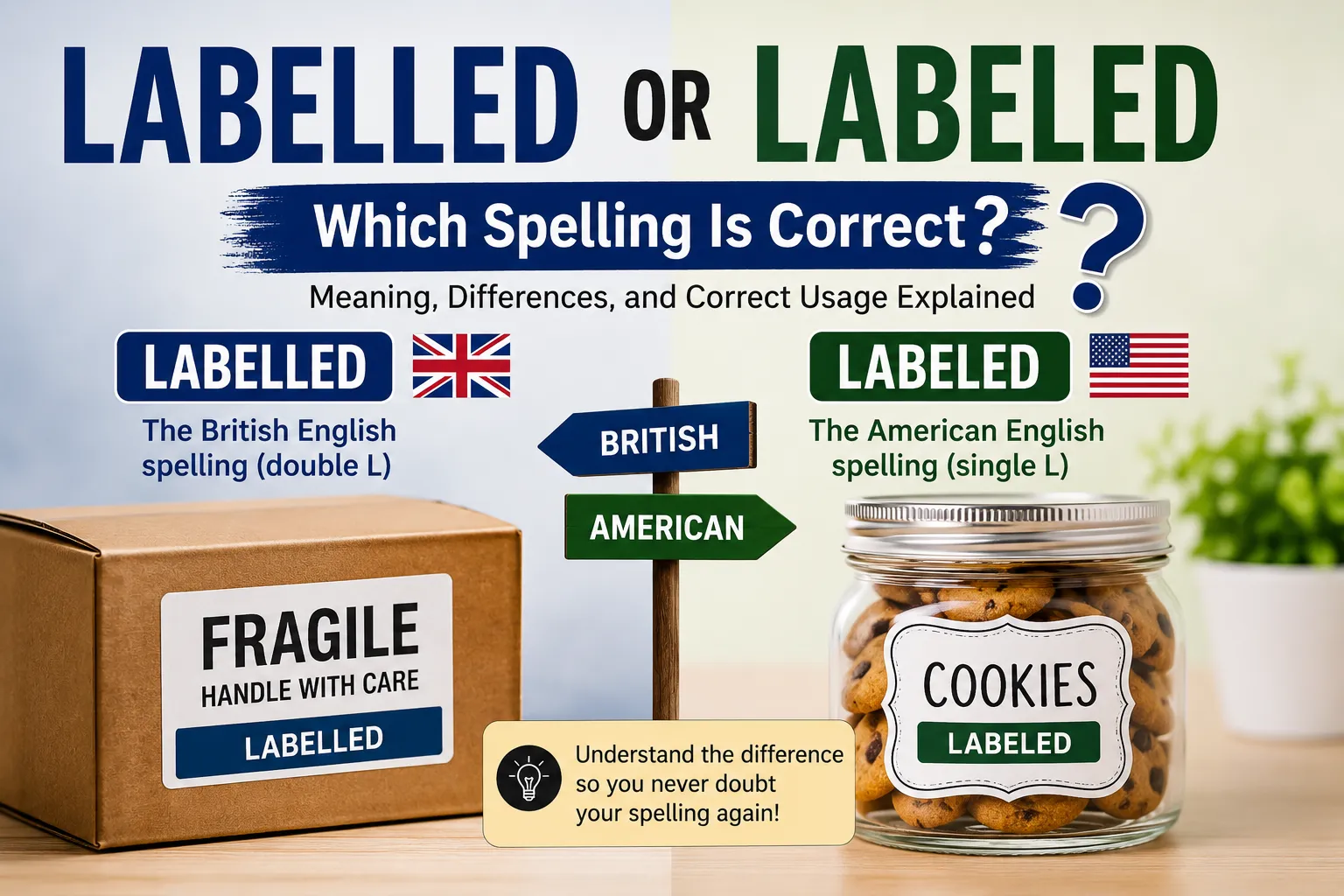
Labeled and labelled mean the exact same thing, which is having a tag or classification attached to something. The only difference is that labeled is the preferred spelling in American English, while labelled is standard in British, Canadian, and Australian English.
I still remember my first week working as a copy editor for a global travel magazine. I was proofreading a piece on French wines and confidently changed every instance of “labelled” to “labeled.” My boss, a brilliant editor from London, sent it back with a gentle note: “We use British English here, mate.” I felt so embarrassed. I realized then how easily a single letter can trip up even the most careful writers.
People search for this topic because English spelling rules often change depending on where you live. This spelling clash confuses millions of students, writers, and business owners every single day. You do not want a simple spelling choice to distract your readers or lower your grade. This guide will solve your confusion once and for all. You will learn the history behind the double “l,” how to pick the right style, and how to avoid common mistakes. Let us dive in and clear this up.
Labelled or Labeled – Quick Answer
The words labeled and labelled are both past-tense forms of the verb “label.” They both describe something that has a tag, name, or description attached to it.
- The doctor labeled the test tubes carefully.
- She bought a beautifully labelled bottle of olive oil.
Both spellings are correct. Your choice depends entirely on who you are writing for.
The Origin of Labelled or Labeled
The word “label” comes to us from Old French, where it meant a narrow band or ribbon of cloth. By the middle of the 14th century, people used it in English to describe a strip of paper or parchment attached to a document.
The spelling split happened much later in the early 19th century. Noah Webster published his famous American dictionary in 1828. He wanted to simplify English spelling for Americans. He cut out letters he felt were useless. One of his rules was to drop the double consonant in words with unstressed final syllables. That is why Americans started writing labeled, while British writers kept the traditional labelled.
Labelled or Labeled Explained — Key Differences
The main difference between these two words is regional preference. If you write for a US audience, use one “l.” If you write for readers in the UK, Canada, Australia, or New Zealand, use two “l’s.”
| Term | Meaning | When to Use | Region/Context |
|---|---|---|---|
| Labeled | Tagged or categorized | For American audiences | United States |
| Labelled | Tagged or categorized | For British Commonwealth audiences | UK, Canada, Australia |
Here is a clear example of how they look in action:
- US Style: He labeled his boxes before the big move to New York.
- UK Style: She labelled her luggage before boarding her flight to London.
Which Version Should You Use?
Choosing the right spelling depends on who will read your work. You must be consistent throughout your entire document.
- For American Readers: Use labeled with one “l.” This is the standard in US schools, newspapers, and offices.
- For Commonwealth Readers: Use labelled with two “l’s.” This fits perfectly in the UK, Australia, New Zealand, and South Africa.
- For Canadian Readers: Use labelled with two “l’s.” Canada generally follows British spelling for double-consonant words.
- For Global Audiences: Use labeled or labelled, but stick to one style. Mixing them up in the same document looks messy and unprofessional.
Common Mistakes with Labelled or Labeled
People often get confused when adding endings to the word “label.” Here are the most common spelling errors to avoid.
- Mistake: Labbeled (Double ‘b’)
- Correction: Labeled or labelled
- Why: The letter “b” is never doubled in this word.
- Mistake: Labeling and Labelled in the same paragraph
- Correction: Keep spelling styles matching.
- Why: Mixing American and British styles in one document looks careless.
- Mistake: Labeled (used in a British academic paper)
- Correction: Labelled
- Why: British universities expect UK spelling standards.
Labelled or Labeled in Real-World Examples
See how these words fit naturally into different types of writing. Notice the regional spelling patterns in each case.
A Professional Email (US Style)
Hi Sarah, I have labeled the new project folders in the shared drive. Please review the folder names when you get a moment.
A News Headline (UK Style)
“Local organic foods must be clearly labelled under new country-of-origin laws.”
A Social Media Post (US Style)
Just spent my Sunday getting organized. I labeled every single jar in my spice rack and it feels amazing! #organization
A Formal Document (UK Style)
The scientific samples were carefully labelled and stored at sub-zero temperatures to ensure accuracy.
Labelled or Labeled — Data, Trends & Usage
Most web searches for labelled or labeled are informational. Readers want a quick answer to make sure they are spelling the word correctly in their essays or emails.
Data shows that labeled is much more common globally because of the large volume of American digital media. However, search trends spike in September and January. This is when students around the world go back to school and start writing papers. Understanding this difference matters right now because clear writing builds trust with your readers, no matter where they live.
Standalone Comparison Table
Here is a quick-reference guide to keep you on track.
| Term/Variant | Meaning | Region/Context | Best Used When |
|---|---|---|---|
| Labeled | Having a label attached | United States | Writing for a US client or school |
| Labelled | Having a label attached | UK, Canada, Australia | Writing for a Commonwealth audience |
| Labeling | The act of attaching a tag | United States | Describing a US packaging process |
| Labelling | The act of attaching a tag | UK, Canada, Australia | Describing a UK packaging process |
FAQ Section
Q: What does labeled mean?
A: It means to attach a label, tag, or description to something to identify or classify it. It can also mean describing someone or something with a word or phrase, often unfairly.
Q: How do you use labeled correctly?
A: Use labeled when writing in American English. For example, write: “The jar was labeled honey.”
Q: Labeled vs labelled — what’s the difference?
A: The only difference is the spelling. Labeled with one “l” is the American spelling, while labelled with two “l’s” is the British and Commonwealth spelling.
Q: Is labeled acceptable in formal writing?
A: Yes, both spellings are perfectly acceptable in formal writing. Just make sure to match your spelling to your target audience’s region.
Q: Which version is correct — labeled or labelled?
A: Both are correct. Use labeled for American English and labelled for British English.
Q: Where does the word label come from?
A: It comes from an Old French word meaning a ribbon or band of cloth. It entered the English language in the 14th century.
Q: Can labeled be used in scientific papers?
A: Yes, it is used frequently in scientific papers to describe samples. Use labeled for American journals and labelled for international journals.
Conclusion
Spelling choices do not have to be stressful. The choice between labelled or labeled is simply a matter of geography.
Remember these key takeaways:
- Labeled is the standard American spelling.
- Labelled is the standard British, Canadian, and Australian spelling.
- Both words share the exact same definition and pronunciation.
- Consistency is the most important rule of all.
Now you know exactly how to use labelled or labeled in your next piece of writing. Go ahead and write with confidence. Bookmark this guide so you never second-guess your spelling again.
True or False