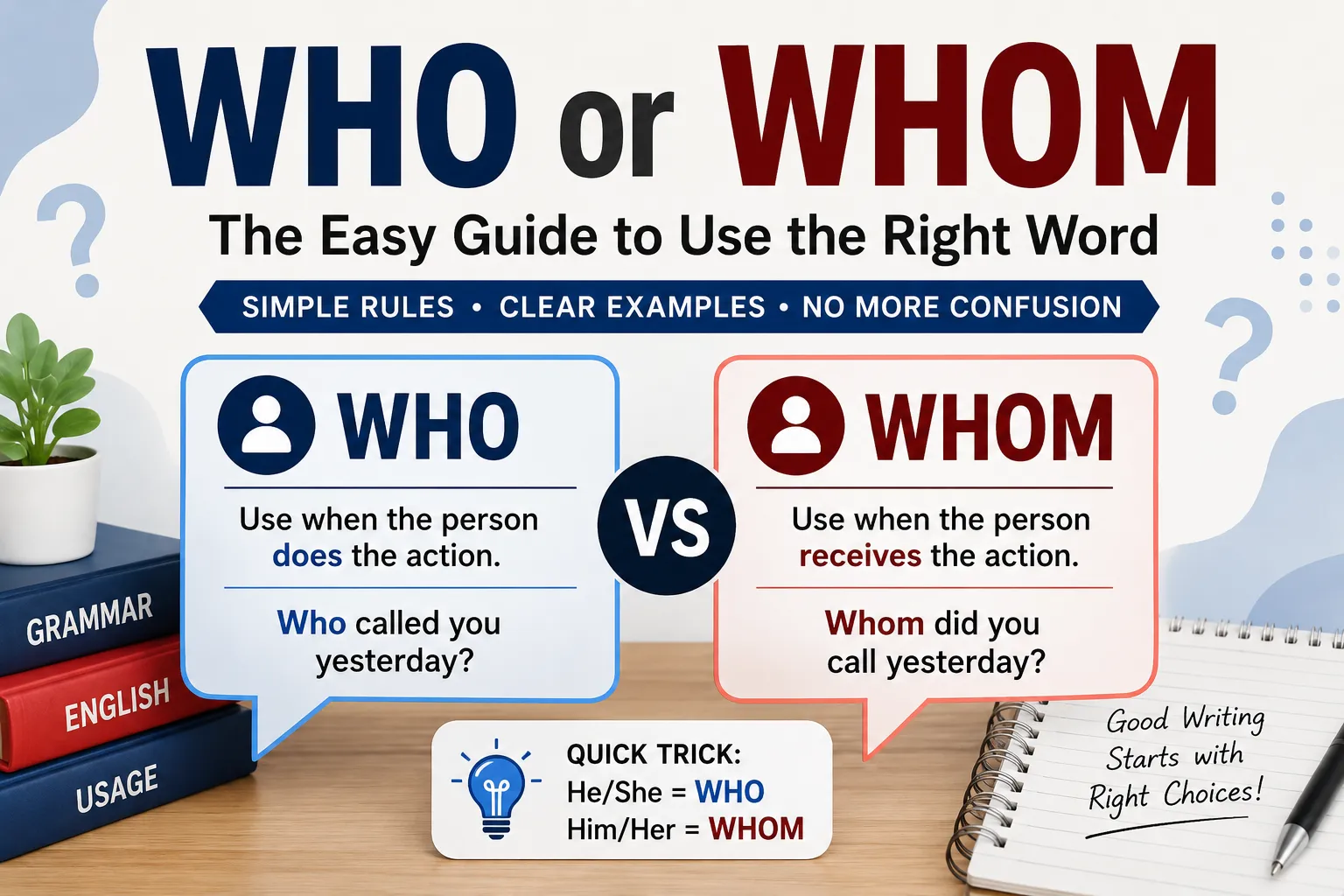
Who is the subject of a sentence. Whom is the object of a verb or preposition. If you can replace the word with he/she, use who. If you can replace it with him/her, use whom.
Who or Whom: Why This Tiny Choice Matters
I still remember marking a student’s essay years ago. Everything looked great until I reached the sentence, “To who should I send this email?” The student smiled and said, “Nobody really knows the difference anymore.” That moment reminded me how confusing these two words can be.
Many people avoid using whom because they fear getting it wrong. Others use it everywhere because they think it sounds more formal. The truth is much simpler.
Once you learn one easy trick, choosing between who and whom becomes almost automatic.
By the end of this guide, you will know when to use each word, avoid common mistakes, and write with confidence in emails, schoolwork, and professional documents.
Who or Whom – Quick Answer
Think about the job the word is doing.
- Use who when talking about the person doing the action.
- Use whom when talking about the person receiving the action.
Examples
- Who called you yesterday?
- Whom did you call yesterday?
In the first sentence, who is doing the calling. In the second, whom receives the call.
The Origin / Background of Who or Whom
English once had many word endings that showed grammar clearly. Over time, most of those endings disappeared.
One difference survived.
The word who became the subject form. The word whom became the object form.
Modern English uses whom less often than it did hundreds of years ago. Many people now say who in everyday speech. Still, whom remains correct in formal writing and after many prepositions.
Who or Whom Explained — Key Differences
The easiest way to remember the rule is to look for the subject and the object.
| Term | Meaning | When to Use | Region/Context |
|---|---|---|---|
| Who | Subject of the sentence | Person performs the action | Everyday English |
| Whom | Object of a verb or preposition | Person receives the action | Formal writing |
Easy Examples
- Who opened the door?
- Whom did the teacher praise?
- To whom should I address the letter?
- Who wants pizza?
Quick Memory Trick
Replace the word with:
- He/She → Who
- Him/Her → Whom
Example:
“___ did you invite?”
You would answer, “I invited him.”
Therefore:
Whom did you invite?
Which Version Should You Use?
Your audience matters.
- For beginners and everyday conversations → Who is common and natural.
- For school essays and exams → Use whom when grammar requires it.
- For business letters and legal writing → Whom often sounds more polished.
- For blogs and casual social media → Who is usually accepted unless the sentence clearly needs whom.
If you are unsure, try the he/him test before choosing.
Common Mistakes with Who or Whom
Here are mistakes many writers make.
| Mistake | Correct Form |
|---|---|
| Who did you invite? (formal) | Whom did you invite? |
| To who should I write? | To whom should I write? |
| Whom is coming today? | Who is coming today? |
| Who did the manager hire? (formal) | Whom did the manager hire? |
Why These Mistakes Happen
- People hear who more often.
- Whom sounds old-fashioned to many speakers.
- Writers forget to identify the subject and object.
Who or Whom in Real-World Examples
Professional Email
“Could you tell me whom I should contact about the project?”
News Headline
“Who Will Lead the Company Next Year?”
Social Media Post
“Who else loves rainy days?”
Formal Report
“The committee selected the candidate whom everyone recommended.”
Who or Whom — Data, Trends & Usage
Interest in this grammar topic stays strong because people write more emails, reports, and online content than ever before.
- Most searched in: United States, United Kingdom, Canada, Australia, and India.
- Search intent: Informational.
- Popular among: Students, teachers, job seekers, writers, and professionals.
- Why it matters today: Clear grammar builds trust. Good writing helps people communicate with confidence.
Standalone Comparison Table
| Term/Variant | Meaning | Region/Context | Best Used When |
|---|---|---|---|
| Who | Subject pronoun | Everyday English | Person performs the action |
| Whom | Object pronoun | Formal English | Person receives the action or follows a preposition |
Frequently Asked Questions
Q: What does who or whom mean?
A: Who is the subject of a sentence. Whom is the object of a verb or preposition.
Q: How do you use who or whom correctly?
A: Use the he/him test. If he fits, choose who. If him fits, choose whom.
Q: Who or whom—which is more common today?
A: Who is far more common in everyday conversation. Whom is mostly used in formal writing.
Q: Is whom acceptable in formal writing?
A: Yes. It is the preferred choice when grammar requires the object form.
Q: Which version is correct—who or whom?
A: Both are correct. The right choice depends on whether the word acts as the subject or object.
Q: Where does whom come from?
A: It comes from Old English, where different word forms showed grammatical roles more clearly.
Q: Can who replace whom?
A: In casual speech, many native speakers use who instead of whom. In formal writing, whom is still the grammatically correct choice in many sentences.
Conclusion
The difference between who and whom is easier than it first appears. Remember that who performs the action, while whom receives it. The simple he/him trick can solve most grammar questions in seconds.
If you are writing a friendly text or social media post, who is often enough. If you are writing an academic paper, business email, or formal report, knowing when to use whom will make your writing stronger and more professional.
Now you know exactly how to use who or whom. Try the he/him test in your next sentence, bookmark this guide, and share it with anyone who still finds these two words confusing.
Aluminum or Aluminium