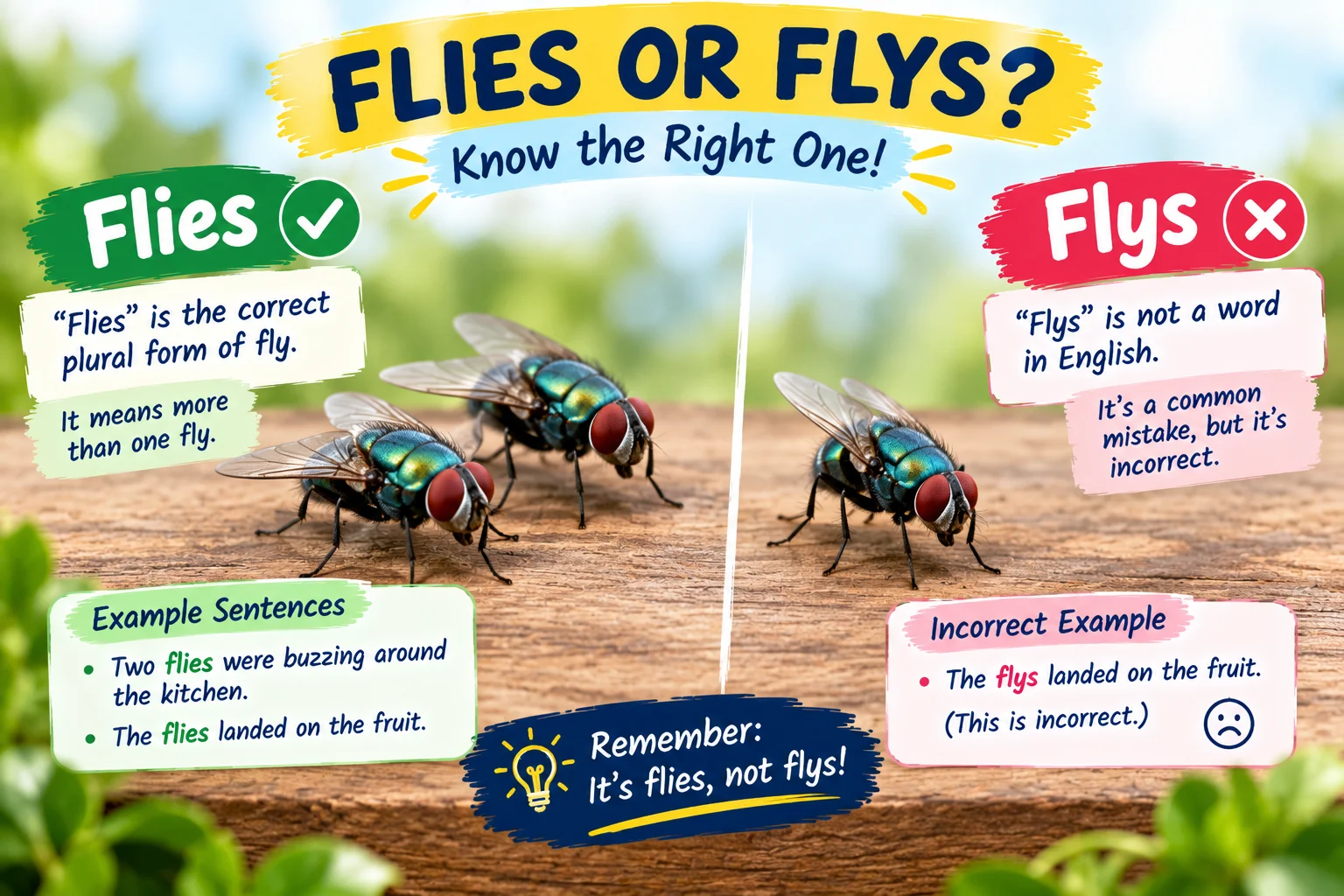
Flies is the correct spelling in standard English. Flys is usually incorrect, but flys can appear as part of a proper name or specialized term.
Have you ever typed “flys” and stopped because it looked wrong? You are not alone. This is a common spelling question, especially because English has many words that form plurals by simply adding -s.
When you know that the plural of “book” is “books” and “car” becomes “cars,” it seems logical to write flys. But English has a different rule here.
The correct word is usually flies.
I have seen learners make this mistake because they try to apply the basic plural rule without checking the spelling pattern. The same issue appears with verbs. For example, “The bird flies” uses flies because the verb fly changes its ending too.
So, when should you write flies? Can flys ever be correct? What happens when fly is used as a noun, verb, or part of a name?
Let’s make the difference simple.
Flies or Flys – Quick Answer
Flies is the standard and correct spelling in ordinary English.
It can be:
- The plural of fly: “There are three flies.”
- The third-person singular form of fly: “The bird flies south.”
- A noun referring to more than one fly.
- A verb describing what one person, animal, or thing does.
Flys is generally not the standard spelling for these uses.
Simple Examples
Correct:
“There are flies near the window.”
Correct:
“The eagle flies over the mountains.”
Incorrect in standard English:
“There are many flys in the kitchen.”
The main rule is easy:
fly → flies
The Origin and Background of Flies
The word fly is an old English word. It has been used for a long time to describe an insect that moves through the air.
The spelling pattern in flies comes from a common English rule.
When a noun ends in a consonant followed by y, the plural often changes y to ies.
For example:
- fly → flies
- baby → babies
- city → cities
- story → stories
- party → parties
The same spelling pattern can appear when forming certain third-person singular verbs:
- fly → flies
- try → tries
- carry → carries
- study → studies
- cry → cries
This explains why flys looks reasonable at first but is normally wrong.
There is another important rule, though. Not every word ending in y changes to ies.
If the y comes after a vowel, we usually keep the y and add s.
For example:
- boy → boys
- day → days
- toy → toys
- key → keys
The word fly has a consonant before the y, so it becomes flies.
Flies or Flys Explained — Key Differences
The difference between flies and flys is mainly about standard spelling.
| Term | Meaning | When to Use | Region/Context |
|---|---|---|---|
| flies | More than one fly | Plural noun | Standard English |
| flies | Moves through the air | Third-person singular verb | Standard English |
| fly | One insect or the base verb | Singular noun or base verb | Standard English |
| flys | Usually a misspelling of “flies” | Avoid in normal writing | Nonstandard |
| Flys | May appear in a proper name or specialized context | Only when officially written that way | Context-specific |
1. Flies as a Plural Noun
When you are talking about more than one insect, use flies.
Examples:
- “The flies are bothering the dog.”
- “Several flies landed on the table.”
- “I saw two flies near the door.”
Here:
one fly → two flies
Not:
one fly → two flys
2. Flies as a Verb
Flies is also the third-person singular form of the verb fly.
For example:
“The plane flies from London to Paris.”
The subject is the plane, which is singular.
Compare:
- I fly.
- You fly.
- We fly.
- They fly.
- He flies.
- She flies.
- The bird flies.
This is why you should not write:
“The bird flys.”
The correct form is:
“The bird flies.”
3. Fly as a Noun
The singular noun is fly.
Example:
“A fly landed on my desk.”
If there is more than one:
“Three flies landed on my desk.”
This is one of the easiest ways to remember the spelling.
One fly → many flies.
Why Do We Write “Flies” Instead of “Flys”?
The spelling rule is the key.
When a word ends in consonant + y, the y often changes to i before adding the plural ending -es.
So:
fly + es → flies
The same pattern appears in:
baby → babies
lady → ladies
city → cities
family → families
However, when a word ends in vowel + y, the y usually stays.
For example:
boy → boys
toy → toys
day → days
key → keys
This small rule can help you remember many English spellings, not just flies.
Which Version Should You Use?
For almost every normal English sentence, choose flies.
For Students
Use flies when writing school assignments, answers, essays, or exams.
“The bird flies across the sky.”
“The garden has many flies.”
For Professional Writing
Use flies in emails, reports, articles, instructions, and business documents.
“The aircraft flies twice a day.”
For Social Media
Use flies when you mean the plural noun or the verb.
“Summer arrives, and suddenly the flies are everywhere!”
For Global or Standard English
Flies is the safe choice.
If you see flys in ordinary writing, it is usually a spelling mistake.
When Could “Flys” Appear?
You may occasionally see Flys in a proper name, brand name, title, username, or other special context.
A name can use unusual spelling because names do not always follow normal dictionary spelling rules.
So do not automatically change a proper name from Flys to Flies if the official name is actually written Flys.
Common Mistakes with Flies or Flys
Mistake 1: Using “Flys” as the Plural
❌ “There are five flys in the room.”
✅ “There are five flies in the room.”
Why? Fly ends in a consonant followed by y, so the plural becomes flies.
Mistake 2: Using “Flys” as a Verb
❌ “The airplane flys every morning.”
✅ “The airplane flies every morning.”
The third-person singular form of fly is flies.
Mistake 3: Thinking Every Word Ending in Y Takes -s
This rule does not work for every word.
❌ “The citys are crowded.”
✅ “The cities are crowded.”
But:
✅ “The boys are outside.”
The difference depends on whether the letter before y is a consonant or vowel.
Mistake 4: Confusing Flies With Fleas
These words are different.
Flies are flying insects.
Fleas are tiny insects that usually live on animals and can jump.
Example:
“The dog has fleas.”
Not:
“The dog has flies.”
Context matters.
Mistake 5: Changing a Proper Name
If Flys is officially part of a company name, team name, product name, or username, do not automatically correct it.
Proper names can use unusual spellings.
In ordinary English, however, flies is the correct spelling.
Flies or Flys in Real-World Examples
1. Professional Email
“The aircraft flies to Dubai every Monday and Thursday.”
Here, flies is a verb because the subject, “aircraft,” is singular.
2. News Article
“Heavy rain has led to an increase in flies around open waste areas.”
Here, flies is a plural noun.
3. Social Media Post
“Summer is here, and the flies have already found my kitchen! 😅”
Again, flies means more than one insect.
4. Formal Report
“The study examined conditions that may attract flies to food storage areas.”
The word flies is a plural noun.
5. Everyday Conversation
“Why does this window have so many flies?”
The answer is simple:
one fly → two or more flies
Flies — Data, Trends & Usage
The search intent behind “flies or flys” is mainly informational and spelling-related.
People usually search this phrase because they want a quick answer to one of two questions:
- Is the plural of fly “flies” or “flys”?
- Is the verb “flies” or “flys”?
Both questions have the same standard answer:
flies
The confusion happens because English has several plural patterns.
Learners often know the simple rule:
Add -s to make a plural.
That works for many words:
- book → books
- car → cars
- chair → chairs
But words ending in consonant + y often follow another pattern:
- fly → flies
- baby → babies
- city → cities
- country → countries
The same pattern also appears in verbs:
- try → tries
- carry → carries
- study → studies
- fly → flies
This makes flies a useful example for learning a wider English spelling rule.
Flies or Flys: Standalone Comparison Table
| Term/Variant | Meaning | Region/Context | Best Used When |
|---|---|---|---|
| fly | One flying insect | Standard English | Singular noun |
| flies | More than one fly | Standard English | Plural noun |
| fly | Base form of the verb | Standard English | I/you/we/they fly |
| flies | Third-person singular verb | Standard English | He/she/it flies |
| flys | Usually a misspelling | Nonstandard English | Avoid in normal writing |
| Flys | Possible proper name | Special context | Only when officially spelled this way |
Frequently Asked Questions About Flies or Flys
Q: Is it “flies” or “flys”?
A: Flies is the correct spelling in standard English. Flys is normally a misspelling when you mean the plural of fly or the verb flies.
Q: What is the plural of “fly”?
A: The plural of fly is flies. For example, “There are several flies in the kitchen.”
Q: Is “flys” ever correct?
A: It can appear in a proper name, brand, title, or other special use. But in ordinary English, use flies.
Q: Why does fly become flies?
A: Fly ends in a consonant followed by y. English commonly changes y to i and adds -es, producing flies.
Q: Is “flies” a noun or a verb?
A: It can be both. Flies is the plural noun for more than one fly, and it is also the third-person singular form of the verb fly.
Q: What is the difference between “fly” and “flies”?
A: Fly can mean one insect or the base form of the verb. Flies can mean several insects or describe what one person, animal, or thing does.
Q: Should I use “flies” in formal writing?
A: Yes. Flies is the standard spelling and is completely acceptable in formal writing. Use it in reports, school work, emails, and professional documents.
Conclusion
The answer to “flies or flys” is simple: flies is the correct spelling in standard English.
Use flies when you mean more than one fly:
“The flies are near the window.”
Use flies when fly is the third-person singular verb:
“The bird flies across the sky.”
The spelling follows a useful English rule. When a word ends in consonant + y, the y often changes to i before the plural or verb ending.
That gives us:
fly → flies
Just remember that flys is normally incorrect in ordinary English. It may appear in a special name or title, but that is a separate case.
Once you learn this pattern, words like babies, cities, stories, tries, and carries become easier too.
Bookmark this guide so you never second-guess “flies” or “flys” again.