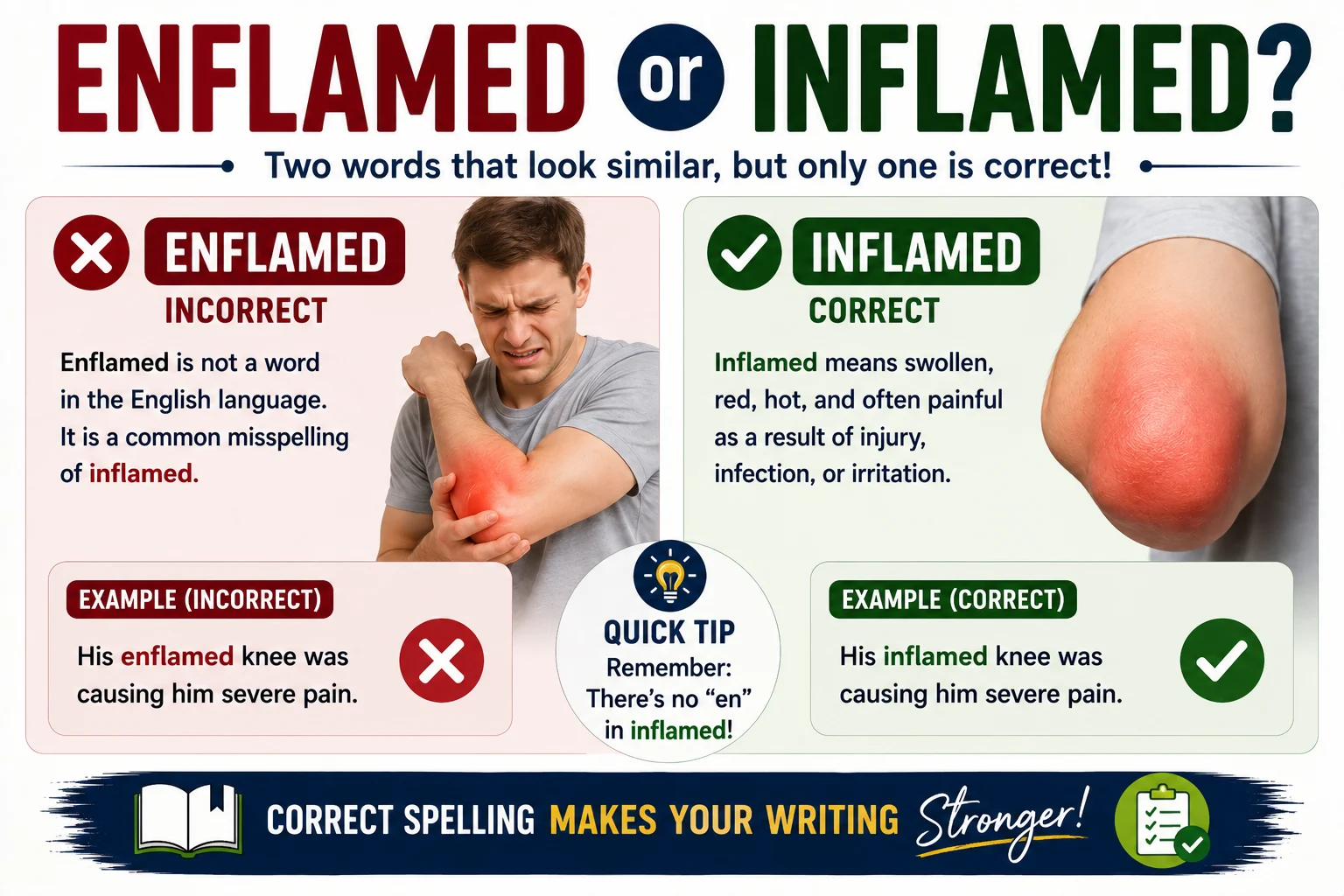
Inflamed is the standard and preferred word. Enflamed is also a real English word, but it is much less common and usually means made angry, excited, or literally set on fire.
Have you ever typed a word, stared at it, and wondered if the first letter was wrong? Enflamed or inflamed is a good example. Both forms exist, but they are not equally common.
As an English teacher and writer, I have often seen learners pause over this word in essays, reports, and health-related writing. The confusion makes sense. The two words look almost identical, and both are connected with the idea of something becoming more intense.
The problem becomes clearer when you look at real sentences. A doctor may describe an inflamed joint. A writer may describe an inflamed argument. But you may also see enflamed in older or literary writing.
So, which word should you choose?
For most modern English writing, the answer is simple: use inflamed. It is the normal form of the verb inflame, and it is widely used for physical inflammation, strong emotions, conflict, and other intense reactions.
Let’s look at the difference and make the choice easy.
Enflamed or Inflamed – Quick Answer
Inflamed is the standard past tense and past participle of inflame.
It can mean:
- physically swollen, red, or irritated
- made more intense
- made angry or emotional
- made a conflict worse
For example:
The doctor examined my inflamed knee.
His comments inflamed the argument.
Enflamed is also found in English, but it is uncommon. It may appear in literary, historical, or figurative writing. In most modern sentences, inflamed will sound more natural.
The simple rule
Inflame → inflamed
If you are unsure, choose inflamed.
The Origin and Background of Inflamed
The word inflamed comes from the verb inflame.
The history goes back to Latin. The Latin verb inflammare meant “to set on fire” or “to kindle.” It was formed from in- and flamma, meaning “flame.”
That connection explains much of the modern meaning.
Think about a flame becoming stronger. Something that is inflamed can also become more intense.
Over time, the word developed several meanings.
Physical meaning
In medicine, inflamed describes tissue that has become irritated. It may become red, swollen, warm, or painful.
For example:
The skin around the wound was inflamed.
This is one of the most common modern uses.
Emotional meaning
Inflame can also mean to make someone angry or excited.
For example:
The unfair decision inflamed public anger.
The idea is similar. An emotion becomes hotter or stronger, like a fire.
Conflict and controversy
The word can describe situations that become more serious.
The report inflamed tensions between the two groups.
Here, inflamed does not mean physical swelling. It means that the tension became stronger.
Why Do “Enflamed” and “Inflamed” Both Exist?
This is where the spelling question gets interesting.
English has many words that developed through different forms over time. Prefixes such as en- and in- can sometimes create related forms.
Enflamed exists as a word, but it is not the normal choice in current standard English.
The Oxford English Dictionary records historical uses of enflame, while modern dictionaries commonly give inflame as the main verb. Merriam-Webster defines inflame with meanings that include causing inflammation, exciting emotions, and increasing the intensity of something.
That means you should not treat enflamed as a simple spelling error.
Instead, think of it as a rare or less common form.
For normal modern writing, inflamed is the clear winner.
Enflamed or Inflamed Explained — Key Differences
The main difference is usage and frequency, not simply spelling.
Inflamed
Inflamed is the normal form.
It is used in medical, emotional, political, social, and everyday contexts.
Examples:
My throat is inflamed.
The article inflamed public opinion.
His angry words inflamed the dispute.
Enflamed
Enflamed is a much less common form.
It can appear in literary or older writing. It may also be used to suggest that something has been set on fire or strongly stirred.
Example:
The poet described an enflamed heart.
This sounds more literary than:
The patient had an enflamed throat.
In medical writing, inflamed is the natural choice.
Comparison Table
| Term | Meaning | When to Use | Region/Context |
|---|---|---|---|
| inflamed | Swollen, irritated, intensified, or made angry | Normal modern writing | General English |
| enflamed | Made fiery, excited, angry, or inflamed | Rare or literary use | Older/literary contexts |
| inflame | To cause inflammation or increase intensity | Present/base form | Standard English |
| inflaming | Making something inflamed or more intense | Continuous form | Standard English |
Which Version Should You Use?
The best choice depends on your audience and purpose.
For students → use inflamed
If you are writing an essay, assignment, or exam answer, choose inflamed.
It is the standard form and will be understood easily.
Example:
The patient’s knee was inflamed after the injury.
For professional writers → use inflamed
Reports, news stories, websites, and business documents should normally use inflamed.
It is clear and familiar.
Example:
The announcement inflamed concerns among local residents.
For medical writing → use inflamed
This is especially important.
When you are describing tissue, organs, skin, joints, or other parts of the body, inflamed is the usual word.
Examples include:
- inflamed skin
- inflamed gums
- inflamed joints
- inflamed tissue
- inflamed throat
For literary writing → enflamed may appear
A writer may choose enflamed for style or an older tone.
For example:
Her enflamed passion consumed every thought.
However, you do not need enflamed to make normal writing sound expressive.
For global English → use inflamed
If your readers come from different countries, inflamed is the safer choice.
It is familiar across standard varieties of English.
Common Mistakes with Enflamed or Inflamed
Mistake 1: Using “enflamed” in medical writing
Less natural:
The patient’s ankle was enflamed.
Better:
The patient’s ankle was inflamed.
Why?
Because inflamed is the standard medical term.
Mistake 2: Thinking “enflamed” is always wrong
This is also incorrect.
Enflamed does exist.
It can be found in English, especially in older, literary, or less common uses. The issue is not that the word is impossible. The issue is that it is far less common.
So remember:
Rare does not always mean wrong.
Mistake 3: Confusing “inflamed” with “inflammatory”
These words are related but different.
Inflamed describes something that has become inflamed.
Her gums were inflamed.
Inflammatory describes something that causes or relates to inflammation.
The doctor suspected an inflammatory condition.
Do not use them as direct substitutes.
Mistake 4: Confusing “inflamed” with “inflammable”
These words look similar but have very different meanings.
Inflamed means affected by inflammation or made more intense.
Inflammable means capable of catching fire easily.
That difference matters.
Mistake 5: Using “inflame” when you need “inflamed”
Remember the grammar pattern.
Present:
The comment may inflame tensions.
Past:
The comment inflamed tensions.
Past participle:
The comments have inflamed tensions.
Enflamed or Inflamed in Real-World Examples
Seeing the words in different settings can make the rule easier to remember.
1. Professional Email
We noticed that the customer’s complaint has inflamed concerns among several team members. We should discuss the issue before responding.
Here, inflamed means made stronger or more serious.
2. News Article
Inflamed tensions lead to calls for calm
This headline uses inflamed because tensions have become more intense.
3. Social Media Post
My ankle is still inflamed, so I am taking a break from running this week.
This is a natural everyday use.
4. Formal Report
The inspection found that the surrounding tissue was inflamed.
This is the correct standard term for formal and medical-style writing.
5. Literary Writing
His heart was enflamed by the sight of the distant city.
Here, enflamed gives the sentence a more literary or dramatic tone.
You could also write:
His heart was inflamed by the sight of the distant city.
Both can make sense, but enflamed sounds more unusual and poetic.
Inflamed vs. Inflammated
Another question sometimes appears alongside enflamed or inflamed:
Is it “inflamed” or “inflammated”?
For normal English, use inflamed.
Inflammated is rare and is not the standard everyday choice.
For example:
The tissue is inflamed.
This is much more natural than:
The tissue is inflammated.
If you are learning English, you can safely remember:
Inflame → inflamed → inflammation
These forms are common and useful.
Enflamed or Inflamed — Data, Trends & Usage
The search intent behind enflamed or inflamed is mainly informational.
People usually search for this pair because they want to know:
- which spelling is correct
- whether both words exist
- which word sounds natural
- how to use the word in a sentence
- whether the word is suitable for formal writing
- what the word means in a medical context
The question also appears because enflamed looks perfectly possible.
English learners often expect a word beginning with en- because many English words use that pattern. But spelling patterns do not always tell you which form is most common.
The useful insight is simple:
Dictionary existence and normal usage are not always the same thing.
A word can be valid but rare. That is exactly what makes enflamed different from inflamed.
For modern readers, inflamed is usually the better choice.
Standalone Comparison: Enflamed or Inflamed
| Term/Variant | Meaning | Region/Context | Best Used When |
|---|---|---|---|
| Inflamed | Physically irritated or made more intense | Modern standard English | Almost all normal writing |
| Enflamed | Made fiery, excited, angry, or intense | Rare, literary, historical | When a distinctive literary tone is wanted |
| Inflame | To cause inflammation or increase intensity | Standard English | Present/base verb |
| Inflaming | Causing inflammation or increasing intensity | Standard English | Ongoing action |
| Inflammation | The body’s inflammatory response or the state of being inflamed | Medical/general English | Noun form |
FAQ: Enflamed or Inflamed
Q: Which is correct, enflamed or inflamed?
A: Inflamed is the standard and preferred form in modern English. Enflamed also exists, but it is much less common and is more likely to appear in literary or older writing.
Q: Is “enflamed” a real word?
A: Yes. Enflamed is a real English word. However, it is uncommon compared with inflamed, so you should normally choose inflamed.
Q: What does “inflamed” mean?
A: Inflamed can mean physically swollen or irritated. It can also mean made more intense, angry, or emotional.
Q: Is “inflamed” correct in medical writing?
A: Yes. Inflamed is the normal word for describing tissue that is swollen, irritated, red, warm, or painful. Examples include inflamed gums, inflamed joints, and inflamed skin.
Q: Is “enflamed” acceptable in formal writing?
A: It can be grammatically possible, but it is uncommon. For most formal writing, inflamed is clearer and more natural.
Q: What is the difference between inflamed and inflammatory?
A: Inflamed describes a state or condition, while inflammatory describes something related to or causing inflammation. For example, “inflamed tissue” and “an inflammatory condition” are both correct.
Q: Where does “inflamed” come from?
A: Inflamed comes from inflame, which traces back to Latin inflammare, meaning to set on fire or kindle. Its modern meanings developed from this idea of something becoming heated or intense.
Conclusion
When choosing between enflamed or inflamed, the safest answer is clear: use inflamed in most modern writing.
Inflamed is the standard form of inflame. It works in many settings. You can use it to describe physical irritation, strong emotions, public anger, rising tensions, and other forms of increased intensity.
Enflamed is not simply a spelling mistake. It is a real but uncommon form. You may see it in literary, historical, or expressive writing. Still, it is not the word most readers expect in everyday English.
If you are writing a school essay, professional email, report, article, or medical text, inflamed is the best choice.
One final rule is worth remembering:
Inflamed = standard and common.
Enflamed = uncommon and often literary.
That small distinction can save you from a lot of second-guessing.
Bookmark this guide so you never have to wonder about “enflamed or inflamed” again.