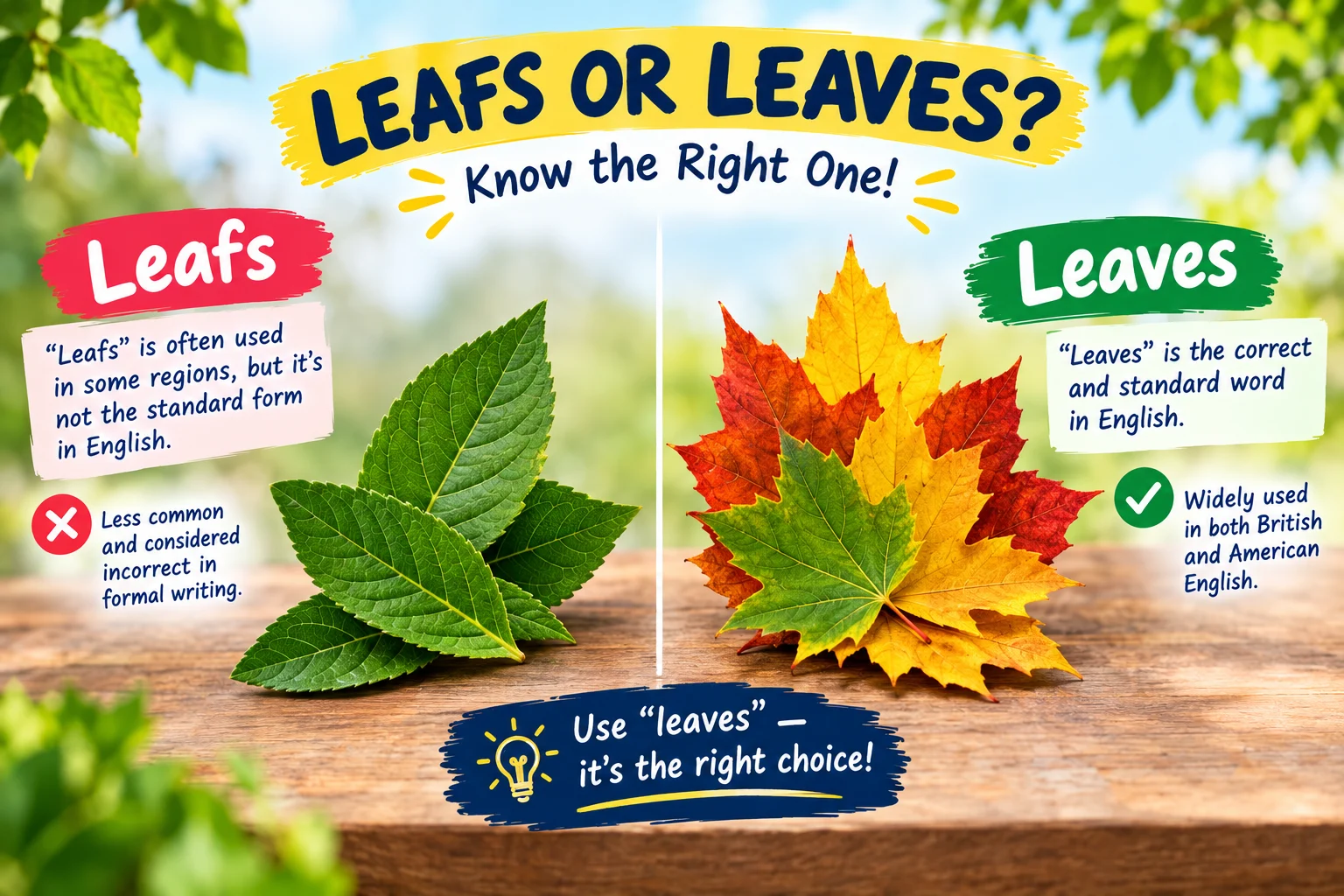
Leaves is the normal plural of leaf. Leafs is usually a verb form, but it is also correct in proper names such as the Toronto Maple Leafs.
Have you ever looked at the word leafs and wondered, “Shouldn’t that be leaves?” You are right to pause. These two words look almost the same, but they do different jobs.
As an English teacher, I have seen this mistake often. A student may write, “The trees lose their leafs in winter,” when the correct word is leaves. The confusion happens because many English plurals do not follow a simple -s rule.
The word leaf is one of them. When you mean more than one leaf on a tree or plant, the usual plural is leaves. But leafs is not always wrong. It can be the third-person singular form of the verb leaf, as in “She leafs through the book.” It also appears in the name Toronto Maple Leafs.
So, when should you use leaves, and when can you use leafs? The answer becomes easy once you understand whether you are talking about more than one leaf or an action. Let’s break it down.
Leafs or Leaves – Quick Answer
If you are talking about more than one leaf, use leaves.
The tree has green leaves.
The wind blew the leaves off the trees.
Leafs is normally used as a verb.
She leafs through a magazine.
It is also used as a proper name:
The Toronto Maple Leafs won the game.
So the basic rule is:
- Leaf → one
- Leaves → more than one
- Leafs → usually a verb, or part of a proper name
A simple way to remember it
Think about the meaning first.
If you can replace the word with “more than one leaf,” use leaves.
There are many leaves on the tree.
If the word describes someone quickly turning pages, use leafs.
He leafs through the newspaper.
The Origin and Background of Leafs and Leaves
The word leaf has a very old history. It comes from Old English lēaf, which referred to the leaf of a plant or tree.
Like many old English words, its plural form developed over time.
The plural leaves follows an older English pattern in which some nouns changed their final sound when they became plural. The f sound changed to a v sound, followed by -es.
This is why we have:
- leaf → leaves
- knife → knives
- wife → wives
- life → lives
- wolf → wolves
However, English has many exceptions and special cases. Not every word ending in -f changes to -ves.
For example:
- roof → roofs
- chief → chiefs
- belief → beliefs
- chef → chefs
That is one reason English plurals can be confusing.
Why does “leafs” exist?
Leafs exists because leaf can also function as a verb.
To leaf through something means to turn the pages quickly or casually.
For example:
She leafs through her notes before the exam.
Here, leafs is not a plural noun. It is a verb.
The spelling also appears in the proper name Toronto Maple Leafs, which is the name of a professional ice hockey team.
Leafs or Leaves Explained — Key Differences
The easiest way to understand these words is to look at their grammatical roles.
| Term | Meaning | When to Use | Region/Context |
|---|---|---|---|
| Leaf | One flat part of a plant or tree | When talking about one | All English varieties |
| Leaves | More than one leaf | When talking about two or more plant leaves | All English varieties |
| Leafs | Third-person singular verb form of leaf | When someone turns pages quickly or casually | Standard English |
| Leaf | To turn pages casually | As a verb | Standard English |
| Toronto Maple Leafs | Name of a hockey team | As a proper name | Sports |
Leaves as a plural noun
The most common use is leaves.
The leaves are falling from the trees.
I collected five leaves from the garden.
The autumn leaves were red and orange.
Here, leaves means more than one leaf.
Leafs as a verb
Leafs can mean turns pages casually or quickly.
He leafs through the book.
She leafs through the magazine while waiting.
The subject is usually he, she, or it, because leafs is the third-person singular present form.
Compare:
I leaf through the book.
You leaf through the book.
They leaf through the book.
But:
She leafs through the book.
Leafs as a proper name
Leafs is also part of the name Toronto Maple Leafs.
In this case, Leafs is not the normal plural of leaf. It is part of a specific team name and is therefore capitalized.
The Toronto Maple Leafs played last night.
This is a special use. It should not be used as a general plural for leaves on trees.
Leaves vs. Leafs in Different Contexts
Context can tell you which word you need.
Trees and plants → leaves
The leaves turned yellow in autumn.
Correct.
The leafs turned yellow in autumn.
Incorrect for standard English.
Books and magazines → leafs
When someone turns pages, leafs can be correct.
She leafs through the magazine.
However, in everyday English, flips through or looks through may sound more natural.
Sports → Leafs
If you are talking about the Toronto hockey team, Leafs is correct.
The Maple Leafs have a large fan base.
A single plant part → leaf
There is one leaf on the branch.
Which Version Should You Use?
The answer depends on what you mean.
For trees and plants → use leaves
If you mean more than one plant or tree leaf, always choose leaves.
The leaves fell from the tree.
This is the standard plural.
For books → use leafs when it is a verb
If someone turns pages casually, leafs can be used with he, she, or it.
She leafs through the report.
Still, alternatives such as flips through are very common in everyday writing.
For sports → use Leafs
If you are referring to the Toronto Maple Leafs, use Leafs because it is part of the official team name.
The Leafs are preparing for their next game.
For beginners → remember “leaf = leaves”
If you are learning English, the safest rule is simple:
One leaf, many leaves.
Do not use leafs as the ordinary plural.
Common Mistakes with Leafs or Leaves
Mistake 1: Using “leafs” as the plural of leaf
❌ The tree has many leafs.
✅ The tree has many leaves.
The noun leaf normally changes to leaves in the plural.
Mistake 2: Thinking “leafs” is always wrong
❌ Leafs is never correct.
✅ She leafs through the newspaper.
The verb leafs is a valid English word.
Mistake 3: Confusing leaves with the verb “leaves”
The word leaves has two common uses.
It can be a plural noun:
The tree has green leaves.
It can also be a verb:
He leaves home at eight.
The meaning comes from the context.
Mistake 4: Forgetting the Toronto Maple Leafs
In the hockey team name, Leafs is correct.
❌ Toronto Maple Leaves
✅ Toronto Maple Leafs
A proper name does not have to follow the normal plural pattern.
Mistake 5: Using “leafs” in academic or formal writing as the plural
❌ The plant has broad leafs.
✅ The plant has broad leaves.
For scientific, academic, or formal writing about plants, leaves is the correct plural.
Leafs or Leaves in Real-World Examples
1. Professional Email
Please remove the fallen leaves from the entrance before the meeting.
Here, leaves refers to parts of trees.
Another example:
I leafed through the report and found the information you needed.
Here, leafed is the past tense of the verb leaf.
2. News Headline
Autumn Leaves Cover Streets Across the City
Here, leaves is the plural noun.
For sports:
Maple Leafs Prepare for Their Next Game
Here, Leafs is part of the team’s name.
3. Social Media Post
The autumn leaves look beautiful today! 🍂
This is the normal plural form.
A sports fan might write:
Go Leafs! 🏒
Here, the word refers to the hockey team.
4. Formal Report
The plant develops large green leaves during the growing season.
This is correct for academic or scientific writing.
Another example:
The researcher leafs through the reference material before beginning the analysis.
This is grammatically possible, although reviews or looks through may sound more formal.
Leaves and Other Forms of Leaf
Learning the related forms can make the word easier to remember.
Singular noun
One leaf fell from the tree.
Plural noun
Several leaves fell from the tree.
Verb
I leaf through the book.
Third-person verb
She leafs through the book.
Past tense
He leafed through the pages.
Notice something useful here: the plural noun is leaves, but the verb forms use leaf as their base.
That gives you:
leaf → leaves for the noun plural.
leaf → leafs → leafed → leafing for the verb.
Leafs or Leaves — Data, Trends & Usage
The search intent behind “leafs or leaves” is mainly informational and grammatical.
People commonly search this phrase when they want to know:
- The plural of leaf
- Whether leafs is a real word
- How to spell the plural correctly
- Why leaf changes to leaves
- Whether leafs can be used in a sentence
- The difference between leafs and leaves
- Why the Toronto Maple Leafs use “Leafs”
The most important distinction is grammatical. Leaves is far more common when people are talking about plants, trees, gardening, nature, or seasons.
Leafs appears in more specific contexts. It can function as a verb, and it appears prominently in the name of the Toronto hockey team.
This makes the phrase interesting because both spellings are real words. The mistake is not that one exists and the other does not. The real issue is using the right word for the right meaning.
Standalone Comparison Table
| Term/Variant | Meaning | Region/Context | Best Used When |
|---|---|---|---|
| Leaf | One part of a plant | All English varieties | Talking about one plant leaf |
| Leaves | Plural of leaf | All English varieties | Talking about multiple plant leaves |
| Leaf | To turn pages casually | All English varieties | Using leaf as a verb |
| Leafs | Third-person singular of leaf | All English varieties | “She leafs through a book” |
| Leafed | Past tense of leaf | All English varieties | “He leafed through the pages” |
| Leafing | Present participle of leaf | All English varieties | “She is leafing through the magazine” |
| Leafs | Part of a proper name | Sports | Toronto Maple Leafs |
FAQs About Leafs or Leaves
Q: Is it leafs or leaves?
A: Leaves is the normal plural of leaf. Use it when you mean two or more leaves from a tree or plant.
Q: Is “leafs” a correct word?
A: Yes. Leafs is a correct word when it is the third-person singular form of the verb leaf, as in “She leafs through the book.” It is also used in proper names such as the Toronto Maple Leafs.
Q: What is the plural of leaf?
A: The standard plural is leaves. For example, “The tree has many leaves.”
Q: Why does leaf change to leaves?
A: Leaf follows an old English plural pattern in which the f sound changes to a v sound before -es. Similar examples include knife → knives and wife → wives.
Q: Is “leafs” acceptable in formal writing?
A: It can be correct when used as a verb or proper name. However, if you mean the plural of the plant part, formal writing should use leaves.
Q: What is the difference between leafs and leaves?
A: Leaves is normally the plural noun of leaf. Leafs is normally a verb meaning “turns pages casually,” or it can be part of a proper name such as the Toronto Maple Leafs.
Q: Can I say “the tree has many leafs”?
A: No. The standard form is “the tree has many leaves.” Use leaves when referring to multiple parts of a plant.
Q: Is “leaves” also a verb?
A: Yes. Leaves can mean “goes away,” as in “She leaves work at five.” It can also be the plural noun for leaf, as in “The leaves are green.”
Q: Why is the hockey team called the Maple Leafs and not Maple Leaves?
A: Toronto Maple Leafs is the team’s established proper name. Proper names can use forms that do not follow the normal plural pattern.
Q: Is “leafs through a book” correct?
A: Yes. Leafs through means casually or quickly turns the pages of a book or magazine. For example, “He leafs through the newspaper every morning.”
Conclusion
The difference between leafs or leaves becomes simple once you focus on meaning.
When you are talking about more than one part of a tree or plant, use leaves. For example, “The leaves are falling from the tree.” This is the standard plural of leaf.
Leafs has a different job. It can be the third-person singular form of the verb leaf, as in “She leafs through the magazine.” It is also correct as part of the proper name Toronto Maple Leafs.
Remember this easy rule:
One leaf → many leaves.
If you are describing trees, plants, gardens, or autumn, leaves is almost certainly the word you need. If you are talking about turning pages or the hockey team, leafs may be correct.
Now you know why both words exist and when to use each one. Bookmark this guide so you never confuse “leafs” and “leaves” again, and share it with someone learning English.