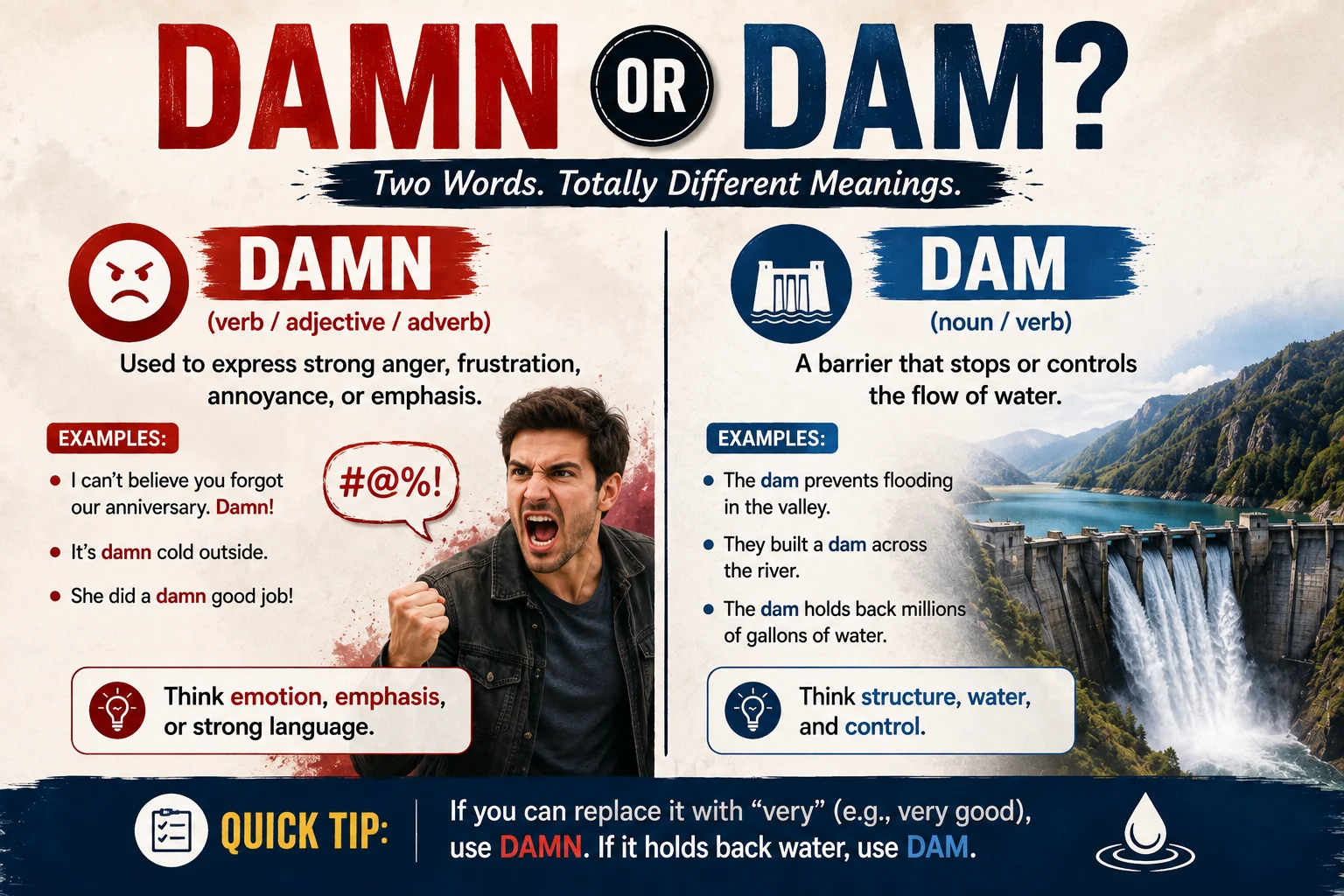
Damn is the correct spelling when you mean an expression of anger, surprise, emphasis, or a curse. Dam is a different word that means a barrier built to hold back water.
Have you ever typed “dam” when you really meant “damn”? It is an easy mistake to make. The two words look almost identical, and when people speak quickly, the final n in damn is often barely heard.
I have seen this confusion many times in casual writing. A learner may write, “Dam, that was close!” when the intended word is “damn.” The sentence can still be understood, but the meaning changes when the final letter disappears.
The good news is that the difference is simple. Damn is an interjection and can also work as a verb, adjective, adverb, or noun in some contexts. Dam, on the other hand, is a physical structure that holds back water.
This guide will help you tell these words apart without memorizing complicated rules. You will learn their meanings, origins, correct uses, common mistakes, real-world examples, and when each word is appropriate. Let’s start with the quick answer.
Damn or Dam – Quick Answer
Use damn when you want to express strong emotion, such as anger, surprise, frustration, or admiration.
Use dam when you mean a structure built across a river or other waterway to control water.
Examples of damn
Damn! I forgot my keys.
That was a damn good performance.
Examples of dam
The engineers built a dam across the river.
The dam helps control the water supply.
The easiest memory trick
Think:
Damn = emotion
Dam = water
If you are talking about a river, lake, flood control, or a water reservoir, you probably need dam.
If you are expressing anger, surprise, or emphasis, you probably need damn.
The Origin / Background of Damn
The word damn has a long history.
It comes from the Latin verb damnare, meaning to condemn or judge as wrong. The word entered English through Old French and developed into the modern form damn.
Over time, its uses expanded.
Today, damn can express:
- Anger
- Surprise
- Frustration
- Disappointment
- Admiration
- Strong emphasis
For example:
Damn! That hurt.
Here, damn expresses emotion.
It can also be used for emphasis:
That is a damn good idea.
Where does dam come from?
Dam has a different history.
It is connected to older words for barriers or structures that hold back water. The modern English word refers to a structure designed to stop, control, or redirect water.
For example:
The dam created a large reservoir.
So, although dam and damn look similar, they are not different spellings of the same word.
They are two separate words with different meanings.
Damn or Dam Explained — Key Differences
The main difference is meaning.
| Term | Meaning | When to Use | Region/Context |
|---|---|---|---|
| Damn | An expression of strong emotion or emphasis | Anger, surprise, frustration, admiration, emphasis | Informal English |
| Dam | A barrier that holds or controls water | Rivers, reservoirs, flood control, water systems | Standard English |
| Damn! | Strong emotional reaction | Casual speech or writing | Informal |
| Damned | Condemned or used as strong emphasis | Literary, religious, or informal contexts | Depends on context |
1. Damn
Damn is often used as an emotional reaction.
Damn! That was close.
It can show surprise or frustration.
It can also add emphasis:
That was a damn difficult exam.
The tone is informal and can be considered mildly offensive in some situations.
2. Dam
A dam is a structure that holds back or controls water.
The river dam provides water for nearby towns.
You will often see this word in discussions about:
- Rivers
- Hydroelectric power
- Reservoirs
- Flood control
- Irrigation
- Water storage
3. Damned
Damned is related to damn, but it has its own uses.
For example:
The damned machine won’t work.
Here, damned is being used as an informal intensifier.
It can also have a religious or historical meaning:
The souls were believed to be damned.
Which Version Should You Use?
The correct choice depends on what you mean.
For students
Use dam when your topic involves water or engineering.
Example:
The dam stores water for the city.
Use damn only when the context calls for an informal emotional expression.
For school essays, it is usually better to avoid damn unless you are discussing language, literature, or a quotation.
For professional writers
Choose dam when discussing water infrastructure.
For example:
The proposed dam will improve flood control.
Avoid damn in most professional writing. It can sound too informal or emotional.
For casual conversations
Damn is common in everyday speech.
You might say:
Damn, that’s expensive!
However, remember that it can be considered a swear word. The level of offense varies by person, culture, and situation.
For global or neutral English
Use dam for the water structure.
If you want to express surprise or frustration in neutral English, choose alternatives such as:
- Wow!
- Oh no!
- That’s surprising!
- That’s frustrating!
- I can’t believe it!
These options are safer in formal and international settings.
Common Mistakes with Damn or Dam
The most common errors happen when people confuse the two words because their pronunciation is similar.
1. Writing “dam” when you mean “damn”
❌ Dam! That was amazing.
✅ Damn! That was amazing.
Why does this happen?
The final n in damn is usually silent.
2. Writing “damn” when you mean a water structure
❌ The damn holds back the river.
✅ The dam holds back the river.
Why does this happen?
People sometimes add the n automatically because they are more familiar with the emotional word.
3. Thinking they are different spellings
❌ “Dam” is the short version of “damn.”
✅ Dam and damn are separate words.
They have different meanings and different origins.
4. Using “damn” in formal writing
❌ The project will build a damn across the river.
If you mean the structure:
✅ The project will build a dam across the river.
If you mean the swear word, consider whether it is appropriate for your audience.
5. Confusing “dam” with “damp”
These are also different.
Dam = a water-control structure.
Damp = slightly wet.
Example:
The walls are damp.
The river has a large dam.
Damn or Dam in Real-World Examples
Seeing the words in context makes the difference much easier to remember.
1. Professional Email
When discussing water infrastructure:
Subject: Dam Construction Update
The new dam project is expected to improve water storage and flood control.
This is appropriate professional usage.
If you are expressing frustration, a professional email would usually use a more neutral phrase:
I was very frustrated by the delay.
That is safer than:
Damn, this project is delayed again.
2. News Headline
A news headline might say:
New Dam Opens to Improve Regional Water Supply
Here, dam refers to the physical structure.
A headline might also use damn when reporting a direct quote:
Actor Says “Damn” After Surprise Victory
The word is correct because it is part of the quoted speech.
3. Social Media Post
Casual social media often uses damn.
Damn! That sunset looks incredible.
Here, damn expresses strong admiration.
For a post about engineering, you might write:
The new dam will provide water to thousands of homes.
Both words can appear online, but their meanings remain different.
4. Formal Report
A formal report may say:
The dam controls the flow of water during periods of heavy rainfall.
This is standard technical usage.
A report about language could also say:
The word damn is often used as an informal expression of strong emotion.
Here, the word is being discussed rather than used as a casual exclamation.
Damn — Data, Trends & Usage
The search query “damn or dam” is mainly an informational spelling and meaning query.
People often search it because the words sound very similar.
The silent n in damn creates the main problem. When you hear the word, you may not notice the final letter. When you write it, however, the spelling matters.
Who is likely to search this?
The question may be common among:
- English learners
- Students
- ESL writers
- People checking spelling
- Social media users
- Writers editing informal dialogue
Why does the question matter?
A spelling error can completely change the meaning.
Compare:
Damn! That’s beautiful.
with:
The dam is beautiful.
The first sentence expresses emotion.
The second sentence describes a structure.
One missing letter changes the word.
Search intent
The main search intent is:
Informational → spelling clarification → meaning → usage
There is usually no need for a complicated explanation. The reader wants a clear distinction and examples that make the difference easy to remember.
Damn vs. Dam: Standalone Comparison Table
| Term/Variant | Meaning | Region/Context | Best Used When |
|---|---|---|---|
| Damn | Strong emotional expression | Informal English | Expressing anger, surprise, or emphasis |
| Dam | Structure that controls water | Standard English | Talking about rivers, reservoirs, or flood control |
| Damn! | Emotional exclamation | Casual speech and writing | Showing surprise or frustration |
| Damned | Condemned or used for emphasis | Religious, literary, or informal | Depending on the context |
| Damming | Building or using a dam | Technical/environmental | Discussing water control |
Is “Damn” a Bad Word?
Damn is generally considered a mild swear word or profanity in modern English.
Its strength depends on the situation.
Among close friends, someone might say:
Damn, that’s amazing!
In a professional meeting, the same expression may sound inappropriate.
The word also appears in older religious or literary contexts with the meaning of condemning someone or something.
So, the meaning and tone depend on how the word is used.
Safer alternatives
If you want to avoid profanity, you can use:
- Wow!
- Oh no!
- Goodness!
- That’s incredible!
- That’s frustrating!
- I can’t believe it!
These choices work better in formal settings.
Why Is the “N” Silent in Damn?
This is one of the biggest reasons people confuse damn and dam.
In modern English, the n in damn is generally silent.
The word is commonly pronounced like “dam.”
That means the spoken forms sound almost identical.
But spelling is different:
dam
damn
This is a good example of why English spelling cannot always be predicted from pronunciation.
You may know how a word sounds but still need to remember how it is written.
How to Remember Damn vs. Dam
Try this simple trick.
Remember the meaning
Dam = water
Picture a large structure holding back a river.
Damn = emotion
Picture someone reacting after dropping their phone:
Damn!
This mental image can help you remember the difference.
Use the sentence test
Ask yourself:
Am I talking about water?
If yes → dam
Am I expressing strong emotion?
If yes → damn
That simple question will solve most spelling problems.
FAQ: Damn or Dam
Q: What does “damn” mean?
A: Damn can express anger, surprise, frustration, admiration, or emphasis. It can also have older meanings related to condemnation.
Q: What does “dam” mean?
A: A dam is a structure built to hold back or control water. Dams are used for water storage, irrigation, flood control, and power generation.
Q: Is “dam” or “damn” correct?
A: Both are correct words, but they have different meanings. Use dam for a water barrier and damn for the emotional expression or related meanings.
Q: Why is the “n” silent in “damn”?
A: English pronunciation has changed over time, while the spelling remained. As a result, the n is usually not pronounced in modern English.
Q: Is “damn” acceptable in formal writing?
A: It depends on the purpose. It may be discussed in a formal paper about language, but as an emotional expression it is usually better avoided in professional and academic writing.
Q: Is “damn” a swear word?
A: Yes, damn is generally treated as a mild swear word or profanity. Its offensiveness depends on the audience, culture, and setting.
Q: Where does the word “dam” come from?
A: Dam has a long history connected with words for barriers that hold back water. Its modern meaning refers to a structure used to control water.
Q: Can “damn” and “dam” be used in the same sentence?
A: Yes. For example: “Damn, that dam is huge!” Here, damn expresses surprise, while dam refers to the water structure.
Q: Is “damn” the same as “dam”?
A: No. They sound very similar because the n in damn is silent, but they have completely different meanings.
Q: What is the easiest way to remember the difference?
A: Remember dam = water and damn = emotion. If you can connect each word to its meaning, the spelling becomes much easier.
Conclusion
The difference between damn or dam is simple once you connect each word with its meaning.
Dam is a structure that holds back or controls water. You will see it in topics such as rivers, reservoirs, irrigation, hydroelectric power, and flood control.
Damn is usually an informal expression of strong emotion. It can show anger, surprise, frustration, or admiration. It can also be used in other forms and expressions, such as damned and psych up—but its emotional use may be considered profanity.
The main reason people confuse these words is pronunciation. The n in damn is normally silent, so damn and dam sound almost identical.
Here is the rule to remember:
Dam = water.
Damn = emotion.
Keep that simple connection in mind, and you will rarely mix them up again. Bookmark this guide so you never second-guess “damn or dam,” and share it with someone who might find the distinction useful.