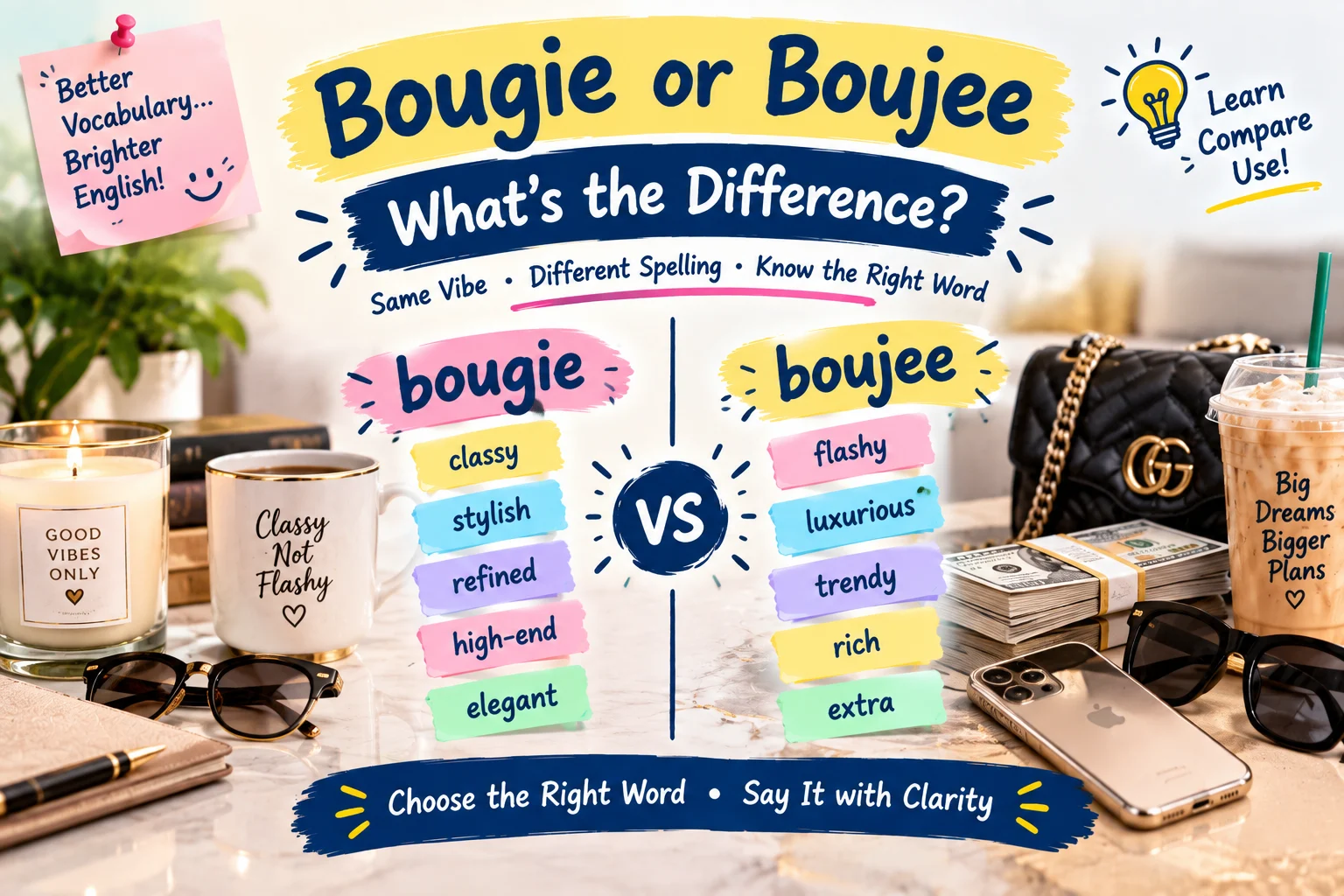
Bougie and boujee are informal spellings for a person, style, or lifestyle seen as fancy, luxurious, or concerned with status. Bougie is the older and more established spelling, while boujee is a popular modern variant.
Have you ever seen someone describe a restaurant, outfit, hotel, or person as bougie and wondered what they meant? Then you see boujee online and wonder if it is the same word. It can feel like a spelling mistake, but there is more going on.
As an English teacher, I have watched slang change quickly through music, social media, and everyday speech. Words that once appeared mainly in certain communities can become widely recognized within a few years. Bougie is a good example.
Both bougie and boujee are used in informal English. They are often used to describe something that seems fancy, expensive, stylish, luxurious, or focused on wealth and status. The exact tone can be positive, playful, teasing, or critical.
The spelling is only part of the story. The history behind the word, its connection to bourgeois, and its use in modern culture help explain why two spellings exist. Once you understand those points, choosing the right form becomes much easier.
Bougie or Boujee – Quick Answer
Bougie and boujee generally have the same basic meaning.
They describe someone or something that appears fancy, upscale, luxurious, or concerned with an expensive lifestyle.
That new restaurant is so bougie.
She loves boujee hotels and fancy dinners.
Both sentences are understandable in informal English.
Which spelling is more established?
Bougie is the more established spelling.
Boujee is a popular modern spelling that became especially visible through music, social media, and internet culture.
Neither form should be treated like a standard formal English word such as luxurious or sophisticated. Both are informal.
The Origin and Background of Bougie and Boujee
The story of bougie starts with the French word bourgeois, which relates to the middle class or a person associated with the middle class.
The word bourgeois entered English from French. Over time, bourgeois also developed cultural and social meanings connected with material comfort, conventional values, and social status.
In modern informal English, bougie became a shortened form associated with this idea.
The meaning then shifted.
Instead of simply referring to a social class, bougie came to describe things that seem:
- Expensive
- Fancy
- Upscale
- Stylish
- Materialistic
- Status-conscious
The modern word can be playful rather than serious.
For example:
I bought fancy candles for my apartment. I’m getting bougie.
The speaker may be joking about enjoying expensive or stylish things.
Where did “boujee” come from?
Boujee is a spelling variant of bougie.
The spelling became highly visible in popular culture and online language. It is often associated with the word boujee as used in music and social media.
The extra e does not create a completely different meaning. Instead, it gives the word a different visual style and pronunciation cue for some readers.
Bougie or Boujee Explained — Key Differences
The two spellings overlap heavily, but there are some useful differences in tone and usage.
| Term | Meaning | When to Use | Region/Context |
|---|---|---|---|
| Bougie | Fancy, upscale, luxurious, or status-conscious | Informal descriptions | Broad informal English |
| Boujee | Modern variant of bougie with the same general meaning | Slang, social media, pop culture | Informal internet and popular culture |
| Bourgeois | Related to the middle class or conventional/material social values | Formal, historical, social, or political discussion | Standard English |
| Luxurious | Very comfortable, expensive, or high-quality | Formal and general writing | Standard English |
| Upscale | High-end or expensive | General and informal writing | Standard English |
Bougie
Bougie is the more established informal spelling.
This café looks really bougie.
Her apartment has a bougie design.
It can be positive:
That hotel is beautiful and bougie.
It can also be teasing:
You ordered sparkling water? You’re so bougie.
Boujee
Boujee usually carries the same broad meaning.
They had a boujee dinner downtown.
His new car looks pretty boujee.
The spelling is especially common in casual digital communication.
Is there a major meaning difference?
Usually, no.
The difference is more about style, spelling preference, and context than a strict difference in definition.
Bougie vs. Boujee Pronunciation
Pronunciation can vary because slang spelling is not always fixed.
Both bougie and boujee are commonly pronounced approximately like:
BOO-zhee
The final sound is similar to the sound in the word “jeans” without the “n.”
However, informal slang can vary by speaker, region, and community.
If you are learning the word, listening to how native speakers use it can help more than relying only on the spelling.
What Does Bougie Mean in Everyday English?
The word can describe much more than a person.
A person
She’s a little bougie.
This can mean she enjoys expensive or fancy things.
Food
We went to a bougie restaurant.
This suggests the restaurant feels upscale, stylish, or expensive.
Clothing
That’s a bougie outfit.
The outfit may look fashionable, expensive, or luxurious.
Home
His new apartment is very bougie.
The apartment may have stylish furniture, expensive decorations, or an upscale design.
Lifestyle
She has a bougie lifestyle.
This suggests a lifestyle involving comfort, luxury, expensive experiences, or status.
Is Bougie Positive or Negative?
This is where context matters most.
Bougie does not have one fixed emotional meaning.
It can be positive:
I love this bougie little café.
Here, the speaker may mean stylish and luxurious.
It can be playful:
I feel bougie because I bought fancy cheese.
The speaker is joking about enjoying something expensive.
It can also be critical:
That place is too bougie for me.
Here, the speaker may feel that the place is too expensive, pretentious, or focused on status.
The tone depends on the speaker
Look at the surrounding words.
Bougie and beautiful → likely positive.
Bougie but fun → likely playful.
Too bougie and pretentious → likely negative.
This is why you should not translate bougie as simply “rich” or “expensive.” The word carries a social and cultural tone.
Which Version Should You Use?
Your choice depends on your audience and the kind of writing you are doing.
For casual social media → bougie or boujee
Both can work.
This hotel is so bougie. ✨
Or:
This hotel is so boujee. ✨
Choose the spelling that matches your personal style.
For slang-heavy content → boujee can fit
If you are writing a casual caption or conversation, boujee may feel natural.
Feeling boujee tonight. 🥂
The word is informal, so the relaxed spelling fits the context.
For general informal English → bougie
Bougie is a widely recognized spelling and is often the safer choice when you want readers to recognize the word easily.
That’s a very bougie restaurant.
For formal writing → avoid both
Neither bougie nor boujee is the best choice for most formal documents.
Instead, choose a precise standard-English word:
- Luxurious
- Upscale
- Expensive
- Sophisticated
- High-end
- Status-conscious
- Materialistic
For example:
Informal:
The hotel is really bougie.
Formal:
The hotel offers a luxurious experience.
Common Mistakes with Bougie or Boujee
Mistake 1: Thinking boujee is simply a spelling error
Boujee is a recognized informal variant.
It is not usually used in formal English, but it is common in slang and online communication.
Mistake 2: Thinking bougie always means rich
Bougie can suggest luxury or wealth, but it does not simply mean “rich.”
Someone can be called bougie because they enjoy:
- Fancy coffee
- Expensive restaurants
- Designer clothes
- Luxury hotels
- Stylish home décor
The word often describes taste or behavior, not a person’s actual income.
Mistake 3: Using bougie in formal academic writing
❌ The research shows that wealthy consumers prefer bougie products.
A more formal version would be:
✅ The research shows that wealthy consumers prefer luxury products.
Slang can weaken the tone of academic or professional writing.
Mistake 4: Assuming bougie is always an insult
The word can be playful or positive.
This little café is so bougie, and I love it.
Context determines the tone.
Mistake 5: Treating bougie and bourgeois as exact synonyms
They are related, but they are not identical.
Bourgeois has broader historical and social meanings.
Bougie is modern informal slang.
For formal discussions of social class, bourgeois is usually the more appropriate word.
Bougie or Boujee in Real-World Examples
1. Professional Email
Slang is usually not suitable for a formal business email.
Instead of:
We stayed at a bougie hotel.
You could write:
We stayed at a luxury hotel.
However, in a casual message to a friend:
This hotel is so bougie!
works naturally.
2. News Headline
A casual entertainment headline might say:
Why “Bougie” Style Is Taking Over Social Media
The word fits because the topic concerns popular culture and informal language.
3. Social Media Post
Weekend plans: good food, nice clothes, and a boujee hotel. ✨
This is a natural informal use.
4. Formal Report
Instead of:
Consumers are becoming more bougie.
A formal report could say:
Consumers are showing greater interest in premium and luxury products.
The second version is clearer and more professional.
5. Everyday Conversation
You got the fancy coffee again? You’re so bougie!
This is a playful use between friends.
Bougie, Boujee, and Bourgeois: What’s the Difference?
These words are connected, but they should not be treated as interchangeable.
Bougie
Modern slang.
That restaurant is bougie.
Meaning: fancy, upscale, luxurious, or status-conscious.
Boujee
Modern informal variant.
They had a boujee dinner.
Meaning: broadly the same as bougie.
Bourgeois
A standard word with social and historical meanings.
The novel explores bourgeois values.
This word is much more appropriate for academic, historical, social, or political discussion.
Luxury
A standard word for expensive or high-quality comfort.
The hotel offers luxury rooms.
This is a better choice in formal writing.
Bougie or Boujee — Data, Trends & Usage
The search intent behind “bougie or boujee” is mainly informational.
People often search the phrase because they have seen both spellings online and want to know:
- Which spelling is correct
- Whether bougie and boujee mean the same thing
- How to pronounce the word
- Where the slang comes from
- Whether the word is positive or negative
- Whether it is appropriate in formal writing
The word is especially visible in social media, music, fashion, food, lifestyle content, and casual conversation.
Its popularity also shows how modern slang can develop. A word may move from a specific cultural setting into wider internet use, where different spellings appear naturally.
For writers, the useful lesson is simple: context matters more than choosing one spelling as universally correct.
If you are writing a formal article, luxurious, upscale, or high-end will usually be clearer. If you are writing a casual post, bougie or boujee can capture the intended slang tone.
Standalone Comparison Table
| Term/Variant | Meaning | Region/Context | Best Used When |
|---|---|---|---|
| Bougie | Fancy, upscale, luxurious, or status-conscious | Informal English | Casual writing and conversation |
| Boujee | Informal variant of bougie | Slang, social media, pop culture | Casual digital communication |
| Bourgeois | Related to middle-class or conventional social values | Formal, historical, social contexts | Academic or formal discussion |
| Luxurious | Very comfortable, expensive, or high-quality | Standard English | Formal and general writing |
| Upscale | High-end or expensive | Standard informal/general English | Describing places, products, or services |
| High-end | Expensive and often high quality | Standard English | Business, marketing, and general writing |
| Materialistic | Focused strongly on possessions and wealth | Standard English | Critical or analytical contexts |
FAQs About Bougie or Boujee
Q: What does bougie mean?
A: Bougie is informal slang for something or someone that seems fancy, luxurious, upscale, or focused on status. It can be positive, playful, or critical depending on context.
Q: Is bougie or boujee correct?
A: Both spellings are used in informal English. Bougie is the more established spelling, while boujee is a popular modern variant.
Q: What is the difference between bougie and boujee?
A: There is usually no major difference in meaning. Both can describe a fancy, upscale, or status-conscious person, place, product, or lifestyle.
Q: Is bougie a formal word?
A: Bougie is informal slang. It is suitable for casual conversation, social media, and some lifestyle writing, but standard words such as luxurious or upscale are usually better for formal writing.
Q: Is boujee a bad word?
A: No. Boujee is not inherently a bad word. Its tone depends on how it is used and whether the speaker means it as praise, humor, teasing, or criticism.
Q: Does bougie mean rich?
A: Not exactly. Bougie can suggest wealth or expensive taste, but it often describes someone’s style, preferences, or behavior rather than their actual income.
Q: Where does the word bougie come from?
A: Bougie is connected to bourgeois, a French-derived word associated with the middle class and related social ideas. Modern slang uses bougie in a more casual sense for fancy or status-conscious tastes.
Q: How do you pronounce bougie?
A: It is commonly pronounced approximately BOO-zhee. Pronunciation can vary somewhat because the word is informal slang.
Q: Can I use bougie in an essay?
A: You can if you are discussing slang or quoting informal language. Otherwise, a formal word such as luxurious, upscale, or status-conscious is usually more suitable.
Q: Is boujee more modern than bougie?
A: Boujee is strongly associated with modern slang, popular culture, and social media. Bougie is the more established spelling and has a longer history of use in informal English.
Conclusion
The choice between bougie or boujee is mostly a question of informal style and context.
Bougie is the more established spelling. Boujee is a popular modern variant. Both can describe something that feels fancy, luxurious, upscale, stylish, or focused on status.
The word can describe a person, restaurant, outfit, home, vacation, meal, or lifestyle. Its tone can also change. Someone may use bougie as a compliment, a joke, or a criticism.
For formal writing, it is usually better to replace the slang with a more precise word such as luxurious, upscale, high-end, or sophisticated. If you are writing a casual social post or chatting with friends, either bougie or boujee can work.
One final tip: do not assume bougie simply means rich. It often says more about taste, style, and the way something feels than about actual wealth.
Now you know the difference. Bookmark this guide so you can use “bougie” and “boujee” with confidence in your next conversation or post.