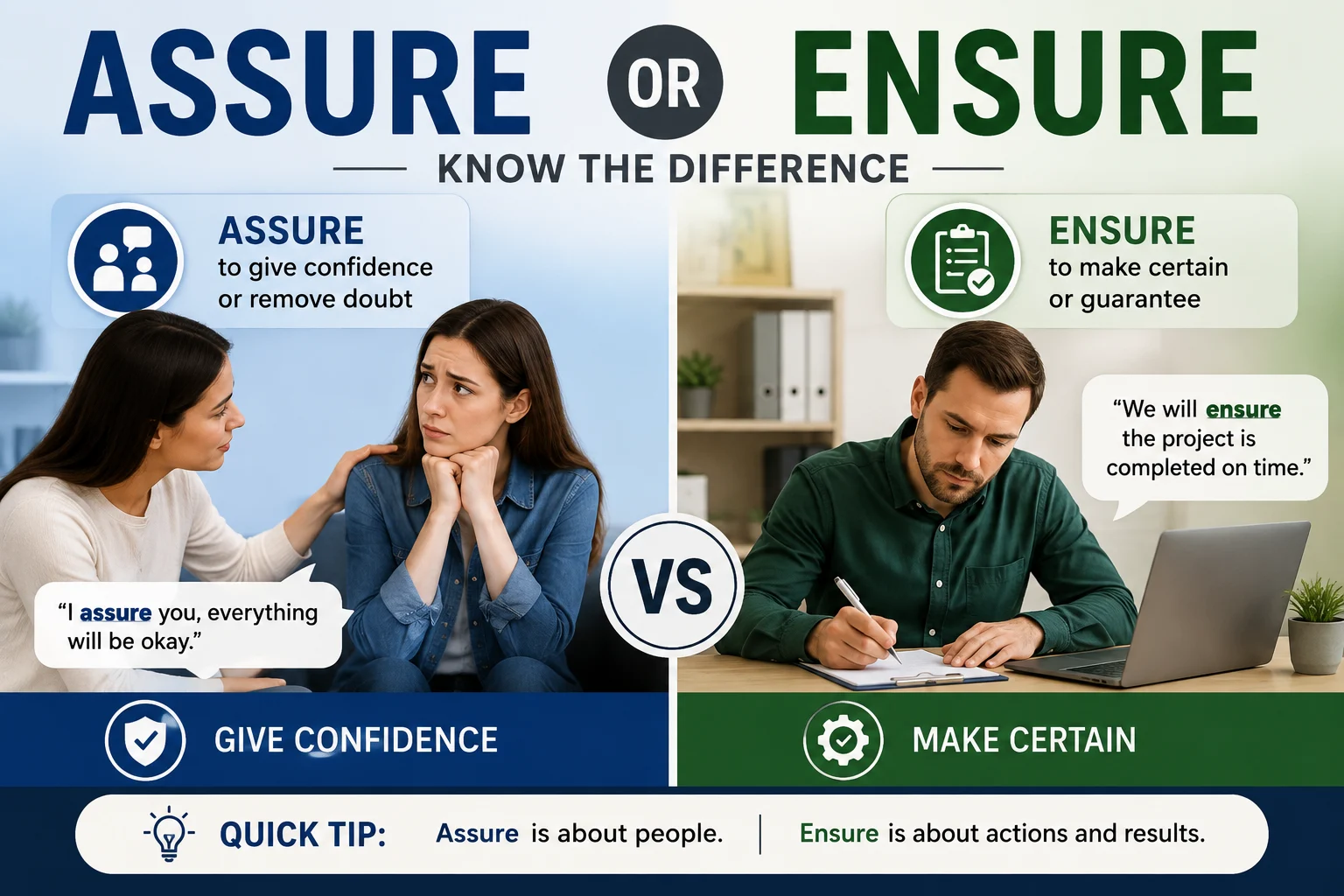
Assure means to give someone confidence or reassurance, while ensure means to make certain that something happens.
Have you ever wondered whether you should use assure or ensure? These two words are often confused because they sound similar and both relate to confidence or certainty. However, they have different meanings and are used in different situations. Choosing the wrong word can make your writing sound awkward or even change the meaning of your sentence.
Many people search for assure or ensure when writing emails, reports, business documents, or school assignments. The good news is that the difference is easy to understand. In most cases, assure is used when talking to a person, while ensure is used when talking about making something happen or preventing a problem.
This guide explains the difference between assure and ensure in simple English. You’ll learn where the words came from, how British and American English use them, common mistakes to avoid, and practical examples from everyday writing. By the end, you’ll know exactly which word to choose with confidence.
Assure or Ensure – Quick Answer
Both assure and ensure are correct, but they have different meanings.
- Assure means to give someone confidence or remove their doubts.
- Ensure means to make certain that something happens.
Examples
- I assure you everything will be fine.
- Please ensure that the door is locked.
- The manager assured the staff that their jobs were safe.
Easy Tip:
Assure = People
Ensure = Results or Actions
The Origin of Assure or Ensure
Both words come from the Latin word securus, meaning “safe” or “secure.” They entered English through French and gradually developed different meanings.
Assure came to mean giving confidence or reassurance to another person.
Ensure developed the meaning of making something certain or guaranteeing a result.
Although both words share the idea of certainty, modern English clearly separates their uses.
British English vs American English Spelling
There is no spelling difference between British and American English.
The difference is based on meaning, not region.
| Version | Spelling | Region | Example Sentence |
|---|---|---|---|
| Standard English | Assure | US & UK | I assure you that everything is ready. |
| Standard English | Ensure | US & UK | Please ensure all forms are complete. |
Both countries use the same spellings and meanings.
Which Spelling Should You Use?
US Audience
Use assure when speaking to or reassuring a person. Use ensure when making sure something happens.
UK/Commonwealth Audience
The same rule applies. Both words have distinct meanings and are used in the same way.
Global/SEO Audience
Follow the standard rule:
- Assure = reassure a person.
- Ensure = guarantee an action or result.
This makes your writing clear and professional.
Common Mistakes with Assure or Ensure
Here are common mistakes people make.
❌ The report is complete,Please assure
✅ Please ensure the report is complete.
❌ I ensure you everything is okay.
✅ I assure you everything is okay.
❌ She ensured her friend that help was coming.
✅ He assured his friend that help was coming.
Assure or Ensure in Everyday Examples
Emails
- I assure you that your order has been shipped.
- Please ensure all documents are attached before sending.
News Headlines
- Officials assure residents that water is safe.
- New safety rules ensure better protection.
Social Media
- I can assure everyone we’re doing our best!
- Double-check everything to ensure success.
Formal Writing
- The company assures customers of excellent service.
- Quality checks ensure product reliability.
Assure or Ensure – Google Trends & Usage
Both assure and ensure are widely searched because they are commonly confused.
People often search for assure when writing emails, customer service messages, or business communication where they need to reassure someone.
Ensure appears more often in technical writing, legal documents, instructions, contracts, education, and official policies because it focuses on guaranteeing an outcome.
Across English-speaking countries, both words are used frequently. Writers who understand the difference produce clearer and more professional content.
Comparison Table
| Feature | Assure | Ensure |
|---|---|---|
| Means reassure someone | ✅ Yes | ❌ No |
| Means make certain | ❌ No | ✅ Yes |
| Usually followed by a person | ✅ Yes | ❌ No |
| Usually followed by an action or result | ❌ No | ✅ Yes |
| Common in business writing | ✅ Yes | ✅ Yes |
| Common in legal or technical writing | Sometimes | ✅ Very Common |
| Best memory tip | People | Results |
FAQs
Is it assure or ensure?
Both are correct. Assure is for people, while ensure is for making something certain.
What is the easiest way to remember assure or ensure?
Remember: Assure people. Ensure results.
Can assure and ensure be used interchangeably?
Usually no. They have different meanings.
Is ensure more formal than assure?
Not necessarily. They are both standard English words used in different contexts.
Do British and American English use assure and ensure differently?
No. Both varieties follow the same meanings.
Which word should I use in business writing?
Use assure when reassuring customers or employees. Use ensure when describing procedures or guaranteed outcomes.
Conclusion
Understanding the difference between assure or ensure is easier than many people think. Although the words sound similar and both relate to certainty, they are used in different ways. Assure means giving confidence to a person or removing someone’s doubts. Ensure means making certain that something happens or preventing a problem. Remember the simple rule: assure people, ensure results.
There is no difference between British and American English for these words, so the same rule works everywhere. Whether you’re writing an email, business report, school assignment, or website content, choosing the correct word makes your message clearer and more professional.
If your sentence is directed at a person, choose assure. If your goal is to guarantee an action, process, or outcome, choose ensure. Keeping this simple distinction in mind will help you avoid common mistakes and write with greater confidence every time.