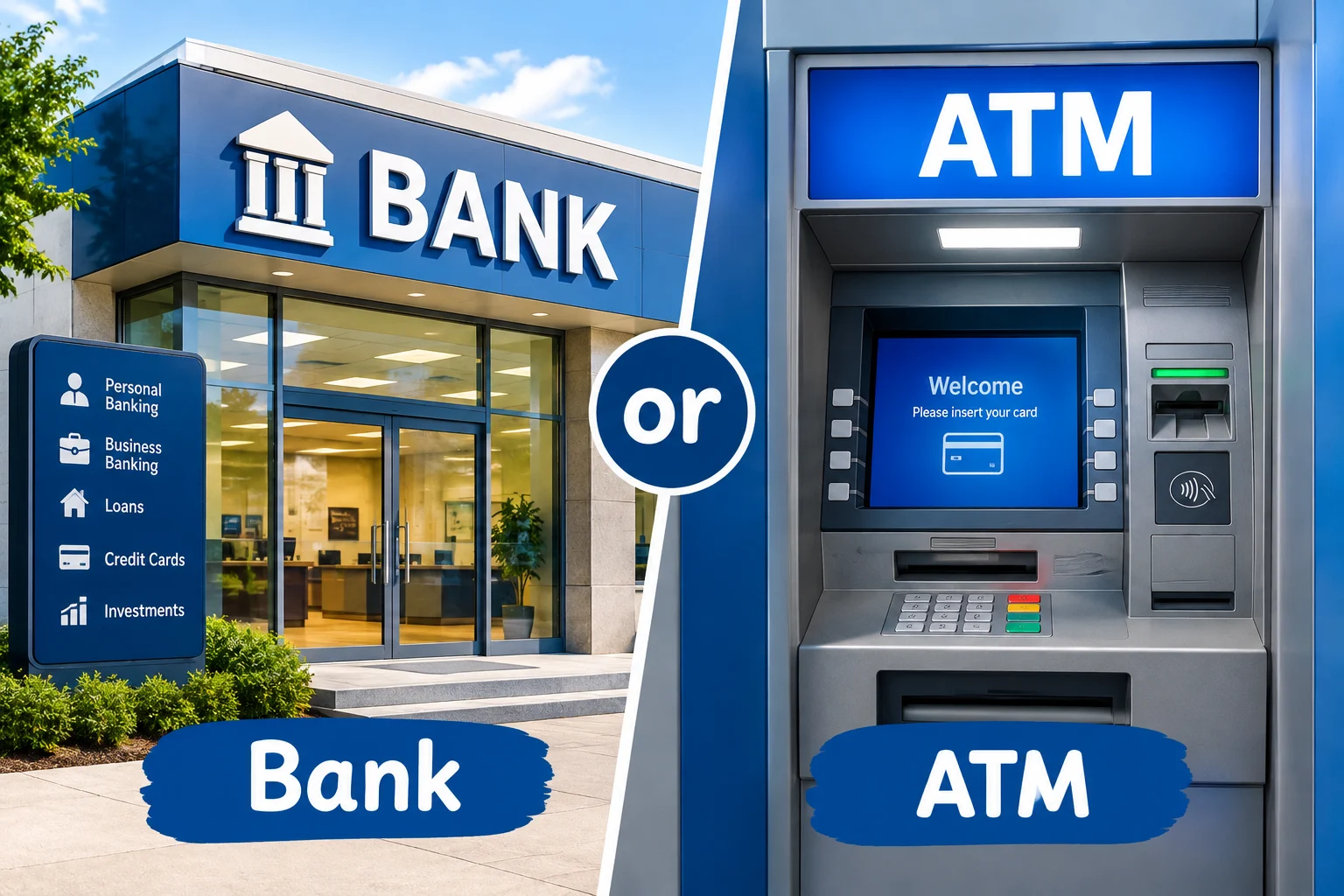
A bank is a financial institution that provides services such as accounts, loans, and money transfers. An ATM is a machine that lets you perform basic banking tasks, such as withdrawing cash and checking your balance.
Have you ever needed cash and wondered, “Should I go to the bank or the ATM?” The answer sounds simple, but these two terms are often mixed up.
A bank and an ATM are connected, but they are not the same thing.
I have noticed this confusion often when explaining everyday financial English to language learners. Someone may say, “I went to the bank to take money out,” when they actually mean they used an ATM outside the bank. Another person may call the ATM itself a “bank” because both are used for banking.
The difference becomes clear when you look at what each one does.
A bank is an organization. It manages money and provides many financial services. An ATM, or automated teller machine, is a self-service machine that gives you access to certain banking services.
Knowing the difference helps you choose the right word in conversation, emails, forms, travel situations, and everyday English.
Let’s make bank or ATM easy to understand.
Bank or ATM – Quick Answer
A bank is a financial institution where customers can manage their money and use services such as:
- Opening or closing accounts
- Depositing money
- Applying for loans
- Transferring money
- Getting financial advice
- Cashing or depositing checks in some locations
An ATM is a machine designed for quick, self-service banking.
You can often use an ATM to:
- Withdraw cash
- Check your balance
- Deposit cash or checks, where supported
- Transfer money between certain accounts
- Change or manage your PIN, depending on the bank
Simple Examples
“I need to go to the bank to apply for a loan.”
Here, bank is correct because a loan is a banking service.
“I need to use the ATM to withdraw $50.”
Here, ATM is correct because you are using a machine to get cash.
The easiest rule is:
Bank = financial institution.
ATM = banking machine.
The Origin and Background of Bank or ATM
The word bank has a long history. It is commonly linked to words meaning a bench or counter, referring to the benches used by early money changers and financial traders.
Over time, bank came to mean an organization that holds, lends, and manages money.
The term ATM is much newer.
ATM stands for automated teller machine. It refers to an electronic machine that allows customers to perform certain banking tasks without speaking directly to a bank employee.
The idea behind ATMs changed everyday banking. People no longer needed to visit a branch every time they wanted to withdraw cash.
This also explains why the terms are sometimes confused.
An ATM is often located at a bank, but it is not the bank itself.
Think about this comparison:
A library is a place and organization that provides books and services.
A self-service book machine might let you borrow or return a book.
The machine can provide one service, but it is not the whole organization.
The same basic idea applies to a bank and an ATM.
Bank or ATM Explained — Key Differences
The biggest difference is the type of thing each word describes.
| Term | Meaning | When to Use | Region/Context |
|---|---|---|---|
| Bank | A financial institution | When discussing banking services or a bank branch | General English |
| ATM | Automated teller machine | When using a self-service banking machine | General English |
| Bank branch | A physical location of a bank | When visiting staff in person | General English |
| Online banking | Banking through a website or app | When managing accounts digitally | Modern banking |
| Cash machine | Another term for an ATM | Common in some English-speaking regions | Especially British English |
| Cashpoint | Another term for an ATM | Informal regional usage | British English |
1. What Is a Bank?
A bank is an organization that provides financial services.
For example, you might visit a bank to:
- Open a checking or savings account
- Apply for a loan
- Ask about a mortgage
- Deposit a large amount of money
- Speak with a bank employee
- Resolve an account problem
Example:
“I need to visit the bank because I want to open a savings account.”
You would not normally say:
“I need to visit the ATM because I want to open a savings account.”
An ATM cannot normally provide that full service.
2. What Is an ATM?
ATM stands for automated teller machine.
It is an electronic machine that lets you perform certain banking tasks without a teller or bank employee.
The most common ATM function is withdrawing cash.
Example:
“I stopped at the ATM to get some cash.”
You may also use an ATM to check your account balance.
“I checked my balance at the ATM.”
The exact services depend on the bank and machine.
3. Bank Branch vs. ATM
A bank branch is a physical location where customers can usually speak with employees.
An ATM is a machine that provides selected services automatically.
Compare:
“I went to the bank branch to discuss my mortgage.”
“I stopped at the ATM to withdraw cash.”
Both can be part of the same bank’s network, but they serve different purposes.
Bank or ATM: Which One Should You Use?
The right choice depends on the service you need.
Use a Bank When You Need Personal Assistance
Go to a bank branch when you need a service that requires an employee or more detailed help.
Examples include:
- Opening an account
- Applying for a loan
- Discussing a financial problem
- Updating certain account information
- Asking about complex transactions
Use an ATM for Quick Cash Services
An ATM is usually better when you need a simple, fast transaction.
For example:
- Withdraw cash
- Check your balance
- Make a supported deposit
- Perform certain account transfers
Use Online Banking for Digital Tasks
Some services do not require either a branch or an ATM.
You may be able to use:
- A banking app
- Online banking
- A mobile payment service
- A bank website
For example:
“I transferred the money through online banking.”
So, the choice is not always bank or ATM. Sometimes the best description is online banking.
Common Mistakes with Bank or ATM
Mistake 1: Calling an ATM a Bank
❌ “I used the bank to withdraw cash.”
This sentence can be understood, but it may be less precise if you specifically mean the machine.
✅ “I used the ATM to withdraw cash.”
However, “I went to the bank to withdraw cash” can still be natural when referring generally to visiting a bank location.
Mistake 2: Calling the Bank Machine an ATM Without Meaning the Machine
❌ “I went to the ATM to apply for a mortgage.”
An ATM does not normally provide this service.
✅ “I went to the bank to apply for a mortgage.”
Mistake 3: Thinking Every Bank Service Is Available at an ATM
ATMs provide only selected services.
You usually cannot expect an ATM to handle complex requests such as:
- Loan applications
- Detailed financial advice
- Complex account disputes
- Some account changes
For these, contact the bank through an appropriate channel.
Mistake 4: Confusing “Bank” With “Bank Account”
A bank is the institution.
A bank account is the financial account you have with that institution.
Compare:
“I opened a bank account.”
“I opened the account at a bank.”
Both are correct, but they refer to different things.
Mistake 5: Using ATM When You Mean Bank Branch
❌ “I need to go to the ATM to speak to a bank employee.”
✅ “I need to go to the bank branch to speak to a bank employee.”
An ATM is usually unattended. A branch may have staff available to help.
Bank or ATM in Real-World Examples
1. Professional Email
“I will visit the bank tomorrow to discuss the issue with my account.”
Here, bank is correct because the customer needs assistance.
Another example:
“I used the ATM to withdraw the cash needed for the meeting.”
Here, ATM refers to the machine.
2. News Article
Bank Opens New Branch With 24-Hour ATM
This headline uses both words correctly.
The bank is the financial institution.
The ATM is the machine available for self-service transactions.
3. Social Media Post
“I finally found an ATM after walking around for 20 minutes! 😅”
Here, ATM is the natural word because the person needed a cash machine.
4. Formal Document or Report
“Customers can withdraw cash from participating ATMs using their bank cards.”
Here, ATMs refers to multiple automated teller machines.
Another example:
“Customers who require assistance should contact their bank.”
Here, bank refers to the financial institution.
Bank or ATM — Data, Trends & Usage
The search intent behind “bank or ATM” is mainly informational.
People may search the phrase because they are learning English, trying to describe a banking activity correctly, or asking which service they need.
The distinction is especially useful for:
- English learners
- Students
- Travelers
- New bank customers
- People completing forms
- Anyone learning financial vocabulary
Modern banking also makes this distinction more useful than ever.
People can now manage money through several channels:
- Bank branches
- ATMs
- Mobile apps
- Websites
- Telephone banking
- Self-service machines
This means the word bank no longer tells you exactly how a transaction happened.
For example:
“I transferred the money through my bank.”
This tells us the financial institution involved, but not whether the transfer happened in a branch, app, website, or another channel.
By contrast:
“I withdrew the money from an ATM.”
This tells us exactly which type of machine was used.
That small difference can make your English clearer.
Bank or ATM: Standalone Comparison Table
| Term/Variant | Meaning | Region/Context | Best Used When |
|---|---|---|---|
| Bank | Financial institution | General English | Discussing banking services |
| Bank branch | Physical location of a bank | General English | Visiting bank employees |
| ATM | Automated teller machine | General English | Withdrawing cash or using self-service banking |
| Cash machine | ATM | Common in British English | Talking about an ATM |
| Cashpoint | ATM | Common in British English | Informal everyday use |
| Bank account | Account held with a bank | General English | Discussing personal finances |
| Online banking | Digital banking service | General English | Banking through an app or website |
Frequently Asked Questions About Bank or ATM
Q: What is the difference between a bank and an ATM?
A: A bank is a financial institution that provides many financial services. An ATM is a machine that provides selected self-service banking functions, such as cash withdrawal.
Q: Is an ATM a bank?
A: No. An ATM is not a bank. It is a machine that is often operated by or connected to a bank.
Q: Should I say “bank” or “ATM” when I need cash?
A: If you specifically use a cash machine, say ATM. You can also say “I went to the bank to get cash” when speaking generally about visiting a bank location.
Q: What does ATM stand for?
A: ATM stands for automated teller machine. It is an electronic machine that allows customers to perform certain banking transactions without a teller.
Q: Is “ATM” acceptable in formal writing?
A: Yes. ATM is a standard and widely understood abbreviation. In formal documents, you may write automated teller machine (ATM) the first time if your audience may not know the abbreviation.
Q: Is “cash machine” the same as ATM?
A: Yes. Cash machine is another common term for an ATM. It is especially common in British English.
Q: Can I use “bank” when I mean a bank branch?
A: Yes. In everyday English, people often say “I went to the bank” when they mean a physical bank branch. If you need to be very precise, bank branch makes the meaning clearer.
Conclusion
The difference between bank or ATM becomes simple once you focus on what each word represents.
A bank is a financial institution. It provides a wide range of services, from accounts and loans to money transfers and customer support.
An ATM is a machine. It gives customers access to selected banking services without requiring direct help from a bank employee.
Remember this simple rule:
Bank = institution.
ATM = machine.
If you need to open an account, discuss a loan, or solve a complex account problem, you will usually need the bank or another customer service channel.
If you simply need to withdraw cash or perform another supported self-service transaction, an ATM may be all you need.
You may also hear cash machine or cashpoint, especially in British English.
Now you know exactly when to use bank and ATM. Bookmark this guide and share it with someone who wants to improve their everyday banking English