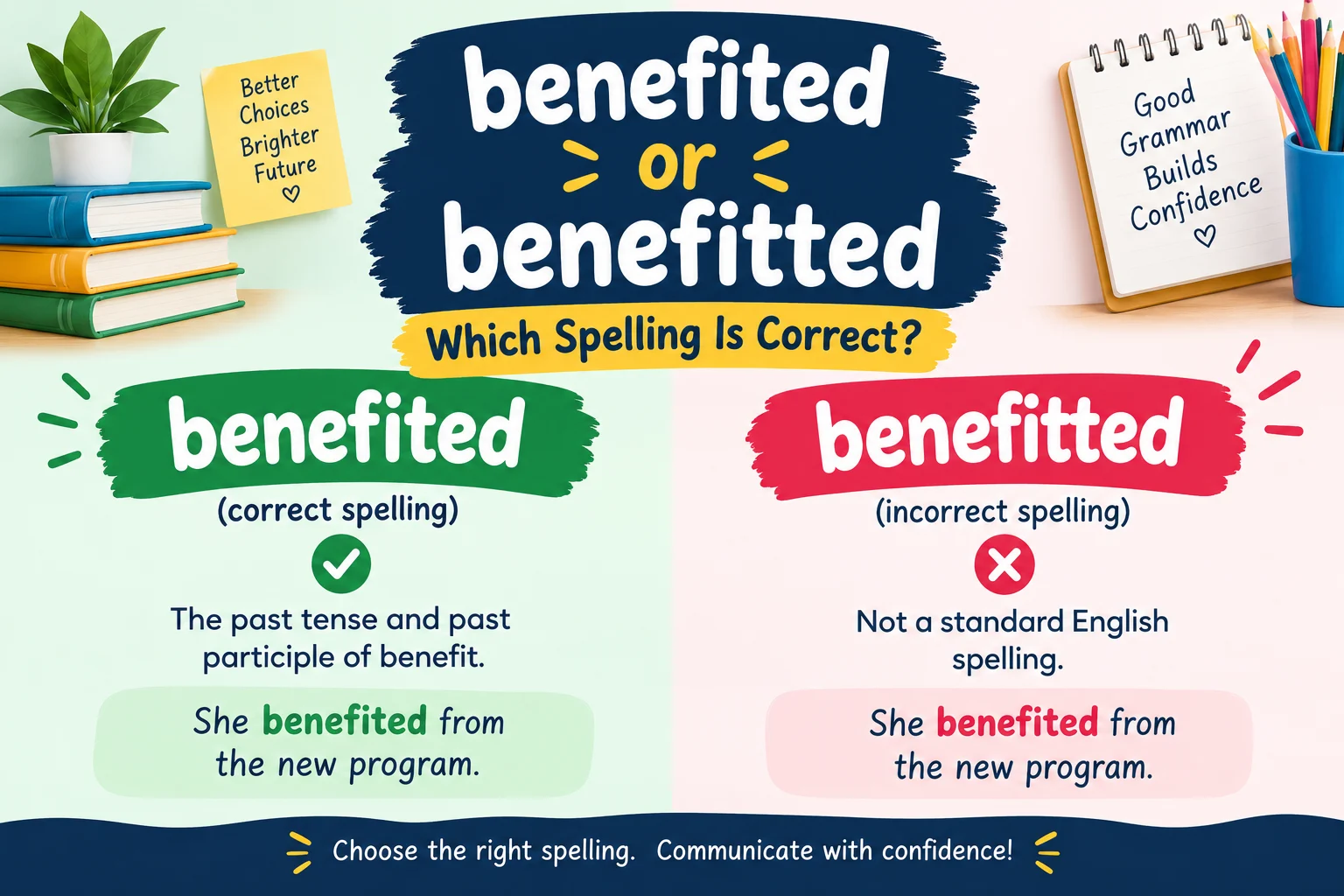
Benefited and benefitted are both correct spellings. Benefited is more common in American English, while benefitted is widely used in British English and some other varieties.
Have you ever typed benefited and stopped to wonder, “Should there be another t?” This is a small spelling choice, but it can cause real doubt when you are writing an email, essay, report, or article.
I have seen this question many times in English writing. A reader may know exactly what they want to say but still pause over one letter. The confusion comes from the way English handles verbs ending in -ed, especially when the final consonant can appear once or twice.
The good news is simple: benefited is not a mistake, and benefitted is not automatically wrong. Both forms appear in standard English. The preferred form often depends on the variety of English you are using.
In this guide, you will learn the difference between benefited or benefitted, where each spelling comes from, how to use them, and which form fits different types of writing. Let’s make this spelling choice easy.
benefited or benefitted – Quick Answer
Benefited and benefitted are both past-tense and past-participle forms of benefit.
The main difference is regional usage:
- Benefited is especially common in American English.
- Benefitted is especially common in British English.
- Both forms can be found in dictionaries and published writing.
- The noun benefit and verb benefit keep the same basic meaning in both forms.
Simple examples
She benefited from the training.
She benefitted from the training.
Both sentences mean that she gained an advantage from the training.
So, if you see benefitted with two t’s, do not assume it is a spelling error.
The Origin and Background of benefited or benefitted
The word benefit has a long history. It came into English through Anglo-French and Latin sources. The Latin word benefactum referred to a good deed or favor.
Over time, benefit developed into a word for an advantage, help, or useful result.
For example:
Regular exercise can benefit your health.
The past form creates the spelling question:
Regular exercise benefited my health.
or:
Regular exercise benefitted my health.
Why do both forms exist?
English has different spelling patterns for verbs that end in a stressed or unstressed syllable. British and American spelling traditions also developed different preferences.
With some verbs, British English often doubles the final consonant when adding -ed or -ing.
For example:
- travel → travelled
- cancel → cancelled
- label → labelled
American English often uses:
- travel → traveled
- cancel → canceled
- label → labeled
Benefit is another case where spelling preferences can differ.
However, there is an extra detail. The spelling benefited is also well established in British English. So the difference is not as simple as saying “one is British and one is American.”
That is why both forms can be correct.
benefited or benefitted Explained — Key Differences
The two words have the same meaning and the same basic grammatical function.
The difference is mainly spelling preference and regional usage.
1. Benefited
Benefited is the form with one t before -ed.
It is very common in American English and is also used in British English.
Example:
The students benefited from the new program.
It means the students gained something useful from the program.
2. Benefitted
Benefitted has two t’s before the final -ed.
This spelling is common in British English and can also appear in other English varieties.
Example:
The students benefitted from the new programme.
Again, the meaning is exactly the same.
Comparison Table
| Term | Meaning | When to Use | Region/Context |
|---|---|---|---|
| benefited | Gained an advantage or received help | General past-tense writing | Very common in American English; also used in British English |
| benefitted | Gained an advantage or received help | General past-tense writing | Common in British English and other varieties |
| benefit | To gain an advantage or help | Present tense/base form | Standard English |
| benefiting | Gaining an advantage | Present participle/gerund | Spelling varies by style |
What about benefiting and benefitting?
The same spelling issue can appear with the -ing form.
You may see:
The company is benefiting from the change.
You may also see:
The company is benefitting from the change.
Both forms are used.
This makes benefit different from verbs such as admit, where doubling the final consonant is much more regular:
admit → admitted
With benefit, usage has developed around both one- and two-consonant forms.
Which Version Should You Use?
Your best choice depends on your audience, style guide, and form of English.
For American English
Use benefited in most cases.
For example:
The patient benefited from the treatment.
This is the usual choice in American writing.
For British English
You can use benefited or benefitted. Both are established forms.
However, benefitted is common in British usage, especially when the writer follows a spelling style that doubles the final consonant.
For example:
The local community benefitted from the project.
For students and ESL learners
If your teacher, school, or publication follows a specific English variety, follow that style.
If no style is given, benefited is a simple and widely recognized choice.
For global or international writing
Consistency matters more than choosing one form.
If your document uses American spelling such as organize, color, and traveling, benefited fits that style well.
If it uses British spelling such as organise, colour, and travelling, benefitted may fit better.
The key rule is simple: choose a style and stay consistent.
Common Mistakes with benefited or benefitted
These spellings often cause a few predictable mistakes.
Mistake 1: Assuming benefitted is always wrong
❌ She benefitted from the course.
Some writers mark this as incorrect.
✅ She benefitted from the course.
This can be correct. Benefitted is an established spelling.
Mistake 2: Assuming benefited is only American
❌ Benefited is wrong in British English.
That is too broad.
✅ Benefited is also used in British English.
British English can use both benefited and benefitted.
Mistake 3: Mixing styles
A document might contain:
The company benefited from the program and organised a new event.
This is not necessarily grammatically wrong, but it may create an inconsistent spelling style.
If you are following American English, you may write:
The company benefited from the program and organized a new event.
If you are following British English, you may write:
The company benefitted from the programme and organised a new event.
Mistake 4: Changing the meaning
Some writers think the extra t changes the meaning.
It does not.
Benefited and benefitted mean the same thing.
Mistake 5: Confusing benefit with beneficiary
These words are related, but they are not interchangeable.
- Benefit = an advantage or useful result
- Benefited = received an advantage
- Beneficiary = a person who receives a benefit
Example:
The charity benefited many families.
The families were the beneficiaries of the program.
benefited or benefitted in Real-World Examples
Knowing the spelling is useful. Knowing how the word works in real writing is even better.
Professional Email
We believe the team has benefited from the new training program.
This sentence works well in a professional email using the one-t spelling.
A British-style version could be:
We believe the team has benefitted from the new training programme.
News Headline
Local Businesses Benefited From Summer Tourism
A news report might use benefited when describing economic gains.
For British English:
Local Businesses Benefitted From Summer Tourism
Both forms communicate the same idea.
Social Media Post
I really benefited from this course. The lessons were simple and practical!
This sounds natural in an informal post.
You could also write:
I really benefitted from this course!
The spelling does not change the message.
Formal Report
Participants benefited from access to additional learning resources.
Or:
Participants benefitted from access to additional learning resources.
Both are grammatically acceptable.
The choice should match the spelling style used throughout the report.
benefited or benefitted — Data, Trends & Usage
Searches for benefited or benefitted usually come from people who want a quick spelling check. The search intent is mainly informational.
People often search for this pair when they are:
- Writing essays.
- Preparing professional documents.
- Checking British and American spelling.
- Editing academic work.
- Learning English as a second language.
- Writing online content.
The interesting part is that this is not a simple right-versus-wrong spelling question.
The two forms have different levels of use across English varieties. This reflects a wider feature of English: spelling can change by region while the meaning stays the same.
That matters for writers because consistency improves clarity and professionalism.
If your website uses American spelling, stay with that style. If your publication uses British spelling, follow its house style.
For SEO writers, this distinction can also help. A reader searching “benefited or benefitted” is usually looking for a clear answer, not a long history lesson. The best explanation should give the answer first and then show the regional difference.
Benefited vs. Benefitted: At a Glance
| Term/Variant | Meaning | Region/Context | Best Used When |
|---|---|---|---|
| Benefited | Received an advantage or gained from something | American English; also British English | You want the widely used one-t form |
| Benefitted | Received an advantage or gained from something | British English and other varieties | Your chosen style uses the doubled t |
| Benefit | To gain or provide an advantage | All major English varieties | You need the base verb |
| Benefiting | Gaining an advantage | Spelling varies by English variety | You need the -ing form |
FAQs About benefited or benefitted
Q: Is benefited or benefitted correct?
A: Both are correct. The choice depends mainly on regional spelling preference and the style you follow.
Q: Is benefited more common in American English?
A: Yes. Benefited is the common spelling in American English. It is also used in British English.
Q: Is benefitted correct in British English?
A: Yes. Benefitted is an established British English spelling. However, benefited is also used in British English.
Q: Do benefited and benefitted have different meanings?
A: No. They have the same meaning. Both mean that someone or something gained an advantage or received a useful result.
Q: Which spelling should I use in formal writing?
A: Use the spelling that matches your chosen English variety and style guide. The most important point is to keep your spelling consistent throughout the document.
Q: What is the past tense of benefit?
A: The past tense can be benefited or benefitted. Both forms are used in standard English.
Q: Is benefitted a spelling mistake?
A: No. Benefitted is a valid spelling. It is especially familiar in British English.
Q: Should I use benefited in American English?
A: Yes. Benefited is the usual choice in American English and is widely understood internationally.
Q: Can I use benefited in British English?
A: Yes. British English uses benefited as well as benefitted. Your choice can depend on the publication or house style.
Q: What is the difference between benefit and benefited?
A: Benefit is the base form of the verb. Benefited is its past-tense and past-participle form. For example, “Exercise can benefit you,” but “Exercise benefited me.”
Conclusion
The spelling question benefited or benefitted looks harder than it really is.
The key fact is that both spellings are correct. They have the same meaning and serve the same grammatical role. The main difference is spelling preference across English varieties.
Benefited is especially common in American English. Benefitted is common in British English, although benefited is also used in British English. Neither spelling should automatically be treated as an error.
When writing for school, work, or publication, check the required style first. If there is no specific rule, choose one spelling and use it consistently.
Remember these three points:
- Benefited = correct.
- Benefitted = correct.
- Consistency = essential.
Now you can use benefited or benefitted with confidence. Bookmark this guide so you never have to second-guess this spelling again.