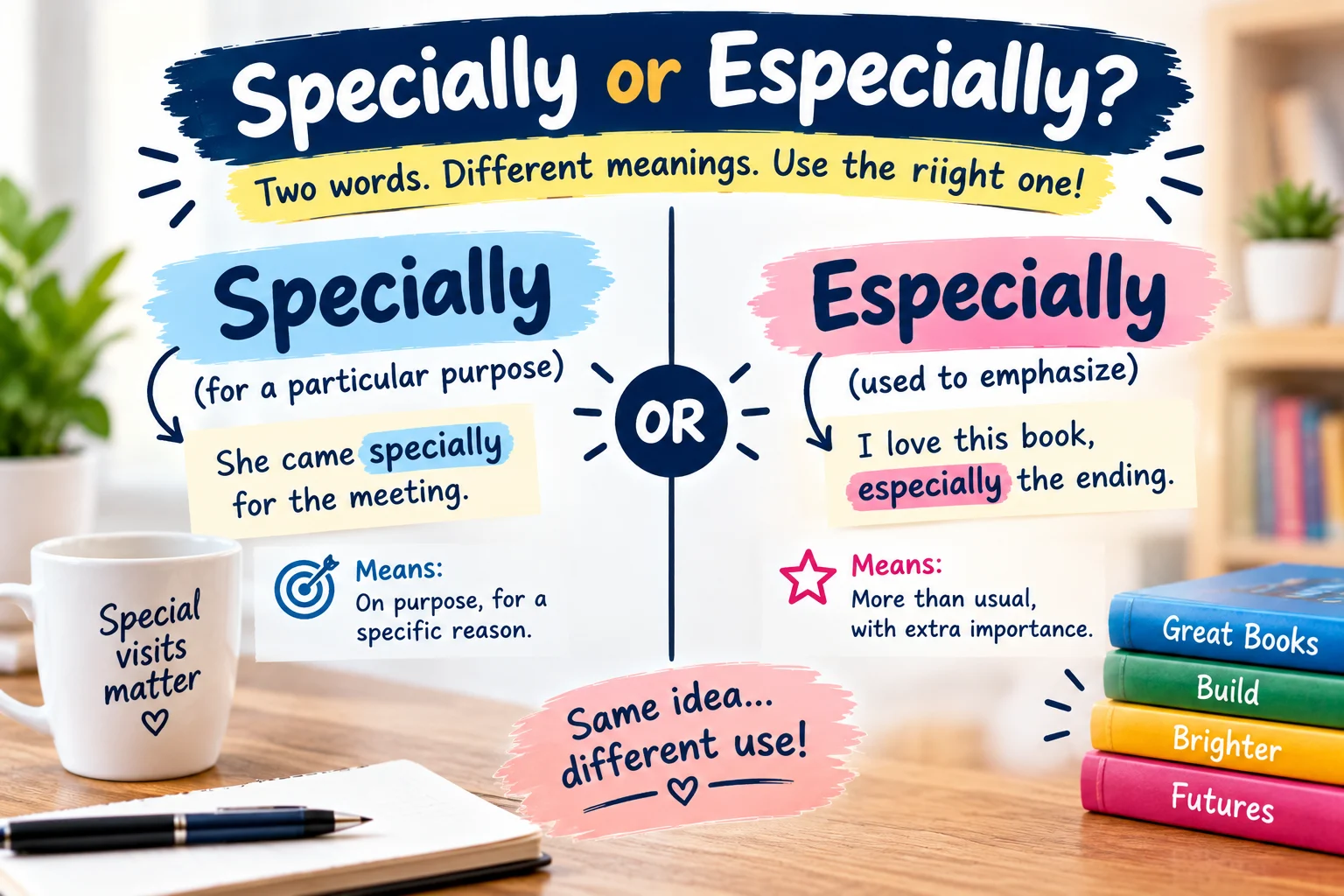
Especially means “particularly” or “more than usual,” while specially means “for a special purpose or reason.” They are close, but they are not always interchangeable.
Have you ever written a sentence with specially and then stopped to wonder if especially would sound better? This is a very common English mistake. The two words look almost the same, sound similar, and both work as adverbs. Yet they often express different ideas.
As an English teacher, I have seen this confusion in student essays, emails, social media posts, and professional writing. The problem is not that learners do not know the words. The problem is knowing which one fits the sentence.
Here is the good news: you do not need to memorize a long grammar rule.
Think of especially as particularly. Think of specially as for a special purpose.
For example, you might say, “I especially like this book.” But you could say, “This book was specially written for beginners.”
That small difference can make your writing much clearer. Let’s break it down with simple rules, examples, common mistakes, and easy memory tricks.
Specially or Especially – Quick Answer
Both specially and especially are correct English words. The difference is mainly in their meaning and use.
Especially
Especially usually means:
- particularly
- above all
- more than others
- to a greater degree
Example:
I enjoy reading, especially mystery novels.
Here, especially means particularly.
Specially
Specially usually means:
- for a particular purpose
- specifically
- in a special way
Example:
This chair was specially designed for children.
Here, the chair was designed for a particular purpose.
The easiest rule
Especially = particularly
Specially = for a special purpose
If you can replace the word with particularly, choose especially.
If you can replace it with specifically or for a special purpose, specially may be the better choice.
The Origin and Background of Specially and Especially
The two words are closely related because both come from the adjective special.
Special comes through French from Latin roots connected with the idea of a particular kind, quality, or group.
From special, English developed several related forms:
- special
- specially
- especial
- especially
The word especial has an older meaning of something particular or especially important. From it came especially.
Over time, especially became very common in English. Today, it is often used to mean particularly.
Specially kept a more focused sense. It is often used when something is made, arranged, changed, or done for a particular purpose.
This history helps explain why the words overlap but are not always interchangeable.
For example:
The cake was specially made for my birthday.
The cake was made for a specific occasion.
But:
I especially liked the chocolate cake.
Here, the speaker liked the chocolate cake more than the other cakes.
The difference is subtle, but the meaning changes.
Specially or Especially Explained — Key Differences
The easiest way to understand these words is to compare their main functions.
| Term | Meaning | When to Use | Region/Context |
|---|---|---|---|
| especially | Particularly; more than others | Showing emphasis or preference | Standard English |
| specially | For a particular purpose | Explaining a special purpose or arrangement | Standard English |
| special | Different or unusual | Describing a person, thing, event, or quality | Standard English |
1. Especially = Particularly
Use especially when you want to emphasize one person, thing, or situation.
Examples:
I love fruit, especially mangoes.
She is especially good at mathematics.
The weather is beautiful, especially in spring.
In each example, especially adds emphasis.
You could replace it with particularly:
I love fruit, particularly mangoes.
The meaning remains almost the same.
2. Specially = For a Particular Purpose
Use specially when something has been done for a specific reason or purpose.
Examples:
This bag was specially designed for travelers.
The room was specially prepared for the guests.
She bought a dress specially for the wedding.
The word tells us why something was done.
3. Sometimes Both Can Work
English has some areas where the two words overlap.
For example:
The meal was specially prepared for the guests.
This focuses on the purpose.
You may also hear:
The meal was especially prepared for the guests.
This can occur in English, but specially is often clearer when you mean “for a particular purpose.”
That is why context matters.
Which Version Should You Use?
Your choice depends on what you want to say.
For emphasis → use especially
If you mean particularly, use especially.
I especially enjoyed the final chapter.
You could say:
I particularly enjoyed the final chapter.
The meaning is clear.
For a special purpose → use specially
If something was done for a particular purpose, use specially.
This software was specially developed for teachers.
The software was developed with a specific group or purpose in mind.
For students → use especially
When writing essays or answering grammar questions, especially is usually the word you need when expressing emphasis.
Example:
Many students enjoy outdoor activities, especially sports.
For professional writing → choose based on meaning
Use especially for emphasis:
The new policy is especially useful for small businesses.
Use specially for a specific purpose:
The training program was specially designed for new employees.
For global or neutral English
Both are standard English words. Do not choose based on British versus American spelling. The main difference is meaning, not regional spelling.
Common Mistakes With Specially or Especially
1. Using specially when you mean particularly
Mistake:
I specially like this song.
Better:
I especially like this song.
Why? You mean particularly, not “for a special purpose.”
2. Using especially when you mean for a specific purpose
Less clear:
This tool was especially designed for students.
Clearer:
This tool was specially designed for students.
Here, the tool was created for a particular group.
3. Thinking specially is always wrong
Mistake:
You should never use “specially.”
That is not true.
Specially is a correct English word.
For example:
This box was specially made to protect the equipment.
The word has a clear purpose-based meaning.
4. Assuming especially and specially always mean the same thing
They can overlap in some sentences, but their main uses are different.
Remember:
Especially → emphasis
Specially → purpose
5. Confusing “special” with “especially”
Special is an adjective.
She gave me a special gift.
Especially is an adverb.
She especially liked the gift.
Their grammatical roles are different.
Specially or Especially in Real-World Examples
1. Professional Email
Thank you for your presentation. I especially appreciated the practical examples you shared.
Here, especially means particularly.
Another example:
We have specially arranged the meeting room for your team.
Here, specially means the room was arranged for a particular purpose.
2. News Headline or Article
New Program Especially Helps Young Entrepreneurs
The word especially highlights the group that benefits most.
A purpose-based example:
New Center Specially Designed for Senior Citizens
Here, specially shows that the center was designed for a particular group.
3. Social Media Post
I love weekend mornings, especially when I can enjoy a quiet cup of coffee.
The speaker is emphasizing one part of the weekend.
Another example:
I made this card specially for my best friend. ❤️
The card was made for a particular person.
4. Formal Document or Report
The new policy is especially beneficial for small businesses.
This means the policy is particularly beneficial to them.
For purpose:
The equipment was specially modified for use in cold environments.
The modification was made for a specific purpose.
Especially vs. Specially in Common Expressions
Some patterns are very common.
Common uses of especially
- especially important
- especially useful
- especially difficult
- especially helpful
- especially common
- especially popular
- especially for
- especially when
Examples:
This advice is especially useful for beginners.
Winter can be especially difficult for older people.
I like all fruits, especially oranges.
Common uses of specially
- specially designed
- specially made
- specially prepared
- specially created
- specially trained
- specially selected
- specially developed
Examples:
The course was specially designed for beginners.
The meal was specially prepared for the guests.
The machine was specially developed for this task.
These patterns can make the distinction much easier to remember.
Specially or Especially — Data, Trends & Usage
The search intent behind specially or especially is mainly informational. Students, ESL learners, writers, editors, and professionals often search this phrase because the two words are easy to confuse.
The confusion comes from three things:
- They look almost identical.
- They both function as adverbs.
- Their meanings overlap in some contexts.
Yet their most useful distinction remains simple.
Especially is common when writers want to emphasize something.
The advice is especially helpful for new writers.
Specially is common when writers describe something created or done for a particular purpose.
The advice was specially prepared for new writers.
This distinction matters in professional and academic writing because choosing the right word can make your meaning more precise.
Specially vs. Especially: Quick Comparison
| Term/Variant | Meaning | Region/Context | Best Used When |
|---|---|---|---|
| especially | Particularly; above all | Standard English | Showing emphasis or preference |
| specially | For a particular purpose | Standard English | Describing a specific purpose |
| special | Unusual or important | Standard English | Describing a noun |
| particularly | Especially; to a notable degree | Standard English | Formal or neutral emphasis |
| specifically | In a precise or particular way | Standard English | Giving exact focus or purpose |
Easy Memory Trick
Use this two-word test:
Especially = particularly
Specially = specifically
For example:
I especially like tea.
Replace it:
I particularly like tea. ✓
Now try:
This cup was specially made for me.
Replace it:
This cup was specifically made for me. ✓
That simple test will help you choose the right word in most cases.
Frequently Asked Questions
Q: What is the difference between specially and especially?
A: Especially usually means “particularly” or “more than others.” Specially usually means “for a particular purpose.”
Q: Is specially a correct English word?
A: Yes. Specially is a standard English word. It is often used when something is created, prepared, designed, or done for a specific purpose.
Q: Is especially more common than specially?
A: Yes, especially is generally more common in everyday English. It is widely used to add emphasis or show that something stands out from others.
Q: Can specially and especially be used interchangeably?
A: Sometimes they can overlap, especially in older or less precise usage. However, using especially for “particularly” and specially for “for a particular purpose” gives you the clearest meaning.
Q: Is “especially” formal English?
A: Yes. Especially is suitable for casual, professional, academic, and formal writing. It is not limited to conversation.
Q: Is “specially” acceptable in formal writing?
A: Yes, when the meaning is correct. For example, “The equipment was specially designed for laboratory use” is perfectly acceptable formal English.
Q: Which is correct: “especially for” or “specially for”?
A: Both can be correct, but the meaning differs. Especially for often emphasizes who or what something is most suitable for, while specially for often means something was done specifically for that person or purpose.
Conclusion
The difference between specially or especially is much easier once you focus on the meaning instead of the spelling.
Use especially when you mean particularly, above all, or more than others. For example, “I especially enjoy reading” means reading is one activity you enjoy more than others.
Use specially when you mean for a particular purpose. For example, “The room was specially prepared for the guests” tells us why the room was prepared.
A quick memory trick can save you from most mistakes:
Especially = particularly
Specially = for a special purpose
Both words are correct. Neither should be avoided. The key is choosing the one that matches your meaning.
When you are unsure, replace the word with particularly or specifically. If “particularly” works, choose especially. If “specifically” or “for a particular purpose” works, choose specially.
Now you know exactly when to use specially and especially. Bookmark this guide so you never second-guess these two words again.