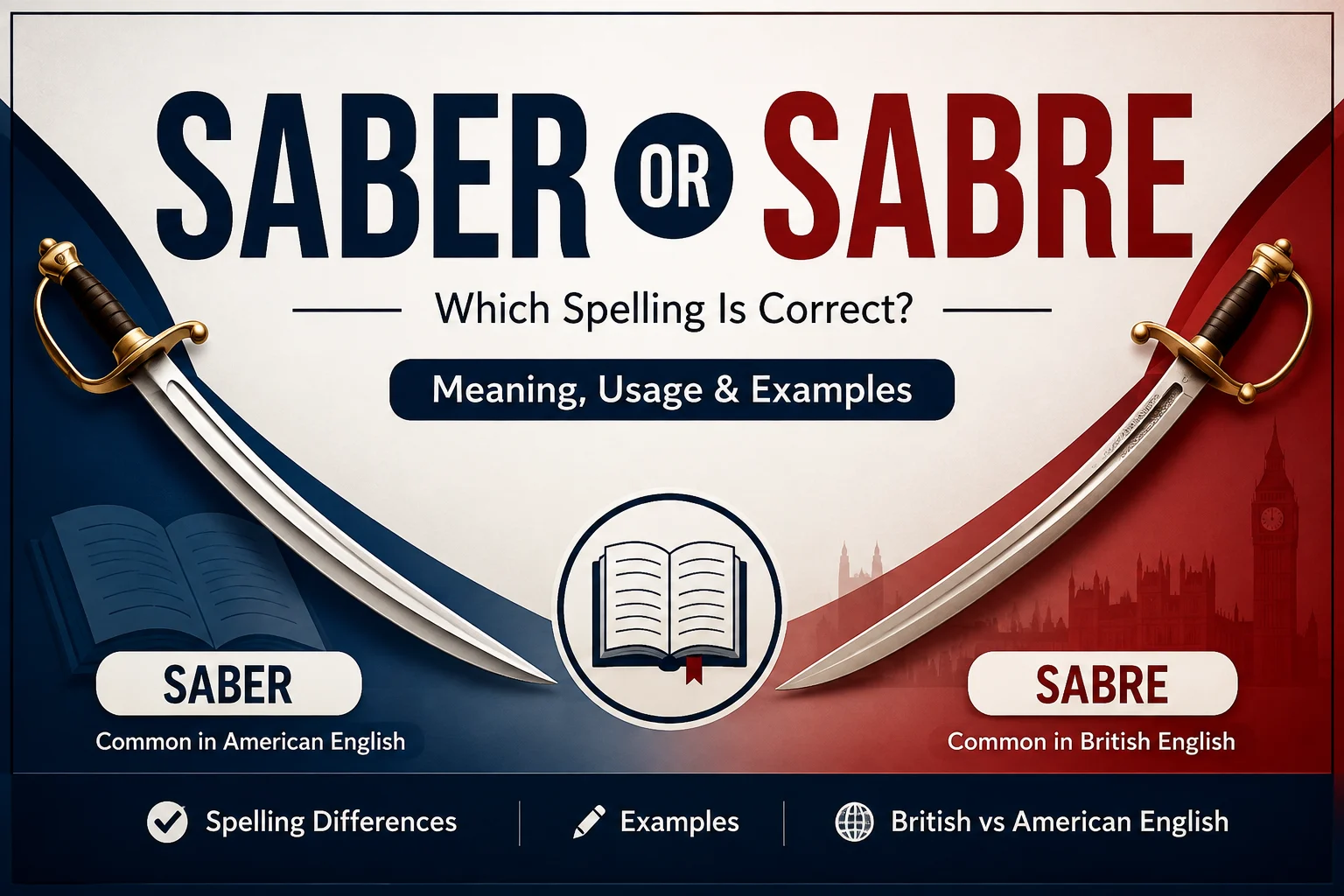
Sabre is the standard English spelling for a type of curved sword. Saber is the standard American English spelling, while sabre is preferred in British English.
Have you ever written saber and wondered whether it should be sabre instead? This is one of those spelling questions where both forms can be correct.
The difference is mainly about British and American English.
As an English teacher, I often see learners hesitate over words that change their spelling between English varieties. Saber or sabre is a good example because the pronunciation and meaning stay almost the same, while one letter changes position.
A saber/sabre is a type of sword. It is usually associated with a curved blade and has a long history in military use. The word is also used in fencing, where the saber is one of the three main weapons.
The key rule is simple:
- Saber → American English
- Sabre → British English
Neither spelling is automatically wrong.
Your best choice depends on your audience, country, and writing style. Once you know that rule, you will rarely need to second-guess this word again.
Saber or Sabre – Quick Answer
Saber and sabre are two accepted spellings of the same word.
| Spelling | Main Usage |
|---|---|
| saber | American English |
| sabre | British English |
Both refer to a type of sword with a curved blade. The word is also used for the saber/sabre fencing weapon.
Simple Examples
American English:
The soldier carried a saber.
British English:
The soldier carried a sabre.
The meaning is the same.
The Easy Rule
Remember:
Saber = American English
Sabre = British English
This is similar to other spelling differences such as:
- color / colour
- honor / honour
- armor / armour
- center / centre
The Origin / Background of Saber or Sabre
The history of saber/sabre is more interesting than its spelling suggests.
The English word is connected to European words for a curved sword. It is generally linked to French sabre, with deeper connections to words used for similar weapons in Central and Eastern Europe.
The weapon itself became strongly associated with cavalry and military fighting.
Unlike a straight sword designed mainly for thrusting, the saber was traditionally known for its curved blade and cutting action.
Over time, the word entered different European languages. English eventually developed two common spellings:
sabre in British English
saber in American English
Why Did American English Change the Spelling?
American English often adopted simplified spellings in the 18th and 19th centuries.
This happened with several words.
For example:
- British centre → American center
- British theatre → American theater
- British armour → American armor
- British sabre → American saber
The goal was not always to change pronunciation or meaning. In many cases, the spelling simply developed along a different path.
Is One Older Than the Other?
Sabre is the traditional British spelling and is closely related to the French form.
Saber became the standard American spelling.
So the difference is not about one word being “real” and the other being “fake.” Both have a legitimate place in English.
Saber or Sabre Explained — Key Differences
The most important difference is English variety.
Saber
Saber is the preferred spelling in American English.
Example:
The museum displayed an old cavalry saber.
You will commonly see this form in American books, websites, newspapers, and educational material.
Sabre
Sabre is the preferred spelling in British English.
Example:
The museum displayed an old cavalry sabre.
You may also see this form in British writing about military history, fencing, and historical weapons.
Fencing Usage
Both spellings can describe the fencing weapon.
In American English:
She competes in saber fencing.
In British English:
She competes in sabre fencing.
The sport and weapon are the same. The spelling follows the English variety being used.
Comparison Table
| Term | Meaning | When to Use | Region/Context |
|---|---|---|---|
| saber | A type of curved sword | American English | United States |
| sabre | A type of curved sword | British English | United Kingdom and British-style English |
| saber fencing | Fencing with the saber | American English | US fencing terminology |
| sabre fencing | Fencing with the sabre | British English | UK and related usage |
Which Version Should You Use?
Choosing between saber or sabre is easy if you know your audience.
For American Readers → Use “Saber”
If you are writing for people in the United States, choose saber.
Example:
The knight raised his saber.
This spelling will look natural to an American audience.
For British Readers → Use “Sabre”
If your audience uses British English, choose sabre.
Example:
The officer carried a ceremonial sabre.
This follows the usual British spelling.
For Students → Follow Your School’s Style
If you are writing an essay or assignment, check which English variety your teacher or school expects.
If the assignment uses British English, write sabre.
If it uses American English, write saber.
For Academic Writing → Follow the Style Guide
Academic publishers may have their own style rules.
The best approach is to follow the required style guide instead of switching between forms.
For Global Websites → Choose One Style
If your website has an international audience, either form can work.
The key is consistency.
If you choose American English, use saber throughout.
If you choose British English, use sabre throughout.
Do not randomly switch between the two.
Common Mistakes with Saber or Sabre
1. Thinking “Sabre” Is Wrong
Mistake:
“Sabre is an incorrect spelling.”
Correction:
Sabre is correct British English.
Saber is correct American English.
2. Thinking “Saber” Is Always Correct
Mistake:
“Saber is the only correct spelling.”
Correction:
Saber is the standard American spelling, but sabre is the standard British spelling.
3. Mixing English Styles
Mistake:
“The soldier carried a sabre and wore armor.”
This mixes British sabre with American armor.
A British-style sentence would be:
“The soldier carried a sabre and wore armour.”
An American-style sentence would be:
“The soldier carried a saber and wore armor.”
The goal is not to avoid one form. The goal is to keep your spelling style consistent.
4. Confusing Sabre With a Different Weapon
A saber/sabre is generally associated with a curved blade.
It should not automatically be used as a synonym for every sword.
Different swords have different designs and histories.
5. Assuming Fencing Uses Only One Spelling
The fencing weapon can be written saber or sabre, depending on the English variety.
American:
Saber
British:
Sabre
Saber or Sabre in Real-World Examples
1. Professional Email
American English:
Subject: Historical Saber Collection
We have added a new cavalry saber to the museum collection.
British English:
Subject: Historical Sabre Collection
We have added a new cavalry sabre to the museum collection.
2. News Headline
American style:
Museum Displays Rare Civil War Saber
British style:
Museum Displays Rare Civil War Sabre
The spelling changes, but the meaning does not.
3. Social Media Post
American:
“Our new historical saber exhibit opens this weekend.”
British:
“Our new historical sabre exhibit opens this weekend.”
Both sound natural in their respective varieties.
4. Formal Document
American:
“The collection contains several military sabers from the nineteenth century.”
British:
“The collection contains several military sabres from the nineteenth century.”
The plural follows the same spelling pattern.
Singular and Plural Forms
| American English | British English |
|---|---|
| saber | sabre |
| sabers | sabres |
This is an easy rule to remember.
Saber or Sabre — Data, Trends & Usage
The search intent behind saber or sabre is mainly informational and spelling-related.
People often search this phrase because they want to know:
- Which spelling is correct?
- Is saber American English?
- Is sabre British English?
- Are saber and sabre the same?
- How do you spell the fencing weapon?
- Which spelling should I use in an essay?
The answer is useful because English has several regional spelling systems.
Where Is “Saber” Used?
Saber is especially associated with American English.
You may see it in:
- American dictionaries
- US educational material
- American historical writing
- US fencing discussions
- American websites
- Military history articles
Where Is “Sabre” Used?
Sabre is common in British English and other writing that follows British spelling conventions.
You may see it in:
- British publications
- UK historical writing
- British fencing material
- Museums and heritage writing
- Historical documents
Why Does This Matter for SEO?
If you are writing online, your spelling can match your target audience.
For an American audience, saber is the natural keyword.
For a British audience, sabre may be more natural.
If your article targets both audiences, you can mention both forms early:
Saber or sabre? Both are correct. Saber is the American spelling, while sabre is the British spelling.
This answers the reader’s question quickly while covering both search terms.
Standalone Comparison: Saber vs. Sabre
| Term/Variant | Meaning | Region/Context | Best Used When |
|---|---|---|---|
| saber | A type of curved sword | American English | Writing for US readers |
| sabre | A type of curved sword | British English | Writing for UK readers |
| sabers | Plural of saber | American English | Referring to multiple weapons |
| sabres | Plural of sabre | British English | Referring to multiple weapons |
| saber fencing | Fencing discipline | American English | US sports writing |
| sabre fencing | Fencing discipline | British English | UK sports writing |
Frequently Asked Questions About Saber or Sabre
Q: What does saber mean?
A: A saber is a type of sword, traditionally associated with a curved blade and cavalry use. It is also the American English spelling of sabre.
Q: How do you use saber correctly?
A: Use saber when writing in American English. For example: “The museum displayed an antique saber.”
Q: Saber vs. sabre — what’s the difference?
A: There is no major difference in meaning. Saber is the standard American spelling, while sabre is the standard British spelling.
Q: Is saber acceptable in formal writing?
A: Yes. Saber is completely acceptable in formal American English. In British English, sabre is normally preferred.
Q: Which version is correct — saber or sabre?
A: Both are correct. Choose saber for American English and sabre for British English.
Q: Where does the word saber come from?
A: The English word is connected to French sabre and related European terms for curved swords. It became established in English as a word for this type of weapon.
Q: Can saber be used for the fencing weapon?
A: Yes. Saber is the American spelling used for the fencing weapon. British English generally uses sabre.
Q: Is sabre British or American?
A: Sabre is mainly the British English spelling. Saber is the standard American form.
Q: What is the plural of saber?
A: The American plural is sabers. The British plural is sabres.
Conclusion
The choice between saber or sabre is not difficult once you know the regional spelling rule.
Saber is the standard American English spelling. Sabre is the standard British English spelling. Both words refer to the same type of sword, and both can describe the fencing weapon.
The main difference is the English variety you are using.
For an American audience, choose saber. For a British audience, choose sabre. If you are writing for school, university, or a professional publication, follow the required style guide.
The same difference appears in the plural:
- American: saber → sabers
- British: sabre → sabres
You do not need to worry when you see the spelling you do not normally use. It is usually a regional spelling difference, not an error.
Now you know exactly when to use saber or sabre. Bookmark this guide and share it with someone who is unsure which spelling to choose.