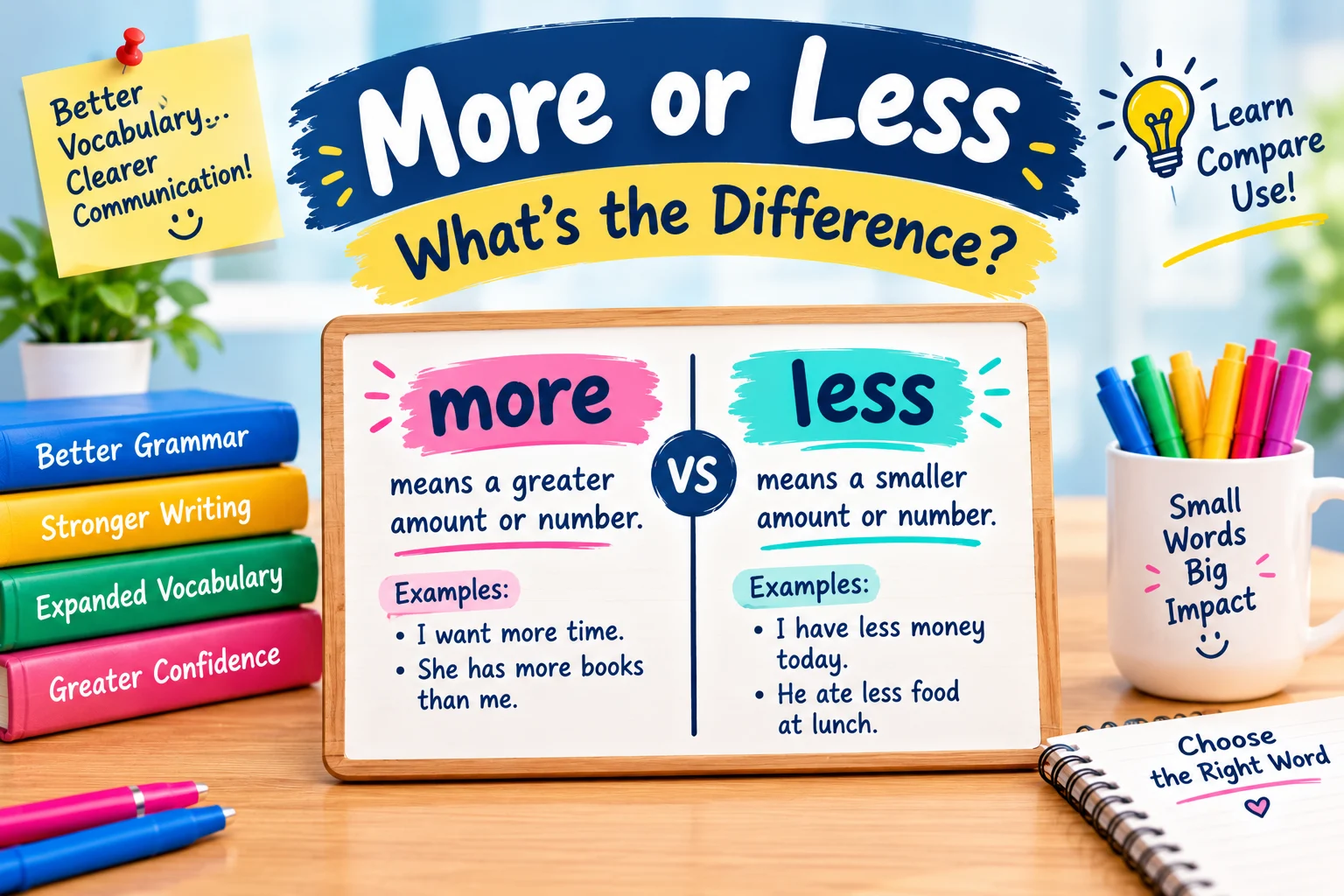
More or less means approximately, somewhat, or to a small degree. It can also mean “mostly” or “nearly”, depending on the sentence.
Have you ever been asked, “How much did it cost?” and answered, “More or less, $50”? You probably knew what you meant, but you may have wondered if more or less was the right phrase.
I have seen this small phrase cause confusion in English lessons for years. Students often think it must mean a simple comparison between “more” and “less.” That is true in some sentences, but more or less has another very common meaning.
For example, if you say, “The trip took more or less three hours,” you are not saying the trip took both more and less than three hours. You mean about three hours.
The phrase can also soften a statement. “I more or less agree” means “I agree to some extent, but not completely.”
So, how can you tell which meaning is intended? The answer becomes easy once you look at the sentence around it. Let’s break down more or less with simple meanings, examples, common mistakes, and practical usage.
More or Less – Quick Answer
More or less is an English phrase with several related meanings.
Most often, it means:
- Approximately: “There were more or less 100 people.”
- Nearly: “The work is more or less finished.”
- Mostly: “I more or less understand the idea.”
- To some degree: “She was more or less happy with the result.”
The exact meaning depends on the context.
Simple Examples
“It costs more or less $20.”
This means it costs about $20.
“The project is more or less complete.”
This means the project is almost completely finished.
The phrase is common in both spoken and written English.
The Origin / Background of More or Less
The words more and less are very old English words. Both have been used for centuries to express differences in amount or degree.
More relates to a greater amount or degree. Less relates to a smaller amount or degree.
When joined with or, the phrase more or less creates an idea of an approximate range. It suggests that something may be a little above or below a stated point.
Over time, the phrase developed broader uses.
Today, more or less can describe:
- Quantity
- Time
- Degree
- Agreement
- Completion
- General accuracy
For example, “The answer is more or less correct” does not give an exact measurement. It tells the listener that the answer is generally correct, although it may not be perfect.
This is why the phrase can feel confusing. Its meaning changes slightly with context, but the basic idea stays the same: the statement is close to a certain point, but not exact.
More or Less Explained — Key Differences and Uses
The phrase more or less has four major everyday uses.
| Term | Meaning | When to Use | Region/Context |
|---|---|---|---|
| More or less | Approximately | Talking about an estimated amount | General English |
| More or less | Nearly | Saying something is almost complete | General English |
| More or less | Mostly | Giving a general description | General English |
| More or less | To some degree | Softening an opinion or statement | Spoken and written English |
1. More or Less = Approximately
This is one of the most common uses.
You use it when you do not know the exact number, time, price, or amount.
Examples:
- “The journey takes more or less two hours.”
- “There were more or less 50 guests.”
- “The repair will cost more or less $100.”
- “I need more or less five minutes.”
Here, more or less means about or approximately.
2. More or Less = Nearly
The phrase can also mean almost.
Examples:
- “The report is more or less finished.”
- “We are more or less ready.”
- “The problem is more or less solved.”
- “The house is more or less complete.”
In these examples, the thing is not necessarily 100% complete. It is close to completion.
3. More or Less = Mostly
Sometimes the phrase means generally or for the most part.
Example:
“The students were more or less satisfied with the lesson.”
This means the students were mostly satisfied, although perhaps not everyone was completely happy.
Another example:
“His explanation was more or less correct.”
This means the explanation was generally correct, but it may have contained a small mistake.
4. More or Less = To Some Degree
The phrase can soften an opinion.
Example:
“I more or less agree with you.”
This does not mean complete agreement.
It means:
“I agree with you to some extent.”
This use is especially common when someone wants to avoid sounding too absolute.
More or Less vs. About vs. Almost
These expressions are similar, but they are not always interchangeable.
More or Less vs. About
When talking about numbers, more or less and about can have almost the same meaning.
“The box weighs about 10 kilograms.”
“The box weighs more or less 10 kilograms.”
Both suggest that 10 kilograms is an estimate.
However, about is often shorter and more natural in simple sentences.
More or Less vs. Almost
Almost usually means something is very close to being complete or true.
“The work is almost finished.”
“The work is more or less finished.”
Both can work, but the feeling is slightly different.
Almost finished strongly suggests that only a small amount remains.
More or less finished can sound less exact. It may mean the work is generally finished, even if a few details remain.
Which Version or Approach Should You Use?
The good news is that there is no spelling choice between two competing versions.
The standard phrase is:
more or less
It is written as three separate words.
For Beginners
Use more or less when you want to say about, almost, or mostly.
For example:
“The meeting lasted more or less an hour.”
For Formal Writing
The phrase is grammatically acceptable in formal writing. However, choose a more precise word when exact meaning matters.
Instead of:
“The project cost more or less $50,000.”
A formal report could say:
“The project cost approximately $50,000.”
For Casual Conversation
More or less sounds very natural in everyday speech.
For example:
“Are you ready?”
“More or less.”
Here, it means “almost” or “mostly ready.”
For Global English
You can safely use more or less in standard English. It is understood by English speakers in many countries.
Common Mistakes with More or Less
Because the phrase is short, learners often make small errors.
Mistake 1: Writing It as One Word
❌ moreorless
✅ more or less
The phrase always has spaces between the three words.
Mistake 2: Using “More or Less” When You Need Exact Information
❌ “The medicine should be taken more or less exactly as directed.”
This can create confusion.
If something must be exact, give the exact instruction instead.
✅ “Take the medicine exactly as directed.”
Mistake 3: Confusing It With “More Than” or “Less Than”
More or less does not always mean that something is both more than and less than something.
For example:
“The journey took more or less three hours.”
This means about three hours.
It does not give two separate measurements.
Mistake 4: Using It Too Often
Because the phrase is useful, some speakers repeat it too much.
For example:
“It was more or less good, and the food was more or less tasty.”
This sounds vague.
When you know the exact meaning, use a stronger word.
Try:
“It was good, and the food was tasty.”
Mistake 5: Assuming It Always Means “Approximately”
Context matters.
Compare:
“The repair cost more or less $500.”
Here, it means approximately.
But:
“I more or less agree.”
Here, it means to some degree.
More or Less in Real-World Examples
Seeing the phrase in different settings makes its use much easier.
1. Professional Email
Subject: Project Update
The first stage is more or less complete. We only need to review two small sections before sending the final version.
Here, more or less means nearly.
For a more formal email, you could write:
“The first stage is almost complete.”
2. News Article
The storm affected more or less 10,000 residents across the region.
Here, more or less means approximately.
A news report may use about or approximately instead if a more formal tone is preferred.
3. Social Media Post
“My room is more or less clean. I just need to deal with the giant pile of clothes. 😂”
Here, the phrase means mostly or almost.
The speaker is joking that the room is not perfectly clean.
4. Formal Report
“The survey found that more or less half of the participants supported the proposal.”
This means approximately half.
However, if the exact number is available, a report should usually provide it:
“The survey found that 52% of participants supported the proposal.”
That gives readers clearer information.
More or Less — Data, Trends & Usage
More or less is a common everyday English expression. People use it when they want to describe an estimate, an incomplete result, or a statement that is broadly true.
Searches for this phrase can come from several different groups:
- English learners checking its meaning
- Students learning English phrases
- Writers checking grammar and usage
- Readers trying to understand a sentence
- Speakers looking for alternatives such as about, approximately, almost, or mostly
Its popularity comes from its flexibility.
One short phrase can describe quantity, degree, or completion.
It also works in both conversation and writing. In casual speech, it can sound natural and relaxed. In formal writing, it is grammatically fine, but words such as approximately, nearly, or generally may provide more precision.
The key lesson is simple: do not translate more or less word by word. Look at the full sentence.
More or Less: Standalone Comparison Table
| Term/Variant | Meaning | Region/Context | Best Used When |
|---|---|---|---|
| More or less | Approximately | General English | Giving an estimate |
| More or less | Nearly | General English | Something is almost finished |
| More or less | Mostly | General English | Describing a general result |
| More or less | To some degree | Conversation and writing | Softening an opinion |
| About | Approximately | Very common English | Simple estimates |
| Approximately | Close to an exact amount | Formal English | Reports and precise writing |
| Almost | Very nearly | General English | Something is close to happening |
| Mostly | For the most part | General English | Describing a general condition |
Frequently Asked Questions About More or Less
Q: What does “more or less” mean?
A: More or less usually means approximately, nearly, mostly, or to some degree. The correct meaning depends on the sentence.
Q: Is “more or less” grammatically correct?
A: Yes. More or less is a standard English phrase. It can be used in both speech and writing.
Q: Does “more or less” mean “approximately”?
A: Yes, when it describes a number, amount, time, or measurement. For example, “The trip took more or less three hours” means it took about three hours.
Q: What is the difference between “more or less” and “about”?
A: Both can mean approximately. “About” is often simpler, while “more or less” can also mean mostly, nearly, or to some degree.
Q: Is “more or less” formal?
A: It is acceptable in formal writing, but it can sound less precise than approximately or nearly. In reports, use the more exact word when precision matters.
Q: Can I say “more or less” by itself?
A: Yes. For example, someone may ask, “Are you ready?” You can answer, “More or less.” This means you are almost ready or mostly ready.
Q: Is “more or less” the same as “almost”?
A: Sometimes. Both can describe something that is close to being complete. However, more or less can also mean approximately, mostly, or partly, so they are not always interchangeable.
Conclusion
More or less is a small phrase with several useful meanings. It can mean approximately, nearly, mostly, or to some degree.
The surrounding words usually tell you which meaning is intended. When the phrase comes before a number, it often means about. When it describes a condition or result, it may mean almost or mostly. When it describes an opinion, it can mean to some extent.
Remember the spelling, too: more or less is always written as three separate words.
For formal reports, consider using approximately, nearly, or another precise word when exact meaning matters. In everyday conversation, more or less sounds natural and useful.
Now you know how this common phrase works. Use it in your next sentence, and bookmark this guide so you never have to second-guess “more or less” again.