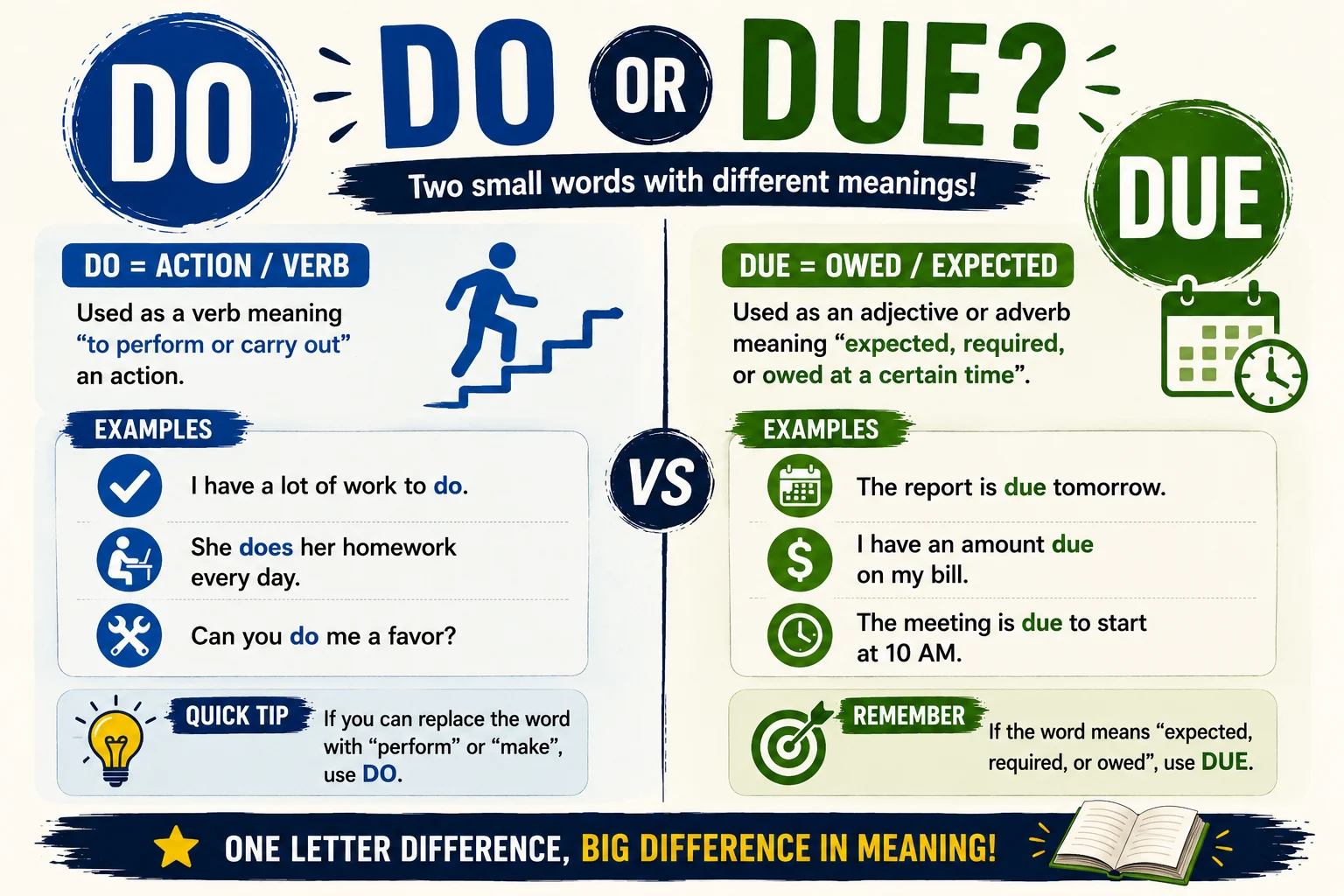
Do is mainly a verb meaning to perform or complete an action, while due usually means expected, owed, or scheduled. They sound similar in some phrases but have different meanings and uses.
Have you ever written a sentence and stopped at do or due because both words seemed possible? This is a common problem, especially for English learners. The two words can sound similar in fast speech, but they do very different jobs in a sentence.
I have seen this confusion in school assignments, emails, work messages, and everyday writing. A sentence such as “The payment is do tomorrow” may look almost right at first glance. Yet the correct word is due.
The good news is that you do not need a difficult grammar rule to remember the difference. You only need to connect each word with its main meaning.
Do usually talks about an action. You do work, do homework, or do something for someone.
Due usually talks about a time, obligation, expectation, or reason. A bill can be due. A baby can be due. A flight can be due to arrive.
Once you learn these patterns, do or due becomes much easier. Let’s break them down with clear examples.
Do or Due – Quick Answer
Do and due are different words with different meanings.
Do
Do is commonly used as a verb.
It can mean perform, complete, carry out, or take part in an action.
Examples:
I need to do my homework.
What should we do next?
Due
Due usually means expected, owed, scheduled, or caused by something.
Examples:
The payment is due tomorrow.
The train is due at 6 p.m.
The delay was due to heavy rain.
A simple rule is:
Do = action.
Due = expected, owed, scheduled, or caused by.
That rule will help you choose the right word in most everyday situations.
The Origin / Background of Do or Due
Although do and due can sound alike in some accents, they have different histories.
The Origin of Do
Do is a very old English word. It comes from Old English dōn, meaning to put, place, make, or perform.
Over time, it developed into the modern verb do.
Today, it is one of the most common verbs in English.
You use it in many expressions:
- do homework
- do work
- do business
- do exercise
- do the dishes
- do your best
It is also used as an auxiliary verb in questions and negative sentences.
For example:
Do you like coffee?
I do not know.
The Origin of Due
Due has a different history.
It comes through Old French from Latin debitus, meaning owed or something that is due.
This connection explains why due is often linked with payments and obligations.
For example:
The rent is due on Monday.
The rent is owed by Monday.
Over time, due developed other meanings related to expected events and causes.
For example:
The train is due at noon.
And:
The accident was due to poor visibility.
So although do and due can sound similar, their meanings and histories are quite different.
Do or Due Explained — Key Differences
The easiest way to understand do or due is to look at how each word works in a sentence.
Do as a Verb
Use do when you are talking about an action or task.
Examples:
I have to do my homework.
She will do the work tomorrow.
What can we do about the problem?
Here, do describes an action.
Do as an Auxiliary Verb
Do also helps form questions and negative statements.
Examples:
Do you understand the question?
I do not agree.
Does he work here?
They did not call me.
In these sentences, do, does, or did helps form the grammar.
Due for Something Owed
Use due when something must be paid, completed, or delivered by a certain time.
Examples:
The rent is due on Friday.
Your assignment is due next week.
Here, due means expected or required by a particular time.
Due for an Expected Event
Due can also mean that something is expected to happen.
Examples:
The bus is due in ten minutes.
Her baby is due in September.
The new product is due next month.
Due to for a Cause
The phrase due to means because of.
Example:
The match was canceled due to rain.
This means:
The match was canceled because of rain.
Comparison Table
| Term | Meaning | When to Use | Region/Context |
|---|---|---|---|
| Do | Perform or complete an action | Talking about tasks or actions | All English varieties |
| Does | Present form of do for he/she/it | Questions and statements | All English varieties |
| Did | Past form of do | Talking about past actions | All English varieties |
| Due | Expected or owed | Deadlines, payments, schedules | All English varieties |
| Due to | Because of | Explaining a cause | Formal and general English |
Which Version Should You Use?
Choosing between do and due becomes easy when you focus on meaning.
For Students
Use do for tasks and actions.
I need to do my homework.
Use due for deadlines.
My homework is due tomorrow.
This is one of the most useful differences for students.
Think:
You do homework.
Your homework is due tomorrow.
For Professional Emails
Use do when asking someone to complete an action.
Please do this before Friday.
Use due when talking about a deadline.
The report is due on Friday.
The second sentence is often more natural in professional writing.
For Business Writing
Use due for payments and deadlines.
The invoice is due on August 30.
Use do when describing an action.
We need to do a final review.
However, in formal writing, you may sometimes replace do with a more precise verb.
Instead of:
We need to do an analysis.
You might write:
We need to conduct an analysis.
The best word depends on the sentence.
For Global or Neutral English
Both do and due are standard English words.
There is no major British-American spelling difference here.
The key is to understand their meaning, not their regional spelling.
Common Mistakes with Do or Due
1. Writing “Do” for a Deadline
Mistake:
The assignment is do tomorrow.
Correction:
The assignment is due tomorrow.
Why?
The assignment is expected by tomorrow. Therefore, use due.
2. Writing “Due” for an Action
Mistake:
I need to due my homework.
Correction:
I need to do my homework.
Why?
Homework is an action or task. Use do.
3. Confusing “Due to” With “Do”
Mistake:
The flight was delayed do to bad weather.
Correction:
The flight was delayed due to bad weather.
Why?
Due to means because of.
4. Confusing Due With “Dew”
There is another word that sounds similar.
Dew means tiny drops of water that form on cool surfaces.
For example:
The grass was covered with morning dew.
So:
- do = perform an action
- due = expected, owed, or caused by
- dew = drops of water
These words sound similar in many accents but have completely different meanings.
5. Forgetting “Due” in “Due Date”
The correct phrase is:
due date
Not:
do date
A due date is the date when something is expected or must be completed.
Example:
What is the due date for the project?
Do or Due in Real-World Examples
Professional Email
Subject: Report Deadline
Please remember to do the final review before sending the report. The completed report is due by Friday afternoon.
Both words appear naturally here.
Do describes the action.
Due describes the deadline.
News Headline
Flight Delayed Due to Heavy Rain
Here, due to explains the reason for the delay.
It means:
because of heavy rain
Social Media Post
My assignment is due tomorrow, and I still have so much to do!
This is a useful example because it shows both words in one sentence.
Due = deadline.
Do = tasks or actions.
Formal Report
The project was delayed due to a shortage of materials.
Again, due to gives the reason.
Everyday Conversation
What do you want to do tonight?
I have some work to do.
My project is due tomorrow.
These are all natural examples of the two words.
Do or Due — Data, Trends & Usage
People who search for do or due usually have a spelling or grammar question.
The search intent is strongly informational.
The confusion often appears in sentences involving deadlines because do and due can sound similar in normal speech.
Common searches include:
- due or do
- do or due meaning
- do vs due
- is it due or do
- due date or do date
- due tomorrow or do tomorrow
- due to or do to
Students often meet the problem when writing about homework and assignments.
Workers may see it in emails, invoices, reports, and deadlines.
English learners can find it especially confusing because pronunciation does not always make the difference clear.
That is why learning the meaning is more useful than simply memorizing the spelling.
A helpful mental test is:
Can I replace the word with “perform” or “complete”?
If yes, you probably need do.
For example:
I need to do the task.
You can say:
I need to complete the task.
Now ask:
Can I replace it with “expected” or “owed”?
If yes, you probably need due.
The payment is due tomorrow.
The payment is owed tomorrow.
This quick test can help you choose correctly.
Do vs Due: Standalone Comparison
| Term/Variant | Meaning | Region/Context | Best Used When |
|---|---|---|---|
| Do | Perform, complete, or carry out | All English | Talking about actions or tasks |
| Due | Expected, owed, or scheduled | All English | Talking about deadlines or expected events |
| Due to | Because of | All English | Explaining a reason |
| Due date | Required or expected date | School, work, bills | Talking about deadlines |
| Dew | Small drops of water | All English | Talking about nature |
Easy Ways to Remember Do or Due
Here are three simple memory tricks.
Trick 1: Do = Action
Think:
Do something.
You can do:
- homework
- work
- exercise
- chores
- research
If it is an action, do is often the right choice.
Trick 2: Due = Deadline
Think:
Due date.
If something must happen by a certain time, it may be due.
The bill is due Friday.
The assignment is due Monday.
Trick 3: Due to = Because of
Remember this fixed phrase:
due to = because of
Example:
The game was canceled due to rain.
If you can replace due to with because of, you have the right expression.
FAQ: Do or Due
Q: What does do mean?
A: Do is mainly a verb meaning to perform, complete, or carry out an action. It is also used as an auxiliary verb in questions and negative sentences.
Q: What does due mean?
A: Due can mean expected, owed, scheduled, or required by a certain time. For example, The payment is due Friday.
Q: Do or due — which is correct for a deadline?
A: Use due for a deadline. The correct phrase is The assignment is due tomorrow, not The assignment is do tomorrow.
Q: What is the difference between do and due?
A: Do usually describes an action. Due usually describes something that is expected, owed, or scheduled.
Q: Is “due to” formal English?
A: Yes. Due to is standard English and is common in formal writing. It means because of, as in The event was canceled due to rain.
Q: Is “do date” or “due date” correct?
A: Due date is correct. A due date tells you when something is expected or must be completed.
Q: Can do and due sound the same?
A: In many accents, they can sound very similar, especially in fast speech. Their meanings and spellings are different, so context helps you choose the correct word.
Conclusion
The difference between do or due becomes simple when you focus on what the word means.
Use do when you are talking about an action, task, or activity. You can do homework, do work, or do your best.
Use due when something is expected, owed, scheduled, or required by a certain time. Your bill can be due, your assignment can be due, and a train can be due to arrive.
Remember the most useful pairs:
- do homework
- assignment is due
- do a task
- due date
- due to rain
There is also a third word, dew, which means small drops of water. Keeping these meanings separate will help you avoid many spelling mistakes.
The easiest rule is this: Do means action. Due means expected or owed.
Now you know exactly how to use do or due. Bookmark this guide so you never second-guess these two words again.