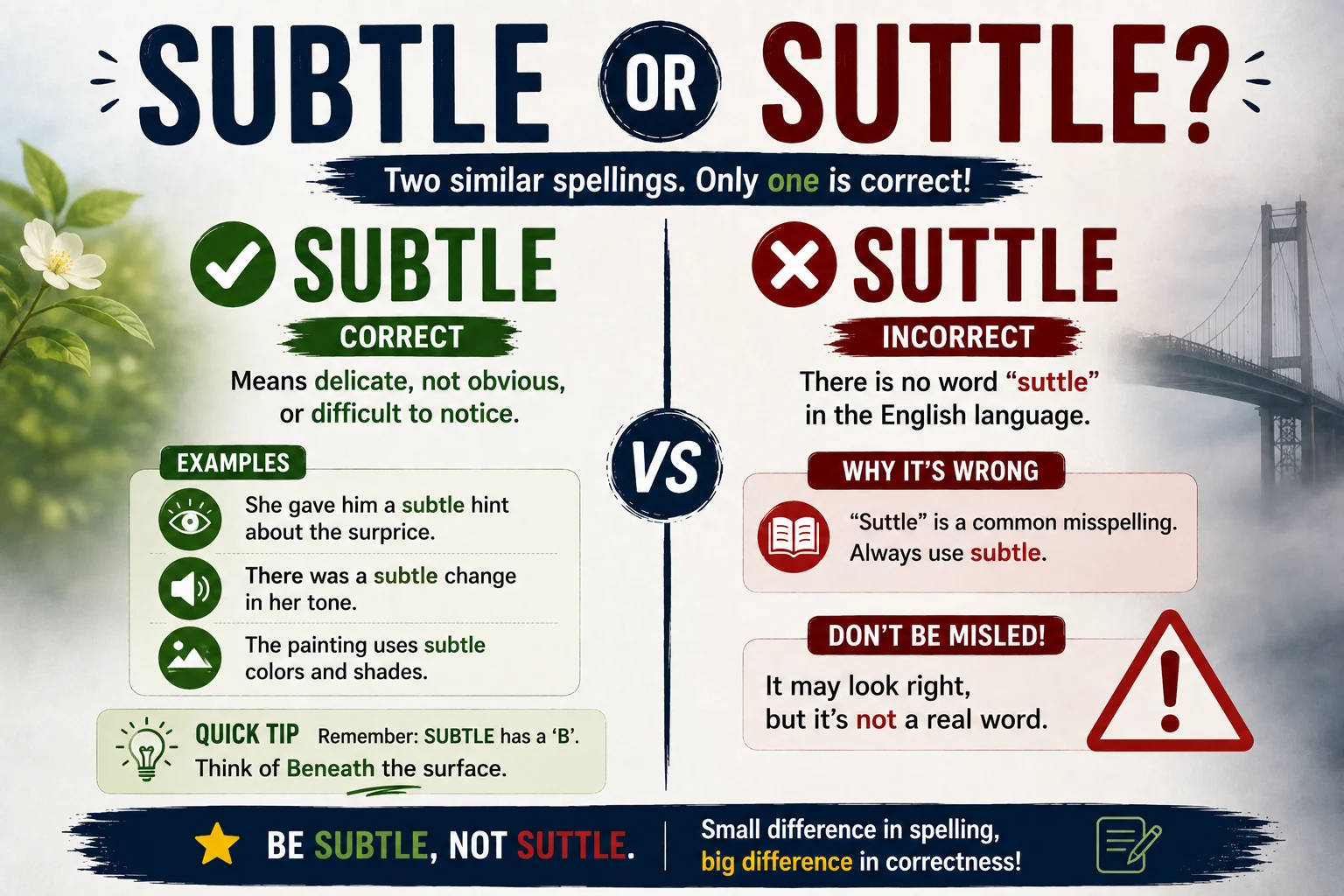
Subtle is the correct spelling. Suttle is a common misspelling and should not be used in standard English when you mean “not obvious” or “delicate.”
Have you ever typed a word, looked at it twice, and thought, “That spelling cannot be right”? Subtle or suttle is one of those words. It looks simple, but the silent b makes it easy to spell incorrectly.
I have seen this mistake often in student essays, emails, social media posts, and even quick notes. The confusion makes sense. When we say subtle, we do not hear the b at all. We usually pronounce it like “suttle.”
That creates a trap. Your ears suggest one spelling, while standard English uses another.
The good news is that the answer is simple. Subtle is the correct spelling. Suttle is not the standard spelling of this word.
But there is more to learn. You also need to know what subtle means, how to pronounce it, where it came from, and how to use it naturally. Once you understand the word, you will be much less likely to misspell it.
Let’s make subtle or suttle easy to remember.
Subtle or Suttle – Quick Answer
The correct spelling is subtle.
Correct: The artist used a subtle shade of blue.
Incorrect: The artist used a suttle shade of blue.
Subtle usually means not easy to notice, understand, or detect. It can also describe something delicate, slight, or carefully done.
For example:
- She gave me a subtle smile.
- There was a subtle change in his voice.
- The painting has subtle colors.
The unusual part is the pronunciation.
Subtle is pronounced approximately “SUT-uhl.”
The b is silent.
That silent letter is the main reason people write suttle.
The Origin / Background of Subtle or Suttle
The word subtle has a long history.
It comes from the Old French word sotil, which came from the Latin subtilis. The Latin word had meanings connected with something fine, delicate, thin, or refined.
Over time, the word entered English and developed several related meanings.
Today, subtle can describe something that is:
- difficult to notice
- gentle or slight
- indirect
- refined
- clever in a quiet way
- not obvious
The spelling changed over the centuries.
The modern spelling subtle contains the letter b, even though the b is not pronounced.
This is a good example of how English spelling can preserve parts of a word’s history.
The word’s pronunciation changed, but the spelling kept the b.
That is why you should not spell the word based only on how it sounds.
Why Does “Suttle” Look Correct?
The mistake is easy to understand.
When you hear:
subtle
you may hear something close to:
suttle
English has many words with silent letters.
Examples include:
- debt — the b is silent
- doubt — the b is silent
- thumb — the b is silent
- lamb — the b is silent
- subtle — the b is silent
So suttle looks logical from a sound-based point of view.
However, it is not the standard spelling of the word.
Subtle or Suttle Explained — Key Differences
There is one important difference between the two forms.
Subtle
Subtle is the correct standard English word.
It can mean something that is small, quiet, indirect, or hard to notice.
Example:
There was a subtle difference between the two paintings.
The difference existed, but it was not obvious.
Another example:
He gave a subtle hint about the problem.
He did not say the problem directly.
Suttle
Suttle is generally a misspelling of subtle when the intended meaning is “not obvious” or “delicate.”
If you write:
She gave me a suttle hint.
you should change it to:
She gave me a subtle hint.
Comparison Table
| Term | Meaning | When to Use | Region/Context |
|---|---|---|---|
| Subtle | Not obvious, slight, delicate, or indirect | Standard English | All major English varieties |
| Suttle | Usually a misspelling of subtle | Avoid in standard writing | Nonstandard spelling |
| Delicate | Fine, gentle, or easily affected | When something is fragile or refined | General English |
| Slight | Small in degree | When describing a small difference | General English |
| Unobvious | Not easy to see or understand | When stressing lack of obviousness | Less common |
The main rule is easy:
If you mean “not obvious,” spell it subtle.
What Does Subtle Mean?
Understanding the meaning can help you remember the spelling.
1. Not Easy to Notice
A subtle change is small.
There was a subtle change in the color.
The color changed, but you may not notice it immediately.
2. Indirect
A subtle message may not be stated clearly.
She gave him a subtle warning.
She warned him without saying it directly.
3. Delicate
A subtle flavor may be gentle rather than strong.
The soup has a subtle garlic flavor.
You can taste the garlic, but it does not overpower the other flavors.
4. Clever or Refined
A person can use a subtle form of humor.
The movie contains several subtle jokes.
The jokes may be easy to miss.
Which Version Should You Use?
The answer is clear.
For Students
Use subtle.
If you are writing an essay, homework assignment, or exam answer, subtle is the correct spelling.
The author makes a subtle point about friendship.
For Professional Writers
Use subtle in emails, reports, articles, and business documents.
For example:
There was a subtle change in the company’s policy.
The spelling is standard and professional.
For Social Media
Use subtle if you mean something indirect or hard to notice.
For example:
That was a subtle way to change the subject.
Social media may be informal, but the standard spelling still applies.
For Global English
Choose subtle.
It is the standard spelling in both British and American English.
There is no British spelling suttle for this meaning.
Common Mistakes with Subtle or Suttle
1. Writing “Suttle”
Mistake:
He made a suttle comment.
Correction:
He made a subtle comment.
Why does it happen?
The b is silent, so the incorrect spelling matches the sound.
2. Pronouncing the B
Mistake:
“sub-tle”
Correct pronunciation:
“SUT-uhl”
The b is silent.
Do not pronounce it like the b in subway.
3. Using “Subtle” When You Mean “Simple”
These words are not always interchangeable.
Subtle means something is not obvious, small, delicate, or indirect.
Simple means something is easy or uncomplicated.
For example:
The design is simple.
means the design is not complicated.
But:
The design has a subtle pattern.
means the pattern is gentle or not immediately noticeable.
4. Confusing Subtle With Substantial
These words can look similar, but their meanings are very different.
Subtle = small, indirect, or difficult to notice.
Substantial = large, important, or considerable.
Compare:
There was a subtle difference.
There was a substantial difference.
The first suggests a small difference. The second suggests a major one.
5. Forgetting the Silent B
This is the most common spelling problem.
A useful memory trick is:
Subtle has a B, even though you cannot hear it.
Think of debt, doubt, and thumb. Their silent b can help remind you that subtle also keeps its b.
Subtle or Suttle in Real-World Examples
Learning a word through real sentences is often easier than memorizing a definition.
Professional Email
Subject: A Subtle Change to the Proposal
I made a subtle change to the wording in Section Two. Please review it before the final version is sent.
Here, subtle means a small change.
News Headline
Subtle Shift in Consumer Spending Raises Questions
The word suggests that the change is real but not dramatic.
Social Media Post
Did anyone else notice that subtle change in the new logo?
The change may be easy to miss.
Formal Report
The survey showed a subtle increase in customer satisfaction during the final quarter.
The increase was small rather than dramatic.
Everyday Conversation
She gave me a subtle look when he walked into the room.
The look communicated something without being obvious.
Subtle vs Similar Words
Knowing related words can make the meaning clearer.
Subtle vs Slight
These words are often close.
Slight usually focuses on size or degree.
There was a slight increase in price.
Subtle often suggests that something is hard to notice.
There was a subtle change in her expression.
Subtle vs Obvious
These are near opposites.
Obvious means easy to notice or understand.
Subtle means less clear or less noticeable.
The mistake was obvious.
The message was subtle.
Subtle vs Indirect
These words can overlap.
An indirect statement does not say something directly.
A subtle statement may communicate an idea without making it obvious.
He gave an indirect answer.
She made a subtle suggestion.
Subtle or Suttle — Data, Trends & Usage
People who search for subtle or suttle are usually looking for a spelling check.
The search intent is strongly informational.
They may have seen the word in:
- a book
- an email
- a school assignment
- a movie review
- a social media post
- a business report
The confusion is common because subtle is pronounced without its b.
This makes it a classic spelling problem for English learners.
It is also useful to remember that subtle is not a rare word. It appears often in everyday English, journalism, academic writing, business communication, art criticism, and conversation.
That makes learning the correct spelling worthwhile.
One useful pattern is this:
Sound: “suttle”
Spelling: subtle
When you remember that difference, the word becomes much easier.
Subtle or Suttle: Standalone Comparison
| Term/Variant | Meaning | Region/Context | Best Used When |
|---|---|---|---|
| Subtle | Not obvious or easy to notice | British and American English | Standard writing |
| Suttle | Common misspelling | Nonstandard | Avoid |
| Slight | Small in degree | General English | Describing a small amount |
| Delicate | Fine, gentle, or fragile | General English | Describing a refined or gentle quality |
| Indirect | Not stated directly | General English | Describing communication |
How to Remember the Spelling of Subtle
If subtle keeps giving you trouble, try this simple trick.
Remember the Silent B
Think:
SUB + TLE = SUBTLE
The b stays in the spelling even though you do not hear it.
You can also connect it with other silent-b words:
- debt
- doubt
- thumb
- subtle
Another trick is to write the word three times:
subtle
subtle
subtle
Then use it in a sentence:
The difference is subtle.
Using the word in context helps your brain remember it better than copying the spelling alone.
FAQ: Subtle or Suttle
Q: What does subtle mean?
A: Subtle means not obvious, easy to miss, slight, delicate, or indirect. For example, a subtle change may be real but difficult to notice.
Q: Is subtle or suttle correct?
A: Subtle is the correct spelling. Suttle is generally a misspelling when you mean something that is not obvious or is delicate.
Q: Why is the B silent in subtle?
A: The spelling comes from the word’s history and older forms. English pronunciation changed over time, but the b remained in the written form.
Q: How do you pronounce subtle?
A: Subtle is commonly pronounced approximately “SUT-uhl.” The b is silent.
Q: Is subtle acceptable in formal writing?
A: Yes. Subtle is a standard English word and is fully appropriate in formal writing, academic work, reports, and professional communication.
Q: Is suttle a British spelling of subtle?
A: No. Suttle is not the standard British spelling of this word. British English uses subtle, just like American English.
Q: Can subtle mean indirect?
A: Yes. A subtle message or suggestion may be indirect. It communicates an idea without stating it in a very clear or forceful way.
Conclusion
When choosing between subtle or suttle, the answer is straightforward: subtle is correct.
The spelling can feel strange because the word does not sound the way it looks. The b is silent, so the pronunciation is close to “suttle.” That is why the misspelling is so easy to make.
Remember these three points:
- Subtle is the standard spelling.
- Suttle is generally a misspelling.
- Subtle can mean slight, delicate, indirect, or difficult to notice.
The word works in everyday speech, school writing, professional emails, reports, journalism, and formal documents. It is useful and common, so learning its spelling is worth the effort.
The easiest memory rule is simple: you hear “suttle,” but you write “subtle.” Keep the silent b.
Now you know exactly how to use subtle or suttle. Bookmark this guide, and the spelling will become much easier to remember the next time you write it.