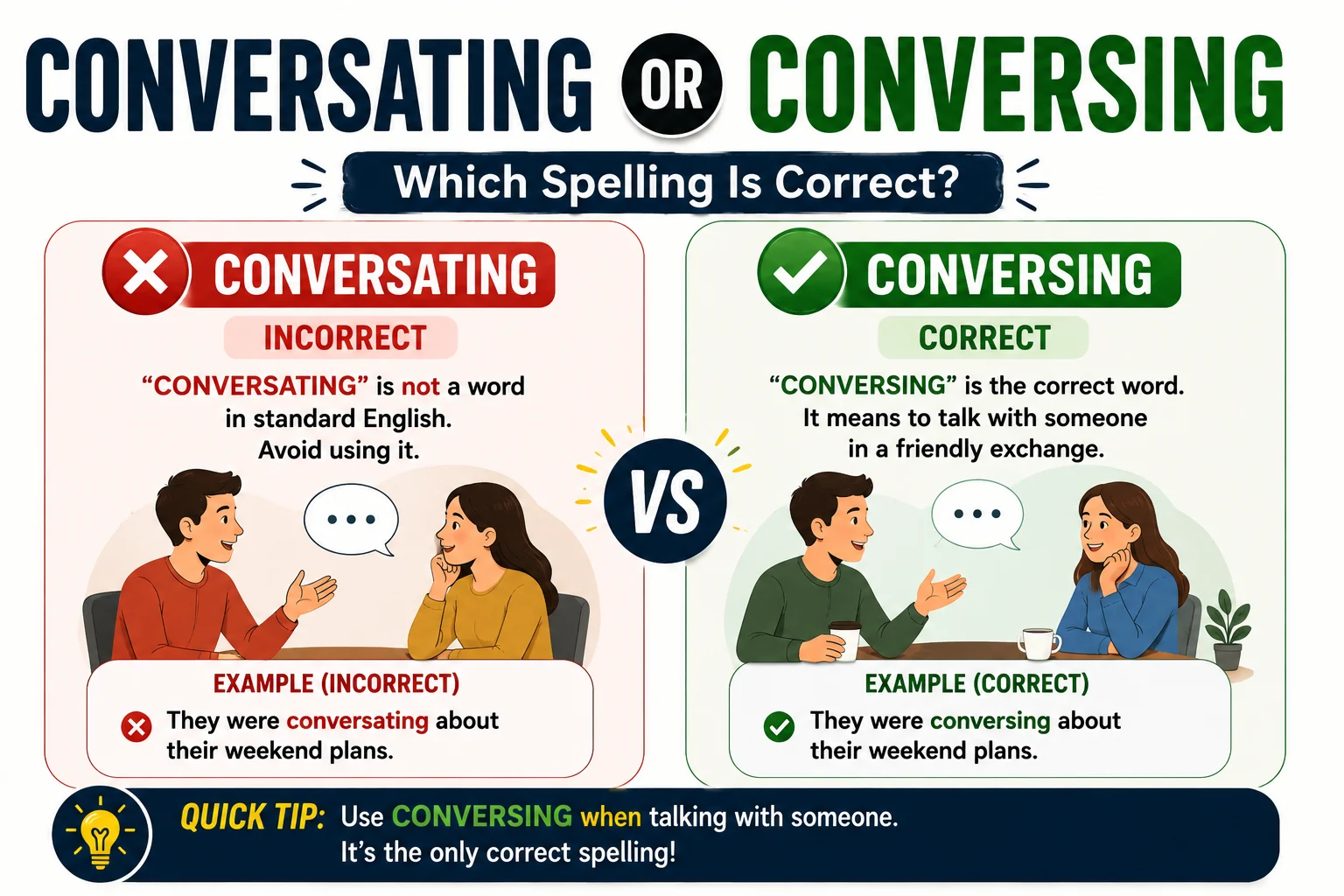
Conversing is the standard English form. Conversating exists in informal and dialectal use, but conversing is the better choice for school, work, and formal writing.
Have you ever written a sentence and suddenly stopped because one word did not look right? Conversating or conversing is a good example.
I have seen this question many times in English writing. A learner may write conversating because the noun conversation makes the form seem natural. After all, we have conversation, so why not conversating?
The answer is a little more interesting than simply calling one word “wrong.” Conversing is the standard form of the verb converse. However, conversating is also used by some English speakers. Dictionaries and language references may record it as informal, nonstandard, or dialectal. (Dictionary.com)
That difference matters when you choose words for an essay, job application, email, or report. You want your writing to sound clear and natural.
So, if you are asking “Is it conversating or conversing?”, you are in the right place. Let’s look at the meaning, history, grammar, common mistakes, and real examples.
Conversating or Conversing – Quick Answer
Conversing is the standard present participle of the verb converse.
It means talking with someone or having a conversation.
We were conversing about the new project.
She enjoys conversing with her friends.
Conversating is also used by some speakers to mean the same thing. However, it is generally treated as nonstandard or informal, so it is best avoided in formal writing. Dictionary.com, for example, labels conversate as “nonstandard except in some dialects” and lists conversating as its present participle. (Dictionary.com)
The easiest rule
Formal English → conversing ✅
Informal or dialectal use → conversating may occur ⚠️
If you are unsure, choose conversing.
The Origin and Background of Conversing and Conversating
The safest way to understand the difference is to start with converse.
Where does “conversing” come from?
Conversing comes from the verb converse.
The verb means to talk with another person or exchange ideas.
Its forms are:
- converse — base form
- converses — third-person singular
- conversed — past tense
- conversing — present participle
For example:
I converse with my colleagues.
She conversed with the teacher.
They are conversing quietly.
The spelling follows the normal pattern:
converse → conversing
So where did “conversating” come from?
This is where the story gets more interesting.
The noun conversation is very familiar. Because of that, some speakers have formed conversate as a verb. The form conversating then follows naturally from that verb.
This type of word formation is sometimes called back-formation. A speaker sees a familiar word and creates a new word that seems to fit its structure.
Merriam-Webster notes that conversate has been used in English for more than two centuries. Historical examples appear as far back as the early 1800s. The word was also used to represent dialect speech, including African American vernacular speech, in some historical writing. (Merriam-Webster)
That history is worth knowing because nonstandard does not mean “made up yesterday.” A word can have a long history and still not be the preferred form in standard English.
Conversating or Conversing Explained — Key Differences
The two forms have the same basic idea: talking or having a conversation.
The main difference is standard usage and context.
| Term | Meaning | When to Use | Region/Context |
|---|---|---|---|
| conversing | Talking or exchanging ideas | Formal and informal writing and speech | Standard English |
| conversating | Talking or having a conversation | Informal or dialectal settings | Some varieties of English |
| converse | To talk or communicate | General use | Standard English |
| conversation | An exchange of spoken ideas | General use | Standard English |
Example with “conversing”
The two students were conversing after class.
This sentence works well in an essay, article, email, or everyday conversation.
Example with “conversating”
They were conversating late into the night.
You may hear or see this form in informal speech and writing. It is understandable, but many readers will regard it as nonstandard.
Why does the difference matter?
Imagine writing this in a job application:
I enjoy conversating with customers.
The meaning is clear. But conversing sounds more standard:
I enjoy conversing with customers.
For professional writing, the second choice is much safer.
Which Version Should You Use?
For most writers, the answer is simple:
For students → Use “conversing”
If you are writing:
- An essay
- An assignment
- An exam answer
- A research paper
- A school presentation
choose conversing.
The students were conversing about the lesson.
For professional writing → Use “conversing”
Use conversing in:
- Business emails
- Reports
- Cover letters
- Workplace documents
- Professional presentations
For example:
I enjoyed conversing with the client about the project.
This sounds polished and standard.
For casual speech → Both may be heard
In relaxed conversation, you may hear conversating.
Some speakers use it naturally. Some use it as part of a particular dialect or speech style. The fact that it is not standard in formal English does not mean that every person who uses it is making a random mistake.
Language varies between communities.
However, if your goal is standard English, choose conversing.
For global English → Choose “conversing”
If you are writing for readers from different countries, conversing is the clearest choice.
It is widely understood and does not carry the same nonstandard label.
Common Mistakes with Conversating or Conversing
1. Using “conversating” in formal writing
❌ The managers were conversating about the issue.
✅ The managers were conversing about the issue.
Why?
Conversating may be understood, but conversing is the standard form.
2. Assuming “conversation” must create “conversating”
❌ conversation → conversate → conversating
✅ converse → conversing
The noun conversation can make conversating seem logical. But the standard verb is converse.
3. Thinking “conversating” is always meaningless
❌ “Conversating” has no meaning at all.
✅ “Conversating” is used by some speakers, but it is generally nonstandard or informal.
This distinction is important. A word can exist in real speech without being the best choice for formal standard English.
4. Using “converse” incorrectly
❌ We were converse about politics.
✅ We were conversing about politics.
After were, use the -ing form:
were conversing
5. Confusing “converse” with “conversation”
Converse is a verb.
They converse every evening.
Conversation is a noun.
They had a long conversation.
Conversing is the -ing form of converse.
They were conversing every evening.
Conversing in Real-World Examples
The word conversing fits many everyday situations.
1. Professional Email
Subject: Client Meeting
I enjoyed conversing with you about the proposed project. I look forward to discussing the next steps.
Here, conversing sounds professional and natural.
2. News Article
Students were conversing with local experts during the event.
The word works well in news writing because it is clear and neutral.
3. Social Media Post
Had a great time conversing with old friends today.
For casual social media, conversing is perfectly natural.
You could also simply say:
Had a great time talking with old friends today.
In everyday English, talking is often more common than conversing.
4. Formal Report
Participants spent several minutes conversing before the meeting began.
This is a good choice for formal or academic writing.
5. Everyday Conversation
We were conversing about travel when the lights went out.
The word is correct in ordinary speech too. It is not limited to formal English.
Conversating or Conversing — Data, Trends & Usage
Searches for “conversating or conversing” are mainly informational. People usually want to know whether conversating is acceptable and which form they should use.
The confusion comes from real-world usage. People encounter conversating in speech, online writing, music, and other informal settings. That can make the word seem fully standard.
But frequency and standard status are not the same thing.
Dictionary.com records conversate and its forms while labeling the verb nonstandard except in some dialects. (Dictionary.com)
Merriam-Webster also discusses the long history of conversate and explains that dictionary inclusion does not automatically mean a word is accepted as standard English. (Merriam-Webster)
What this means for you
If you are writing for a broad audience, conversing is the safest choice.
If you are quoting someone, writing dialogue, or discussing a specific dialect, conversating may appear naturally.
The context matters.
Is “Conversating” a Real Word?
This is one of the most common questions.
The answer is yes, but with a qualification.
Conversating is a real form that people use. It is also recorded in some dictionaries and language resources. But that does not make it the preferred form of standard English.
Dictionary.com labels conversate as nonstandard except in some dialects and gives conversating as a related form. (Dictionary.com)
Merriam-Webster’s discussion also shows that conversate has a long history in English. (Merriam-Webster)
So avoid the overly simple claim:
“Conversating is not a word.”
A better explanation is:
Conversating exists in real usage, but conversing is the standard form and the better choice for formal writing.
That is both more accurate and more useful.
Standalone Comparison Table
| Term/Variant | Meaning | Region/Context | Best Used When |
|---|---|---|---|
| Conversing | Talking or exchanging ideas | Standard English | School, work, formal writing, and general use |
| Conversating | Talking or having a conversation | Informal or dialectal usage | Casual speech, dialogue, or when reflecting a speaker’s style |
| Converse | To talk with someone | Standard English | As the base verb |
| Conversation | A spoken exchange | Standard English | As a noun |
The safest choice
If you only want one answer to remember:
Use “conversing.”
Frequently Asked Questions
Q: Which is correct, conversating or conversing?
A: Conversing is the standard English form. Conversating is used by some speakers but is generally considered nonstandard or informal. (Dictionary.com)
Q: What does conversing mean?
A: Conversing means talking with someone or exchanging ideas. For example, “They were conversing about their plans.”
Q: Is conversating grammatically correct?
A: Conversating occurs in real English usage, but it is not the preferred standard form. For formal and professional writing, use conversing.
Q: Is conversating in the dictionary?
A: Some dictionary resources record conversate and conversating, often with an informal or nonstandard label. Dictionary.com, for example, labels conversate as nonstandard except in some dialects. (Dictionary.com)
Q: Why do people say conversating?
A: The form likely developed from the familiar noun conversation, with speakers creating the verb conversate. Historical evidence shows that conversate has been used for more than two centuries. (Merriam-Webster)
Q: Can I use conversating in an essay?
A: It is better not to. Use conversing in essays, academic papers, reports, and other formal writing.
Q: Is conversing better than conversating?
A: Yes, if you want standard English. Conversing is the safest choice for school, work, formal documents, and writing for a broad audience.
Conclusion
The choice between conversating or conversing becomes easy once you understand the difference.
Conversing is the standard form. It comes from the verb converse and means talking or exchanging ideas with someone.
Conversating is also found in real-world English. Some speakers use it in casual, regional, or dialectal settings. Historical evidence shows that conversate has been around for a long time, so it is more accurate to call it nonstandard or informal than to say it simply does not exist. (Merriam-Webster)
For your own writing, the best rule is simple:
Use “conversing” in formal, academic, professional, and general standard English.
If you are writing dialogue or intentionally reflecting someone’s speech style, conversating may be appropriate when it fits the context.
You do not need to overthink it. Remember the base verb:
converse → conversing
Bookmark this guide so you never second-guess “conversating or conversing” again, and use the standard form with confidence.