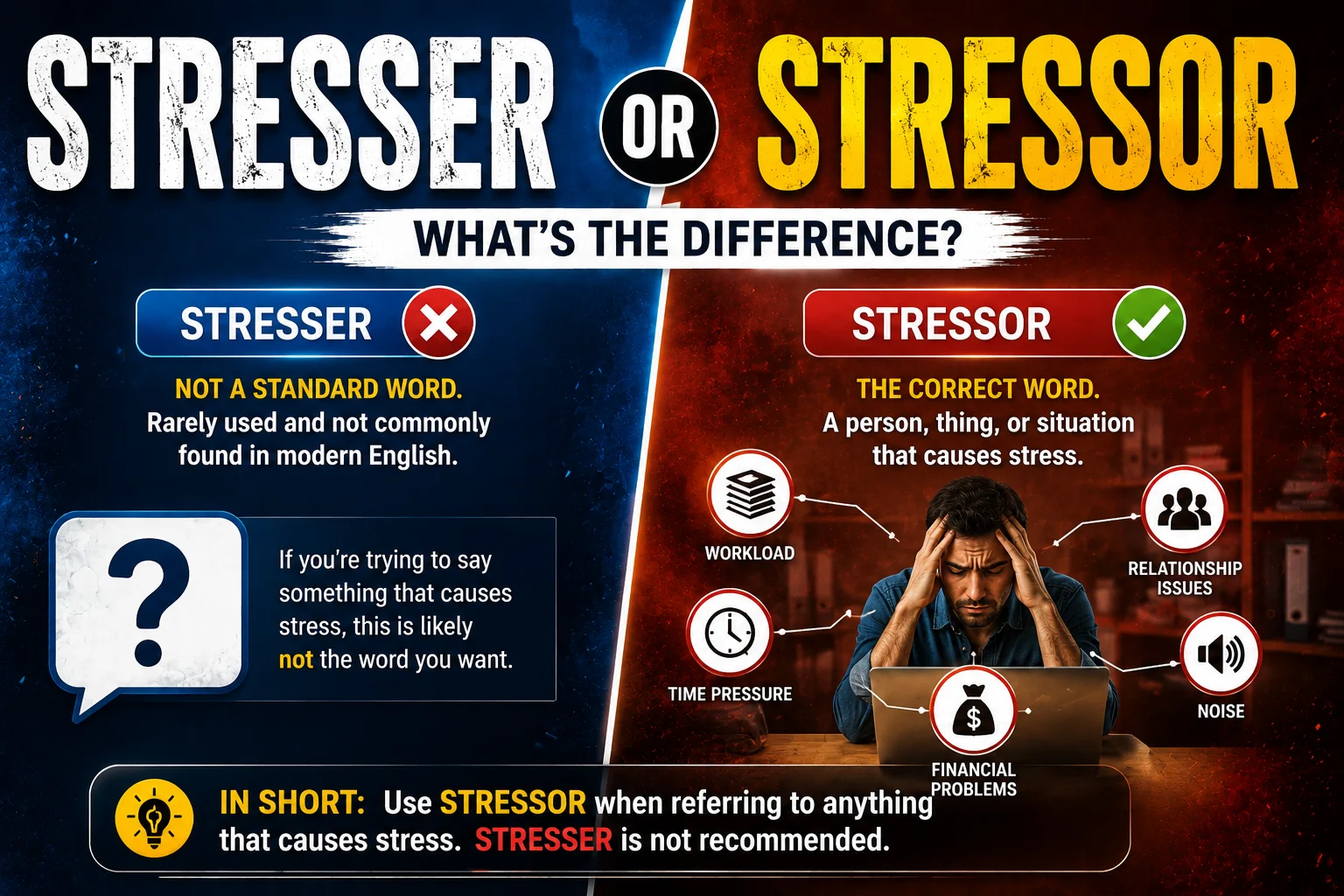
Stressor is the correct word for something that causes stress. Stresser is uncommon and is usually not the preferred spelling in standard English.
Have you ever written stresser and paused because it looked slightly wrong? You are not alone. This is a common spelling question, especially when people try to form a noun from the word stress.
As an English teacher, I have seen this confusion many times. The word stress can be a verb, a noun, or a description of a mental or physical state. So it feels natural to think that something causing stress should be called a stresser.
English, however, does not always follow that simple pattern.
The standard word is stressor. It means a person, event, situation, or condition that causes stress. For example, a heavy workload can be a stressor. Financial problems can also be stressors.
Stresser does appear in some dictionaries and informal usage, but it is much less common. In most formal, academic, medical, and professional writing, stressor is the safer choice.
This guide explains the difference between stresser or stressor, where the words come from, how to use them, common mistakes, and which form you should choose.
Stresser or Stressor – Quick Answer
Stressor is the standard and widely accepted word for something that causes stress.
A stressor can be:
- A difficult situation
- A demanding job
- Financial pressure
- A major life change
- A conflict with another person
Simple Examples
A heavy workload can be a major stressor.
Lack of sleep is another common stressor.
The word stressor is especially common in psychology, health, medicine, education, and workplace writing.
What About “Stresser”?
Stresser is not usually the best choice when you mean something that causes stress.
It may be understood because it follows a common English pattern:
stress + -er = stresser
However, stressor is the established term.
For clear and professional writing, choose stressor.
The Origin / Background of Stresser or Stressor
To understand the difference, it helps to look at the word stress.
The word stress has a long history. It came into English through French and Latin roots connected with ideas such as pressure, strain, and emphasis.
Over time, English speakers began using stress in several ways.
Today, you might say:
“I am under a lot of stress.”
You can also use stress as a verb:
“Deadlines stress me out.”
Then comes the noun stressor.
A stressor is the source or cause of stress.
This distinction is useful:
Stress = the response or condition
Stressor = the thing that causes it
For example:
The exam was a stressor, and the student felt stress because of it.
That makes the two words easier to separate.
Why Does “Stresser” Sound Natural?
The confusion comes from a normal English word-building pattern.
English often adds -er to a verb to describe a person or thing connected with an action.
For example:
- teach → teacher
- drive → driver
- work → worker
- run → runner
So it is easy to assume:
stress → stresser
But English has many words that do not follow the simplest pattern.
Stressor became the established technical term for a factor that produces stress.
That is why stressor is the preferred choice.
Stresser or Stressor Explained — Key Differences
The biggest difference is standard usage and meaning.
| Term | Meaning | When to Use | Region/Context |
|---|---|---|---|
| stressor | Something that causes stress | Standard term | General, academic, medical, professional |
| stresser | A person or thing that stresses; uncommon variant | Rare or informal use | Less common |
| stress | Mental or physical strain or pressure | When describing the response/state | General English |
| stressful | Causing or involving stress | Describing a situation | General English |
| stressed | Experiencing stress | Describing a person or state | General English |
Stressor
Stressor is the word you should normally use.
Examples:
Work pressure is a common stressor.
Moving to a new city can be a major stressor.
Financial uncertainty is a serious stressor for many families.
Notice that the stressor is the cause.
Stress
Stress describes the pressure or response.
Example:
The student felt a lot of stress before the exam.
The exam may be the stressor.
The student’s reaction may be stress.
Stressed
Stressed describes the person experiencing stress.
She felt stressed before the interview.
Stressful
Stressful describes something that causes stress.
The interview was stressful.
This gives you a useful word family:
stressor → causes stress
stress → the condition or response
stressed → experiencing stress
stressful → causing stress
Which Version Should You Use?
For most readers, the answer is simple:
For Students → Use “Stressor”
If you are writing an essay, assignment, research paper, or school project, use stressor.
Example:
Academic pressure is a common stressor among students.
It sounds natural and professional.
For Academic Writers → Use “Stressor”
Psychology, sociology, health, and medical writing commonly use stressor.
Example:
Researchers examined how environmental stressors affect sleep.
Stressors is simply the plural form.
For Professional Writers → Use “Stressor”
Use stressor in reports, workplace documents, presentations, and business writing.
Example:
Long working hours can become a significant workplace stressor.
For Casual Conversation → “Stressor” Is Still Best
Even in everyday English, stressor is easy to understand.
You can say:
“Traffic is a big stressor for me.”
You do not need to use stresser just because the conversation is informal.
For Global or Neutral English → Choose “Stressor”
If your writing is aimed at an international audience, stressor is the safest option.
It is clear, established, and widely recognized.
Common Mistakes with Stresser or Stressor
1. Writing “Stresser” in Formal Work
Mistake:
“Exams are a major stresser for students.”
Better:
“Exams are a major stressor for students.”
The second version is the stronger choice for formal and academic writing.
2. Confusing Stress with Stressor
Mistake:
“Money problems are a lot of stress.”
Better:
“Money problems are a major stressor.”
Money problems are the cause.
The pressure they create is stress.
3. Using “Stressful” as a Noun
Mistake:
“Traffic is a stressful.”
Correct:
“Traffic is a stressor.”
Or:
“Traffic is stressful.”
Stressful is an adjective. Stressor is a noun.
4. Assuming Every “-er” Word Works the Same Way
Mistake:
“The correct noun must be stresser because stress is the verb.”
Correction:
English word formation is not always completely predictable.
Stressor is the established noun for a source of stress.
5. Using “Stressor” to Describe a Person Who Feels Stress
Mistake:
“I am a stressor because I have too much work.”
Better:
“I am stressed because I have too much work.”
A stressor is normally the thing that causes stress.
Stresser or Stressor in Real-World Examples
1. Professional Email
Subject: Workplace Stressors
“We would like to discuss several workplace stressors that may affect employee productivity.”
This sounds professional and natural.
2. News Headline
Financial Pressure Remains a Major Stressor for Families
The word stressor works well because the headline identifies a source of stress.
3. Social Media Post
“What is your biggest daily stressor—traffic, deadlines, or something else?”
This is a natural way to use the word in a casual post.
4. Formal Document or Report
“The survey identified workload, poor communication, and long working hours as major workplace stressors.”
This is suitable for a report or research document.
5. Academic Writing
“The study examined how environmental stressors influence human behavior.”
Here, stressors refers to different factors that can cause stress.
6. Everyday Conversation
“Deadlines are my biggest stressor at work.”
This sounds natural even though the word is often associated with formal writing.
Stresser or Stressor — Data, Trends & Usage
The search intent behind stresser or stressor is mainly informational and spelling-related.
People who search this phrase usually want to know whether stresser or stressor is correct.
They may also be writing:
- A school assignment
- A psychology paper
- A health article
- A workplace report
- A research study
- A personal blog
- A professional email
Why “Stressor” Is More Useful
The word stressor has a clear technical meaning.
It is widely used when discussing factors that can create psychological or physical stress.
Common examples include:
- Workload
- Noise
- Financial pressure
- Relationship conflict
- Lack of sleep
- Major life changes
- Academic pressure
- Environmental conditions
This makes stressor especially useful in psychology and health-related contexts.
“Stresser” Has a Different Problem
Stresser can look logical, but it is not the usual term for a source of stress.
Readers may understand it from context. However, using an uncommon form can make your writing look less polished.
That is why stressor is the better choice when you want clear, standard English.
Standalone Comparison: Stresser vs. Stressor
| Term/Variant | Meaning | Region/Context | Best Used When |
|---|---|---|---|
| stressor | Something that causes stress | Standard English | Almost all formal and general contexts |
| stresser | Something or someone that causes stress | Rare/uncommon | Usually best avoided |
| stress | A state of pressure or strain | General English | Describing the response or condition |
| stressed | Experiencing stress | General English | Describing a person |
| stressful | Causing stress | General English | Describing a situation or event |
| stressors | More than one source of stress | Standard English | Academic, professional, and general writing |
The safest rule is simple:
If you mean “something that causes stress,” use “stressor.”
Frequently Asked Questions About Stresser or Stressor
Q: What does stressor mean?
A: A stressor is something that causes or contributes to stress. It can be an event, situation, condition, person, or environmental factor.
Q: Is stresser or stressor correct?
A: Stressor is the standard and preferred word. Stresser is uncommon and is generally not the best choice in formal writing.
Q: How do you use stressor correctly?
A: Use stressor for something that causes stress. For example: “Heavy workloads can be a major stressor.”
Q: Stresser vs. stressor — what is the difference?
A: Stressor is the established term for a source of stress. Stresser may be understood, but it is much less common and is not normally preferred.
Q: Is stressor acceptable in formal writing?
A: Yes. Stressor is widely suitable for academic, medical, psychological, business, and professional writing.
Q: Which version is correct: stresser or stressor?
A: Choose stressor in most situations. It is the clearest and most widely accepted term for something that causes stress.
Q: Where does the word stressor come from?
A: Stressor is formed from stress with the suffix -or. It developed as a term for a factor that produces stress.
Q: Can stressor be used in psychology?
A: Yes. Stressor is especially common in psychology and related fields. It can describe an event or condition that contributes to a person’s stress response.
Q: What is the plural of stressor?
A: The plural is stressors. For example: “Work pressure and financial problems are common stressors.”
Q: Is stressor the same as stressful?
A: No. A stressor is a source of stress, while stressful describes something that causes stress. For example, “The deadline was stressful” and “The deadline was a stressor.”
Conclusion
When choosing between stresser or stressor, go with stressor.
Stressor is the standard word for something that causes stress. A stressful job, a difficult exam, financial pressure, or a major life change can all be described as stressors.
The word stress is different. It describes the pressure or response itself. Stressed describes someone experiencing that pressure, while stressful describes something that causes it.
The confusion comes from a simple English pattern. Since many nouns use -er to show a person or thing linked to an action, stresser may seem logical. But English does not always build words in a perfectly predictable way.
For schoolwork, academic writing, professional documents, health content, and everyday English, stressor is the clear choice.
Remember this simple rule:
Stressor = something that causes stress.
Now you know exactly which word to use. Bookmark this guide so you never second-guess “stresser or stressor” again.